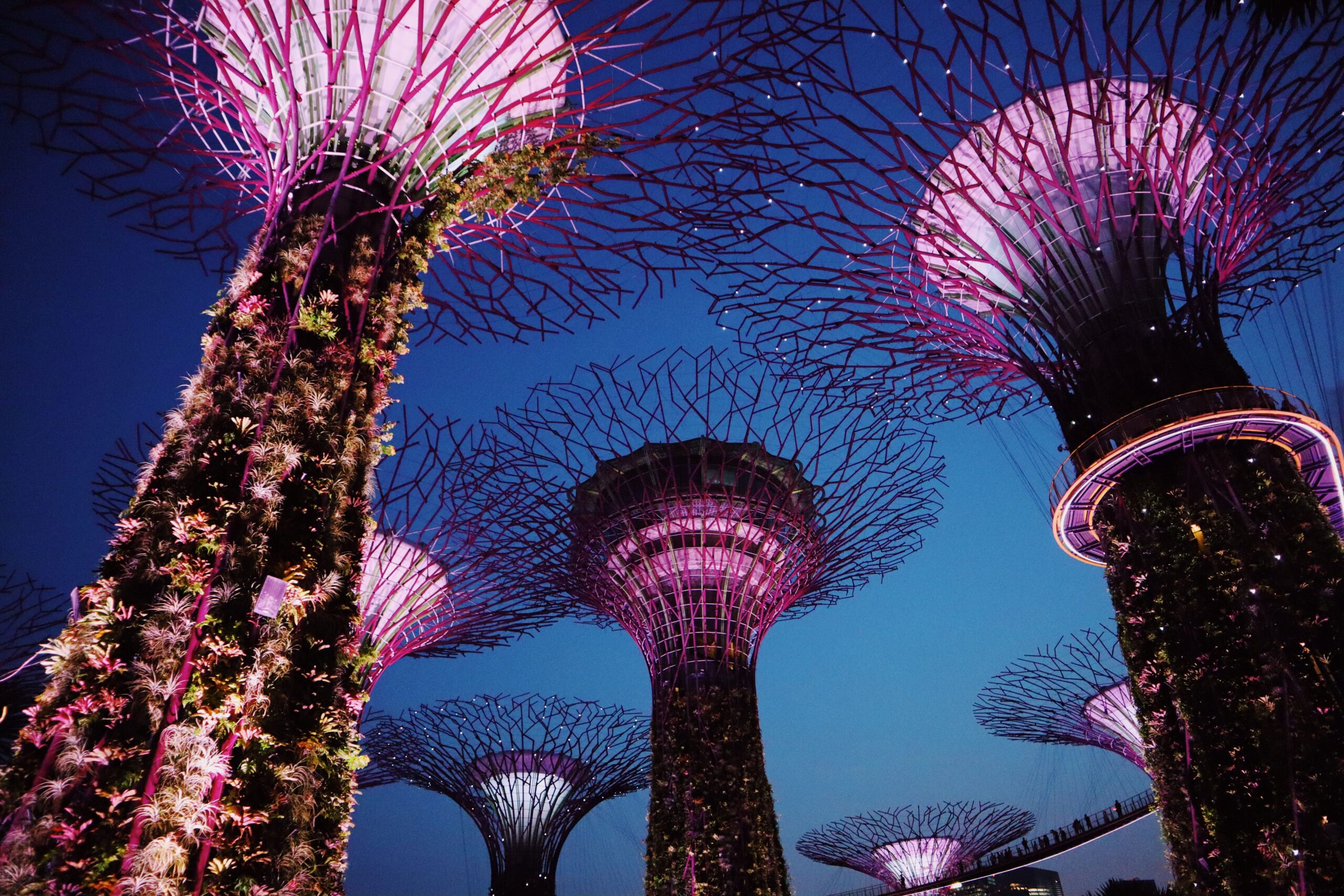
Singapore should not work as well as it does. A city-state of 733 square kilometres — smaller than New York City — with no natural resources, no hinterland, and a history of less than 60 years as an independent nation, it has become simultaneously one of the world’s great financial capitals, the most connected aviation hub in Asia, the finest food city on the continent, and a place of genuine architectural and cultural ambition that has produced, in the space of a single lifetime, supertrees, the world’s largest indoor waterfall, a rainforest canopy walk above the suburbs, a wildlife park where giraffes and rhinoceroses live within sight of high-rise apartments, and a hawker centre system that UNESCO has inscribed as Intangible Cultural Heritage.
Singapore is the most efficient country in the world at turning competing human priorities into something that actually functions. The greenery is intentional, the multicultural harmony is maintained with genuine investment, the food is extraordinary because the population demanded it, and the extraordinary cleanliness is the result of a social compact between citizens and government that has been in operation since 1965.
This guide covers 101 things to do across Singapore — from the Supertrees of Marina Bay to the last kampong, the Peranakan lanes of Joo Chiat to the mangroves of Pulau Ubin.
Marina Bay & the City Centre
The Icons
- Marina Bay Sands SkyPark & Infinity Pool — The three-tower hotel connected at the top by a 340-metre ship-shaped SkyPark: the rooftop infinity pool (for hotel guests) and the SkyPark Observation Deck (ticketed, for all visitors) at 200 metres give the finest panoramic view of the city skyline, the Gardens by the Bay, and the Strait of Singapore. The building’s reflection in the marina at night — lit in amber and gold — is one of the most photographed urban images in Asia. Book the observation deck at dusk.
- Gardens by the Bay — Supertree Grove — The Supertrees: 18 vertical gardens of steel and living plants, 25–50 metres high, which illuminate nightly in the Garden Rhapsody light show. Walk the OCBC Skyway between the two tallest Supertrees for the finest aerial view of the gardens and the marina. The evening show (7:45pm and 8:45pm) transforms the grove into the most theatrical public space in Singapore.
- Cloud Forest, Gardens by the Bay — A 58-metre indoor mountain inside a glass biome, covered in 60,000 plants and the world’s tallest indoor waterfall: a 35-metre cascade of water visible from a walkway that spirals down the mountain through cloud forest. The cold, misty air inside (around 23°C) is a revelation in tropical Singapore. The most immersive single attraction in the city.
- Flower Dome, Gardens by the Bay — The world’s largest glass greenhouse: a Mediterranean climate biome of 1.2 hectares, housing plants from five Mediterranean climate zones (including a 1,000-year-old olive tree from Spain) in a single vast space. The seasonal changing displays — tulips, poinsettias, dahlias — make it Singapore’s finest rotating garden attraction.
- Marina Bay Waterfront Promenade at Night — The 3.5-kilometre waterfront walkway from the Merlion Park to the Helix Bridge, the ArtScience Museum, and the Marina Bay Sands: best walked after 8pm when the buildings are lit, the Supertree Rhapsody is audible, and the reflection of the entire skyline doubles in the marina. Entirely free; entirely spectacular.
- Merlion Park — The national icon: a half-lion, half-fish figure spouting water into Marina Bay, with the Marina Bay Sands behind and the Esplanade to the left. The image is on every Singapore souvenir; the reality is better than the photographs. The small Merlion (the offspring) is on the pier nearby. The best photograph is from One Fullerton at dusk.
- ArtScience Museum — The lotus-shaped museum designed by Moshe Safdie, at the foot of Marina Bay Sands: the finest contemporary and digital art exhibitions in Singapore, with permanent installations exploring the intersection of art, science, technology, and culture. The Future World exhibition — interactive digital art rooms by teamLab — is the most visited contemporary art experience in the city.
- Helix Bridge — A pedestrian bridge across the Marina Bay channel, designed in the form of a double-helix DNA structure, illuminated at night in green, red, and blue light: the most architecturally expressive pedestrian crossing in Singapore and the finest viewpoint for photographing the Marina Bay Sands from the water level. Free to walk; best at dusk.
- The Float @ Marina Bay — The world’s largest floating stage on the Marina Bay: the venue for the National Day Parade (9 August), Formula 1 Grand Prix street party, and major outdoor events. During the Singapore Grand Prix (October), the bay area transforms into the finest urban Formula 1 venue in the world.
- Singapore Grand Prix (Formula 1, October) — The Singapore Grand Prix is the only night race on the Formula 1 calendar: a street circuit around the Marina Bay area, with the city skyline and the Marina Bay Sands floodlit as backdrop. The combination of speed, heat, and extraordinary urban setting makes it the most spectacular single event in Singapore’s annual calendar. Book tickets months in advance.
Colonial Core & Civic District
- Raffles Hotel, Beach Road — The grande dame of Singapore hospitality, opened in 1887 and restored to its full colonial grandeur: the Long Bar (where the Singapore Sling was invented in 1915 by Ngiam Tong Boon), the Tiffin Room, the Palm Court, and the extraordinary sense of layered colonial history that no other building in Singapore possesses. Non-guests are welcome in the bars and restaurants; the lobby and gardens are open to all.
- National Gallery Singapore — The Supreme Court and the City Hall — the two most important colonial buildings in Singapore, where Lee Kuan Yew proclaimed self-government in 1959 — united into the world’s largest collection of Southeast Asian modern art: over 9,000 works by Singaporean, Malaysian, Indonesian, Filipino, and regional artists from the 19th century to the present. Free for Singapore citizens; ticketed for international visitors. The architecture alone — the restored neo-Classical facades connected by a contemporary glass canopy — is extraordinary.
- Fort Canning Park — The hill above the city centre, where Raffles built his bungalow in 1822 and where the British Command surrendered to the Japanese in February 1942: the Battle Box underground bunker (where the decision to surrender was made), the Gothic gate, the Pancur Larangan (the forbidden spring of the Malay sultans), and the terraced gardens. The most historically layered hill in Singapore.
- St Andrew’s Cathedral — The finest colonial ecclesiastical building in Singapore: a white neo-Gothic church in the heart of the civic district, built in 1862 with Madras chunam (a mix of egg, sugar, coconut husk, and shell lime) as the original plaster. Free to enter; the interior — with its whitewashed walls, arched ceiling, and Victorian stained glass — is the most serene public space in the civic district.
- Cavenagh Bridge & the Singapore River at Dusk — The last remaining suspension bridge in Singapore (1870): the finest view of the original commercial heart of the city, with the Fullerton Hotel on the south bank, the Empress Place building to the east, and the river that made Singapore commercially possible running beneath. Walk it at 6pm when the riverside restaurants light up.
The Heritage Neighbourhoods
Chinatown
- Chinatown Heritage Centre — Three restored shophouses on Pagoda Street, with the original living quarters of the coolie immigrants who built Singapore’s commercial infrastructure, preserved exactly as they were found. The most moving social history museum in Singapore: the cramped sleeping spaces, the opium den, and the personal possessions of people for whom Singapore was a one-way journey.
- Chinatown Food Street & the Hawker Centre — The outdoor hawker stalls of Chinatown Food Street and the adjacent Hawker Centre serve the full range of Hokkien, Teochew, and Cantonese street food: char kway teow (stir-fried flat rice noodles), roast duck rice, pig trotter rice, turtle soup, and the famous Chinatown Point chicken rice. The best inexpensive lunch in central Singapore.
- Sri Mariamman Temple, South Bridge Road — The oldest Hindu temple in Singapore, built in 1827 in the Dravidian style: the gopuram (entrance tower) covered in sculpted figures of Hindu deities, painted in vivid colours. The temple is still actively used for worship; the Thimithi festival (October/November), when devotees walk over burning coals, is the most intense religious spectacle in Singapore.
- Buddha Tooth Relic Temple, South Bridge Road — A magnificent Tang Dynasty–style Buddhist temple completed in 2007, housing what is believed to be the left canine tooth of the Buddha, brought from Myanmar. The four-storey building contains the relic chamber, a 10,000-Buddha hall, a rooftop garden, and an exhibition of Buddhist artefacts. The most ambitious piece of religious architecture built in Singapore in the 21st century.
- Tanjong Pagar Conservation Area — The finest concentration of restored shophouses in Singapore: the streets of Tanjong Pagar — Neil Road, Tanjong Pagar Road, Duxton Hill — with their colourful two-storey Straits Chinese shophouses (painted in every combination of cobalt, terracotta, and cream) now house Singapore’s finest wine bars, Japanese restaurants, and cocktail spots. Duxton Hill at night is the most atmospheric bar strip in the city.
Little India
- Little India Walking Tour: Serangoon Road — The most sensory neighbourhood in Singapore: the garland sellers, the sari shops, the sound of Tamil music, the smell of incense and jasmine, and the food — banana leaf rice, dosai, biryani — that makes Little India the finest lunch neighbourhood in the city. The Mustafa Centre (a 24-hour department store of extraordinary variety) and the Tekka Centre hawker market are the two essential stops.
- Sri Veeramakaliamman Temple — The most dramatic Hindu temple in Little India, dedicated to the fierce goddess Kali: the elaborately sculpted gopuram of 21 figures, the interior with its swinging incense lamps, and the daily puja ceremony (at 8:30am, 11:30am, and 6:30pm) constitute the most intensely sensory religious experience in the neighbourhood.
- Little India Arcade & the Heritage Shops — The covered arcade at the corner of Serangoon Road and Campbell Lane: the finest concentration of traditional Indian goods in Singapore — gold and silver jewellery, silk saris, bangles, devotional items, and the best selection of South Indian spices in the city. The Lagnaa Barefoot Dining restaurant upstairs is the finest South Indian set meal in Little India.
- Indian Heritage Centre, Campbell Lane — The newest of Singapore’s four heritage institutions (opened 2015), dedicated to the history of the South Asian communities in Singapore and the broader Indian Ocean world: the most visually sophisticated heritage museum in Little India, with interactive displays, artefacts, and oral history recordings that trace 2,000 years of cultural exchange.
Kampong Glam & Bugis
- Sultan Mosque (Masjid Sultan), Arab Street — The largest and most important mosque in Singapore: a 1928 building of extraordinary eclectic beauty (the golden onion domes, the Saracenic arches, and the black border on the dome — made from glass bottles donated by the poor so that no one should be excluded from the mosque’s construction) on the Rochor River bank. Non-Muslim visitors welcome outside prayer times.
- Haji Lane — The narrowest commercial street in Singapore: a single lane of brightly painted shophouses, now entirely occupied by independent boutiques, vintage clothing shops, street art, and cafés. The street art changes constantly; the shops are some of the most individual in the city. At night, Haji Lane and the surrounding streets of Kampong Glam become one of the finest bar and restaurant areas in Singapore.
- Kampong Glam Heritage Trail — The full neighbourhood walk: Sultan Mosque, the Istana Kampong Glam (the former palace of the Malay sultans, now the Malay Heritage Centre — free entry), Bussorah Street, Haji Lane, Arab Street, and the carpet and fabric shops of Arab Street. The Malay-Arabic cultural landscape of this neighbourhood is the most culturally distinct in Singapore.
- Bugis Street Night Market — The legacy of Singapore’s most famous (and most infamously repressed) street market: the current covered market on New Bugis Street is a shadow of the original, but it remains the largest and most affordable fashion and souvenir market in Singapore, and the surrounding streets — Bugis Junction, the National Library of Singapore — make it the most walkable shopping neighbourhood in the city.
Tiong Bahru & the Art Deco Estate
- Tiong Bahru Estate Walk — Singapore’s oldest housing estate, built by the Singapore Improvement Trust in the 1930s and 1940s in the Streamline Moderne style: curved facades, porthole windows, spiral staircases, and the distinctive pre-war shophouses of Seng Poh Road. The independent bookshops (BooksActually), specialty cafés (Flock), and the Tiong Bahru Market and Food Centre make it the most complete neighbourhood experience in Singapore.
- Tiong Bahru Market & Food Centre — The finest hawker market in central Singapore: the wet market on the ground floor (with the freshest produce in the neighbourhood) and the cooked food centre above, serving char siu (barbecue pork), chwee kueh (steamed rice cakes with preserved radish), and some of the finest bak chor mee (minced meat noodles) in Singapore. Come before 10am for the breakfast crowd.
Joo Chiat & Katong
- Joo Chiat Road Peranakan Shophouses — The finest concentration of Peranakan (Straits Chinese) architecture in Singapore: brightly coloured shophouses from the 1920s and 1930s, decorated with European Rococo plasterwork and Chinese motifs, on a road that also contains the finest Peranakan restaurants, nonya cake shops, and heritage goods in the country. The Katong Laksa stalls (a rich coconut curry noodle soup specific to this neighbourhood) are the finest in Singapore.
- Peranakan Museum, Armenian Street — The finest collection of Peranakan artefacts in the world: the wedding bed, the ceremonial costumes, the porcelain, the silverwork, and the extraordinary material culture of the Baba-Nyonya community (Chinese who intermarried with Malay and adopted aspects of both cultures). The museum’s recently renovated galleries are the finest presentation of a uniquely Singapore heritage anywhere.
- East Coast Park & Katong — The 15-kilometre East Coast Park along the southern shore of Singapore: the finest free beach in the city, with cycling, kayaking, and the food outlets of the Katong neighbourhood behind it. The East Coast Seafood Centre — where black pepper crab, chilli crab, and sambal stingray are served at outdoor tables on the shore — is the finest alfresco seafood dining in Singapore.
Orchard Road & the Civic Centre
- Orchard Road Walking Tour — Singapore’s 2.2-kilometre shopping boulevard: 22 malls in a single street, from the luxury anchors (ION Orchard, Paragon, Ngee Ann City with the Kinokuniya bookshop — the largest bookshop in Southeast Asia) to the independent boutiques of Emerald Hill (a conservation area of Peranakan terrace houses at the hill’s top end). The Christmas light-up along Orchard Road (November–January) is the finest street illumination in the city.
- Singapore Botanic Gardens (UNESCO) — A 183-year-old tropical botanical garden and UNESCO World Heritage Site: the National Orchid Garden (the world’s largest display of orchids, with over 1,000 species including the Vanda Miss Joaquim, the national flower of Singapore), the Heritage Trees, the symphonic concerts on the Shaw Foundation Symphony Stage (free, on selected weekends), and the finest free public garden in Southeast Asia.
- National Museum of Singapore, Stamford Road — The oldest museum in Singapore (1887), recently renovated into one of the finest national history museums in Southeast Asia: the Singapore History Gallery traces 700 years of the island’s history through artefacts, oral histories, and immersive environments. The building — a Victorian dome surmounted by a contemporary glass rotunda — is as remarkable as the collection. Free entry on Friday evenings.
Sentosa & Southern Islands
- Universal Studios Singapore, Resorts World — Southeast Asia’s only Universal Studios: seven themed zones including the Hollywood, Sci-Fi, and Far Far Away (Shrek) sections, with the Battlestar Galactica roller coaster (the world’s tallest duelling coasters at the time of construction) and the Transformers ride as the headline attractions. The finest single theme park experience in Singapore.
- S.E.A. Aquarium, Resorts World Sentosa — The largest aquarium in Southeast Asia: 100,000 marine animals in 50 million litres of water across 10 zones, with the Open Ocean panel — a 36-metre-wide, 8.3-metre-tall acrylic viewing panel with manta rays, whale sharks, and 40,000 fish swimming past — the finest single aquarium exhibit in Asia.
- Palawan Beach & Siloso Beach, Sentosa — The two most accessible beaches in Singapore: Palawan, with the southernmost point of continental Asia (a small island at the beach’s western end, connected by a suspension bridge), and Siloso, with the most beach club and sports activity infrastructure in the city. Both are free; cable car access from Mount Faber or the Sentosa Express from Harbour Front is the most enjoyable approach.
- Capella Singapore & the Sentosa Cove Waterfront — Sentosa’s most exclusive address: the Capella hotel in a colonial-era building surrounded by tropical gardens (the site of the 2018 Trump–Kim summit, a historical fact that makes it the most internationally significant building in recent Singaporean history), and the Sentosa Cove marina waterfront.
- iFly Singapore, Sentosa — The world’s largest indoor skydiving wind tunnel: a 16.4-metre glass wind tunnel at Siloso Beach producing the vertical freefall experience of skydiving without the aircraft. Available to complete beginners from age 7; the finest individual adventure activity in Singapore.
- Tiger Sky Tower, Sentosa — A rotating observation tower at Sentosa’s Fort Siloso headland: panoramic views of the strait, the cable car, Keppel Harbour, and the Singapore skyline from 131 metres. The most affordable skyline view in the city.
Wildlife & Nature
- Singapore Zoo — Open-Concept Wildlife Park — One of the finest zoos in the world: a 26-hectare open-concept zoo on the Mandai reservoir, where animals are separated from visitors by natural barriers (water, ha-has) rather than bars. The Fragile Forest biodome (free-flight birds, free-ranging lemurs and sloths), the orang-utan enclosure, and the elephant exhibit are the finest in the region.
- Night Safari, Mandai — The world’s first nocturnal wildlife park: 35 species of nocturnal animals on a tram circuit and four walking trails, with fishing cats, giant flying squirrels, clouded leopards, Asian elephants, and the extraordinary Creatures of the Night show. The combination of darkness, tropical air, and genuinely wild-feeling habitat makes it Singapore’s most atmospheric wildlife experience.
- River Wonders (River Safari), Mandai — Asia’s first river-themed wildlife park: 11 river habitats from the Ganges to the Amazon, with the giant pandas Kai Kai and Jia Jia as the headline residents, and the Amazon Flooded Forest (the largest flooded forest exhibit outside South America) as the architectural centrepiece.
- Bird Paradise, Mandai — The successor to Jurong Bird Park (relocated and expanded in 2023): the largest bird park in Asia, with 3,500 birds from 400 species in eight walk-through aviaries, including the Crimson Wetlands (flamingos and Southeast Asian wetland species) and the Heart of Africa aviary (hornbills, toucans, and African forest birds in a 3,500-square-metre free-flight zone).
- Sungei Buloh Wetland Reserve — Singapore’s only wetland nature reserve, on the northwest coast: 202 hectares of mangrove forest, mudflats, and secondary vegetation, with Estuarine crocodiles (the largest reptile in Singapore), migratory shorebirds (September–March), and the finest birdwatching in the city. The boardwalk through the mangroves at dawn, before the first visitors arrive, is the finest nature experience within Singapore’s borders.
- MacRitchie Reservoir Treetop Walk — The free-standing suspension bridge 25 metres above the MacRitchie forest canopy, linking two hilltops in the central forest of Singapore: the finest nature walk in the city, through primary rainforest with long-tailed macaques, flying lemurs, and the extraordinary density of the tropical forest understory. The 11-kilometre reservoir trail from the visitor centre is the finest urban rainforest circuit in Southeast Asia.
- Southern Ridges Canopy Walk — A 10-kilometre green corridor from Mount Faber Park to Kent Ridge Park, connected by the Henderson Waves (a 274-metre pedestrian bridge undulating at 36 metres above the valley floor — the finest piece of functional public architecture in Singapore) and the Forest Walk (an elevated wooden walkway through secondary rainforest). Entirely free; the finest free nature walk in Singapore.
- Pulau Ubin Island — A bumboat ride from Changi Point Ferry Terminal to Singapore’s last undeveloped island: kampong houses (the last surviving traditional Singapore village), cycling trails through jungle and mangrove, the Chek Jawa Wetlands (the richest intertidal ecology in Singapore, with dugongs occasionally seen in the sea grass), and the Granite Quarry (a flooded quarry of extraordinary emerald colour). The most complete escape from urban Singapore available within 10 minutes of the mainland.
Singapore’s Hawker Culture
- Hawker Centres: The World’s Best Street Food — Singapore’s hawker centres — UNESCO Intangible Cultural Heritage since 2020 — are the finest organised street food culture in the world: 114 hawker centres across the island, each with 20 to 200 individual stalls selling individual dishes for $3–6 SGD that are the speciality of a lifetime’s practice. The system of collective facilities and individual stalls produces the most democratic and the most diverse food culture in Asia.
- Maxwell Food Centre, Chinatown — One of Singapore’s most celebrated hawker centres, with the Tian Tian Hainanese Chicken Rice (Queue for stall 10 — the most famous hawker stall in Singapore, visited by Anthony Bourdain and Gordon Ramsay) alongside roast duck rice, wonton noodles, and rojak (a fruit and vegetable salad in prawn paste and peanut dressing). The finest single hawker centre in Singapore for concentrated quality.
- Lau Pa Sat Festival Market, Raffles Quay — The oldest hawker market in Singapore (1894), in a Victorian cast-iron octagonal structure originally from Glasgow, now surrounded by the gleaming towers of the CBD: the finest architectural hawker setting in the city, with the outdoor Satay Street (Boon Tat Street), where charcoal satay grills operate on the closed road every evening from 7pm.
- Old Airport Road Food Centre — Singapore’s largest hawker centre and arguably its finest: the stalls have been in continuous operation since the 1970s and include some of the most awarded hawker food in Singapore, including the Heng’s Wanton Mee and the Roasted Meat stalls that have drawn the same regulars for decades. The old airport runway, the residential blocks, and the lack of tourist infrastructure make it the most authentically Singaporean hawker experience.
- Chomp Chomp Food Centre, Serangoon Gardens — The most convivial evening hawker experience in Singapore: a cluster of stalls in the residential Serangoon Gardens neighbourhood, open until midnight, specialising in black pepper crab, stingray, and the neighbourhood’s famous bbq chicken wings.
- Chilli Crab at a Singapore Restaurant — The unofficial national dish of Singapore: whole Sri Lankan or mud crabs stir-fried in a tomato-based chilli and egg gravy, eaten with mantou buns to soak up the sauce. The Palm Beach restaurant, Jumbo Seafood, and the Long Beach Seafood restaurant are the most celebrated addresses. Expensive but entirely essential.
Culture, Art & Singapore’s Creative Scene
- National Gallery Singapore — Already mentioned (item 12), but worth returning to specifically for the DBS Singapore Gallery: the permanent collection of Singaporean art from the 19th century to the present, with Georgette Chen’s Market Scene, Liu Kang’s portrait cycle, and the complete arc of modern Singaporean painting. The most comprehensive single resource for understanding Singapore’s visual culture.
- Esplanade — Theatres on the Bay — The landmark performing arts centre on the Marina waterfront: the two durian-shaped glass and aluminium domes house a 1,600-seat concert hall and a 2,000-seat theatre, with the Singapore Symphony Orchestra and the Singapore Lyric Opera performing regular seasons. The outdoor free performance spaces and the mall’s concourse host free performances most evenings — the most accessible arts experience in the city.
- STPI (Singapore Tyler Print Institute) — The finest printmaking studio and gallery in Southeast Asia, on Robertson Quay: an international printmaking residency that has produced collaborative editions with artists including Do Ho Suh, Lee Ufan, and Sopheap Pich. The public gallery is free and consistently excellent.
- Gillman Barracks — The former British army barracks on Alexandra Road, converted into Singapore’s international contemporary art gallery district: 14 galleries representing artists from Southeast Asia, China, Australia, and Europe, in heritage bungalows and converted colonial buildings. The most serious concentration of international contemporary art in Singapore.
- The Substation, Armenian Street — Singapore’s first independent art space (1990, founded by theatre director Kuo Pao Kun), in a former electricity substation near the National Museum: the most historically important arts institution in Singapore for the performing arts, visual arts, and cultural discourse. The programme of theatre, music, and visual art represents the most genuinely independent arts culture in the city.
- Victoria Theatre & Concert Hall — Singapore’s oldest theatre (1862) and concert hall (1905) on Empress Place, now beautifully restored: the home of the Singapore Symphony Orchestra for decades and still the finest Victorian performance space in Southeast Asia. The Esplanade Outdoor Theatre adjacent to the waterfront and the Esplanade Recital Studio add two of the finest smaller performance spaces.
Food Beyond Hawkers
- Kaya Toast & Soft-Boiled Eggs for Breakfast — The Singapore breakfast ritual: kaya toast (white bread toasted over charcoal, spread with kaya — coconut jam mixed with eggs and pandan leaves — and salted butter) with soft-boiled eggs flavoured with soy sauce and white pepper, and a cup of kopi (Nanyang-style coffee with condensed milk). Served at Ya Kun Kaya Toast, Toast Box, and Killiney Kopitiam — the most specifically Singaporean breakfast available anywhere.
- Laksa at 328 Katong Laksa or Sungei Road Laksa — Singapore’s signature curry noodle soup: thick coconut milk curry broth with rice noodles, prawns, cockles, fishcake, and a scoop of sambal, eaten with a short spoon (the noodles are traditionally cut short enough to eat with no chopsticks required). The Katong style and the Sungei Road version (a 60-year-old charcoal-cooked laksa) are the two most celebrated in Singapore.
- Bak Kut Teh (Pork Rib Soup) — The breakfast of choice for Singapore’s Chinese working class since the 19th century: a clear or peppery broth of pork ribs slow-cooked with garlic, Chinese five-spice, and herbs, served with rice and youtiao (fried dough sticks). Ng Ah Sio at Rangoon Road and the original Song Fa on New Bridge Road are the most celebrated addresses.
- Roti Prata at a Mamak Stall — The Indian Muslim flatbread: a thin, layered dough cooked on a griddle in ghee until crispy and served with fish curry, dhal, or a plain sugar dip. The Prata House on Upper Thomson Road and the Casuarina Curry stalls are the finest in Singapore.
- Nasi Lemak at the Coconut Club, Ann Siang Hill — The Malay national dish of fragrant coconut milk rice, fried chicken, sambal, anchovies, peanuts, and half a hard-boiled egg, served on banana leaf. The Coconut Club on Ann Siang Hill has elevated the dish to its most refined expression; the traditional versions at the early-morning hawker stalls in Geylang are the most authentic.
- Peranakan Cuisine at Candlenut or National Kitchen by Violet Oon — Nonya cooking — the Peranakan fusion of Chinese and Malay culinary traditions — is Singapore’s most complex and most historically specific food culture: ayam buah keluak (chicken cooked with the black nuts of the kepayang tree), itek sio (braised duck in tamarind), and kueh (the elaborate steamed and fried cakes). Candlenut is the world’s only Michelin-starred Peranakan restaurant; National Kitchen at the National Gallery is the most accessible.
Art, Architecture & the Modern City
- Jewel Changi Airport — The most remarkable airport in the world: a five-storey circular glass dome at Changi Airport Terminal 1, containing the world’s tallest indoor waterfall (the Rain Vortex, 40 metres), a forest valley, 280 shops, and a canopy park with a 250-metre sky net above the forest. Accessible to all visitors whether flying or not; the finest piece of commercial architecture in Singapore.
- Gardens by the Bay OCBC Skyway — The 128-metre aerial walkway connecting the two tallest Supertrees at 22 metres above the ground: the finest elevated perspective of the Gardens, the Marina Bay Sands, and the city skyline in a single view. Best at dusk (5pm–7pm) when the light is golden and before the evening crowds arrive for the light show.
- Chinatown’s Club Street & Ann Siang Hill — The finest restaurant and bar district in Singapore’s conservation area: a hill of pre-war shophouses between Ann Siang Road and Club Street, now entirely occupied by cocktail bars, restaurants, and the boutique hotel boutiques that make Chinatown’s upper end the most atmospherically sophisticated part of the city after dark.
- The Rail Corridor — The 24-kilometre former KTM (Keretapi Tanah Melayu) railway line from Tanjong Pagar station to Woodlands, converted into a linear park of secondary rainforest and heritage railway structures: the finest long-distance walk in urban Singapore, through a continuous corridor of greenery that reconnects the city’s forests from north to south.
- Haw Par Villa — The Chinese Mythology Park — The most eccentric attraction in Singapore: the former Tiger Balm garden of the Aw Boon Haw family, with over 1,000 statues and 150 dioramas depicting scenes from Chinese mythology, folk tales, and the Ten Courts of Hell — a vivid representation of the punishments awaiting the wicked in Chinese Buddhist cosmology. Free entry; entirely extraordinary.
History, Heritage & Remembrance
- Fort Siloso, Sentosa — The only preserved coastal battery in Singapore: a 20th-century gun emplacement that faced west (towards the Strait of Malacca) rather than north (towards Malaysia), the military decision that contributed to the fall of Singapore in 1942. The interactive Surrender Chambers exhibit, with life-size figures of Lieutenant General Percival’s surrender, is the most historically specific war museum in Singapore.
- Old Changi Hospital — The former RAF base hospital used by the Japanese military as a prisoner-of-war detention and torture facility during the Second World War occupation: the most haunted building in Singapore, and the most atmospherically loaded piece of war heritage on the island. Accessible through organised heritage tours.
- Kranji War Cemetery — The Commonwealth war graves cemetery in the north of Singapore, with 4,461 graves and the Singapore Memorial listing 24,346 names of soldiers who died in the Malayan Campaign and the defence of Singapore with no known grave. The most moving war memorial in Singapore; free to visit.
- Asian Civilisations Museum, Empress Place — The finest collection of Asian art and material culture in Singapore: objects from China, Japan, Korea, India, the Islamic world, and Southeast Asia, in the beautifully restored colonial Empress Place building on the Singapore River. The Tang Shipwreck gallery — the cargo of a 9th-century Arab dhow, the oldest and largest collection of Tang-era ceramics outside China — is the most significant single collection in the museum.
Adventure & the Outdoors
- Cycling Pulau Ubin — The finest cycling experience in Singapore: hiring a bicycle from the bicycle shop at Pulau Ubin jetty and cycling the dirt tracks of the island through granite quarries, mangrove forests, the Chek Jawa boardwalk, and the kampong roads that represent Singapore 50 years ago.
- Kayaking the Southern Islands — A kayak tour from Sentosa Beach to Lazarus Island (a pristine white-sand beach accessible only by water) and St John’s Island (a former quarantine station with beach and snorkelling): the finest sea kayaking accessible from Singapore and the best way to see the city’s southern coastline.
- Stand-Up Paddleboarding, East Coast Beach — The sheltered water off East Coast Park, with board hire available from the water sports operators between lagoon bridges, is the most accessible paddleboarding in Singapore. The early-morning session — before 8am — gives the water largely to itself.
- Singapore Flyer — A giant observation wheel at 165 metres (the second-largest Ferris wheel in the world at its opening in 2008): a 30-minute revolution gives a complete panorama of the Marina Bay, the Botanic Gardens, Sentosa, and on clear days the Indonesian islands of the Riau Archipelago to the south.
- Zorbing, Skyline Luge, Sentosa — The 650-metre Skyline Luge runs from the top of Imbiah hill down to the beach: a gravity-powered descent in a small wheeled sled (luge), with the views of the Sentosa coastline and the harbour. The most consistently enjoyable family outdoor activity in Singapore.
Festivals & Singapore’s Year
- Chinese New Year, Chinatown (January/February) — The most spectacular event in Singapore’s cultural calendar: the Chinatown street light-up (the finest in Asia), the River Hongbao fair on the Marina Bay floating platform, the lion dances, the Chingay Parade (Singapore’s largest street parade), and the visit to the temples on the first and second day. The city is at its most vivid and most communal.
- Thaipusam, Little India (January/February) — The Tamil Hindu festival celebrated with extraordinary physical devotion: kavadi bearers carry ornate steel frames attached to their bodies with hooks and skewers, processing from Sri Srinivasa Perumal Temple to Sri Thandayuthapani Temple. The faith, the preparation, the community that walks alongside the bearers, and the complete absence of blood or pain among the devotees make it the most intense religious event in Singapore’s calendar.
- Hari Raya Puasa, Kampong Glam (End of Ramadan) — The Malay Muslim community’s celebration of the end of Ramadan: Kampong Glam’s Geylang Serai neighbourhood hosts the finest night bazaar in Singapore during Ramadan, with hundreds of Malay food stalls, textiles, and gifts. The atmosphere in the neighbourhood from sunset to midnight during Ramadan is unlike any other time of the year.
- Singapore Food Festival (July–August) — An annual celebration of Singapore’s hawker and restaurant culture: cooking demonstrations by hawker masters, heritage food trails through the neighbourhoods, and the Hawker Master Creed programme recognising outstanding stalls. The finest opportunity to understand the full depth of Singapore’s food culture in a single structured event.
- National Day (9 August) — Singapore’s national holiday: the parade at the Float @ Marina Bay, with military and civilian contingents, mobile columns, and an aerial display by the RSAF Black Knights aerobatic team. The fireworks over Marina Bay in the evening are the finest in Singapore’s annual calendar.
Hidden Singapore & Unexpected Discoveries
- Kampong Lorong Buangkok (Last Kampong) — Singapore’s last remaining traditional kampong (village), hidden in the heart of Hougang in the northeastern suburbs: 26 families in wooden houses on stilts, with chickens, fruit trees, and the pace of life that preceded the Housing Development Board apartments. The most historically resonant 15 minutes in Singapore; accessible by taxi or MRT to Kovan.
- Hike Bukit Timah Hill — The highest natural point in Singapore (163 metres): a patch of primary rainforest in the centre of the island, with walking trails through a forest that has been protected since 1883 and that contains 40% of Singapore’s native plant species in a 164-hectare reserve. Flying lemurs and reticulated pythons can occasionally be seen; the forest feels genuinely wild.
- The Substation Basement Theatre — Singapore’s most important small theatre space, in the basement of the former electricity substation on Armenian Street: the venue that launched the careers of Singapore’s most significant theatre-makers, including TheatreWorks, Wild Rice, and Practice Theatre. The programme is consistently the most adventurous in the city.
- Labrador Nature Reserve & World War II Tunnels — A coastal park on the southern shore of Singapore, with the only cliff-face in Singapore, the remnants of Rimau gun battery (used in the defence of 1942), and an access point for the tunnel system beneath the cliffs. The combination of maritime history, coastal views, and the tranquillity of a park that most tourists never visit makes it one of the finest free afternoon experiences in Singapore.
- St John’s Island & Lazarus Island — The two ferry-accessible southern islands: St John’s Island (a former British administration facility for gamblers and drug addicts, then a political detention facility — now entirely cleared and operating as a day-use beach park) and the adjacent Lazarus Island (a pristine sand beach with no permanent facilities and some of the finest snorkelling water in Singapore’s jurisdiction). Take the Southern Islands Ferry from Marina South Pier.
- Geylang: The Real Singapore After Dark — The most honest neighbourhood in Singapore: a grid of lorongs (lanes) east of the city centre where the official rules of the city-state are most visibly negotiated. Durian stalls, frog porridge restaurants, Muslim caterers preparing for Hari Raya, temples, and the general energy of a neighbourhood doing exactly what it needs to do — including things that other Singapore neighbourhoods have gentrified into invisibility. The best durian in Singapore is in Geylang at midnight.
- The Former Tanjong Pagar Railway Station — The old terminus of the Malayan Railway, closed in 2011 and preserved as a heritage building: the Art Deco interior of the waiting hall, the mosaic murals of Malaysian landscapes, and the memory of the trains that once connected Singapore to Kuala Lumpur and beyond. Occasional heritage events and art installations are held here; the exterior is always accessible.
- Chinatown’s Pagoda Street at Night — The shophouse street that is most densely associated with the original Chinese immigrant experience, at night when the red lanterns are illuminated and the food stalls spill onto the pavement. The combination of heritage architecture, cheap food, and the specific quality of Chinatown at night that no regeneration project has quite extinguished.
- The Green Corridor Cycling — Rail Corridor — Cycling the 24-kilometre former railway corridor from Tanjong Pagar station to Woodlands checkpoint on a bicycle: the most complete survey of Singapore’s secondary rainforest available in a single urban journey, through a living green corridor that the city has — remarkably — preserved intact.
- Raffles Long Bar: A Singapore Sling at the Source — The Singapore Sling — gin, cherry heering, Bénédictine, cointreau, pineapple juice, lime, grenadine, and Angostura bitters — was invented at the Long Bar in 1915 by bartender Ngiam Tong Boon. Drinking it at the original bar (now in the new Raffles Hotel building), with peanut shells on the floor and the overhead fans turning, is an experience of genuine historical continuity.
- Mount Faber Sunset — The hill south of the city centre, accessible by cable car or on foot: the finest sunset view of the Harbour, the CBD skyline, and the Sentosa cable car towers from a position that involves no queue and no ticket price. The Faber Peak cable car terminal has restaurants and bars; the viewing terrace is free.
- Night Cycling, East Coast Park — The 15-kilometre East Coast Park cycling path, at midnight: the park is busy with cyclists, food vendors, and families even after midnight, in the specific night-culture of Singapore that cannot be experienced during daylight hours. Bicycle hire is available at the park’s cycling kiosks until midnight on weekends.
- Kopitiam Culture at Dawn — Any HDB (Housing Development Board) estate coffee shop at 6am: the kopi-o (black coffee sweetened with sugar in Nanyang style), the kaya toast, the soft-boiled eggs, the Malay uncle making roti prata, the Indian woman selling banana leaf rice. The morning kopitiam in a residential neighbourhood is the most democratic and the most genuinely Singaporean experience available in the city — entirely free, entirely open, and entirely invisible to the tourist circuit.
- Watch the Garden Rhapsody from the Supertree Observation Deck at Night — On your last evening in Singapore, take the OCBC Skyway to the highest Supertree’s observation deck as the 8:45pm Garden Rhapsody begins: the 18 Supertrees illuminate and respond to the music below, the Marina Bay Sands glows across the water, the Cloud Forest biome pulses with light, and the entire extraordinary achievement of Singapore — a city that decided what it wanted to be and built it with complete determination — is laid out below you in the warm tropical night. The Lion City, which should not exist and does, magnificently and defiantly, exactly as it intended.
Quick Facts for Visitors
| Best time to visit | February–April (drier, slightly cooler) · July–September (festivals, slightly drier) |
| Rain | Year-round; November–January wettest; carry an umbrella always |
| Currency | Singapore Dollar (SGD) |
| Language | English (official), Mandarin, Malay, Tamil (all four official) |
| Getting around | MRT (excellent, air-conditioned, covers all major attractions) · Bus · Grab app |
| Visa | Most nationalities 30–90 day visa-free entry |
| Hawker note | A full hawker meal costs $3–8 SGD. This is intentional; it is the social policy, not the budget option |
| Chewing gum | Banned for sale (not for personal use); do not bring gum into the country |
| Ideal trip length | 3–4 days for highlights · 5–7 days for neighbourhood depth and nature |
| Changi Airport | Voted world’s best airport; Jewel Changi is a destination in itself |
Singapore is a city that rewards surrender. Stop trying to understand how it works and simply let it deliver what it has prepared for you: the perfect breakfast, the perfectly cold MRT carriage, the Supertrees at 8:45pm, the crab at midnight. It has been thinking about your visit longer than you have. Trust it.