Ireland does things to people that are difficult to explain in rational terms. A country of five million, occupying a wet Atlantic island of ancient limestone and older bogland, it has produced four Nobel Prize–winning writers, invented the most recognisable music in Europe, given the world its best-loved stout, built a 2,500-kilometre coastal driving route along the most dramatic seacliff scenery on the continent, and maintained — despite everything — a quality of welcome so genuine and so consistent that it is the first thing every first-time visitor mentions and the thing that brings them back.
The Ireland of postcards is real: the green fields exist, the craic is genuine, the Guinness tastes different here, and the light on the west coast in the late afternoon of a September day is a specific and unrepeatable phenomenon. But Ireland is also older and stranger than its tourist image allows: the passage tombs of Newgrange are 5,000 years older than Stonehenge, the monks of Skellig Michael clung to a sea-rock off Kerry in conditions of radical spiritual solitude that still communicate themselves to anyone who makes the boat journey, and the Burren — a limestone plateau of extraordinary biological diversity — grows orchids and arctic-alpine plants in the same field because the Gulf Stream and the altitude make it possible.
This guide covers 101 things to do across the whole island — Dublin to Donegal, Connemara to the Copper Coast — including Northern Ireland.
Dublin: The Literary Capital
Trinity College & the Historic Centre
- Book of Kells & Trinity College Library — The most visited cultural attraction in Ireland: the 9th-century illuminated gospel manuscript produced by Celtic monks in the monastery of Kells, displayed in the ground floor of the Long Room — the greatest library interior in the world, 65 metres of dark oak shelving holding 200,000 of the library’s oldest volumes under a barrel-vaulted ceiling. The Book of Kells is extraordinary; the Long Room is transcendent. Book online; the queues without a ticket are substantial.
- Trinity College Dublin — A Walk — The 47-acre campus at the heart of Dublin, with the cobbled Front Square, the Campanile (a landmark since 1853), the Rubrics (the oldest surviving buildings, 1700), the Museum Building (a Venetian Gothic fantasy of 1857), and the Fellows Square where Samuel Beckett and Oscar Wilde walked as students. Free to enter and walk; one of the finest urban campuses in Europe.
- Dublin Castle & the Chester Beatty Library — Dublin Castle — the seat of British rule in Ireland for 750 years until 1922 — contains the State Apartments (used for presidential inaugurations), the medieval Record Tower, and the 13th-century Chapel Royal. Directly adjacent, the Chester Beatty Library houses the extraordinary personal collection of the American mining magnate Sir Alfred Chester Beatty: Islamic manuscripts, Chinese jade books, Japanese woodblock prints, and Coptic papyri of the New Testament. Free admission; ranked the finest museum in Ireland.
- Kilmainham Gaol — The most emotionally charged building in Ireland: the prison where the leaders of the 1916 Easter Rising were executed, one by one, in the stone-walled prison yard, until a single broken figure named James Connolly — unable to stand, strapped to a chair — was shot in the May dawn. The guided tour, through the Victorian wing’s central hall and into the execution yard, is the finest single museum experience in the country. Book weeks in advance.
- Glasnevin Cemetery & Museum — The national cemetery of Ireland, with 1.5 million graves including those of Daniel O’Connell, Michael Collins, Éamon de Valera, Brendan Behan, and Patrick Pearse — the political and cultural leaders of Irish independence. The guided history tour is excellent; the museum’s gravestone-rubbing programme and the multimedia history of modern Ireland are among the finest interpretive experiences in Dublin.
- National Museum of Ireland — Archaeology, Kildare Street — The finest collection of prehistoric Irish artefacts in the world: the Tara Brooch, the Ardagh Chalice, the Broighter Gold (a 1st-century BC model of a gold boat), and the Iron Age bog bodies (preserved in the Kildare peatlands for 2,000 years with the details of their violent deaths still visible). Free; extraordinarily significant.
- National Gallery of Ireland — A world-class collection of Irish and European art, including Vermeer, Caravaggio, Rembrandt, and the finest collection of Irish painting from the 18th century to the present: Jack B. Yeats (the greatest Irish painter, whose work covers a canvas in the street outside), William Orpen, and Walter Osborne. The Millennium Wing extension is the finest gallery space in Dublin. Free.
- St Patrick’s Cathedral — Ireland’s largest cathedral, built in 1191 over the site of the well where St Patrick baptised converts: the burial place of Jonathan Swift (Dean of the cathedral from 1713 to 1745), with his epitaph in Latin — which Yeats translated as “He served human liberty” — carved on the wall. The cathedral’s medieval floor plan, the national flags hanging in the nave, and the Swift memorial make it the most literary sacred space in Dublin.
- Howth Cliff Walk — The coastal village of Howth, 30 minutes from Dublin by DART, with a 5-kilometre cliff walk around the headland above the Irish Sea: purple heather, gorse, sea stacks, and the view back to Dublin Bay. The best free coastal walk accessible from the capital, and the finest fish and chips (Leo Burdock’s Howth branch, or the Bloody Stream restaurant) in the Dublin commuter zone.
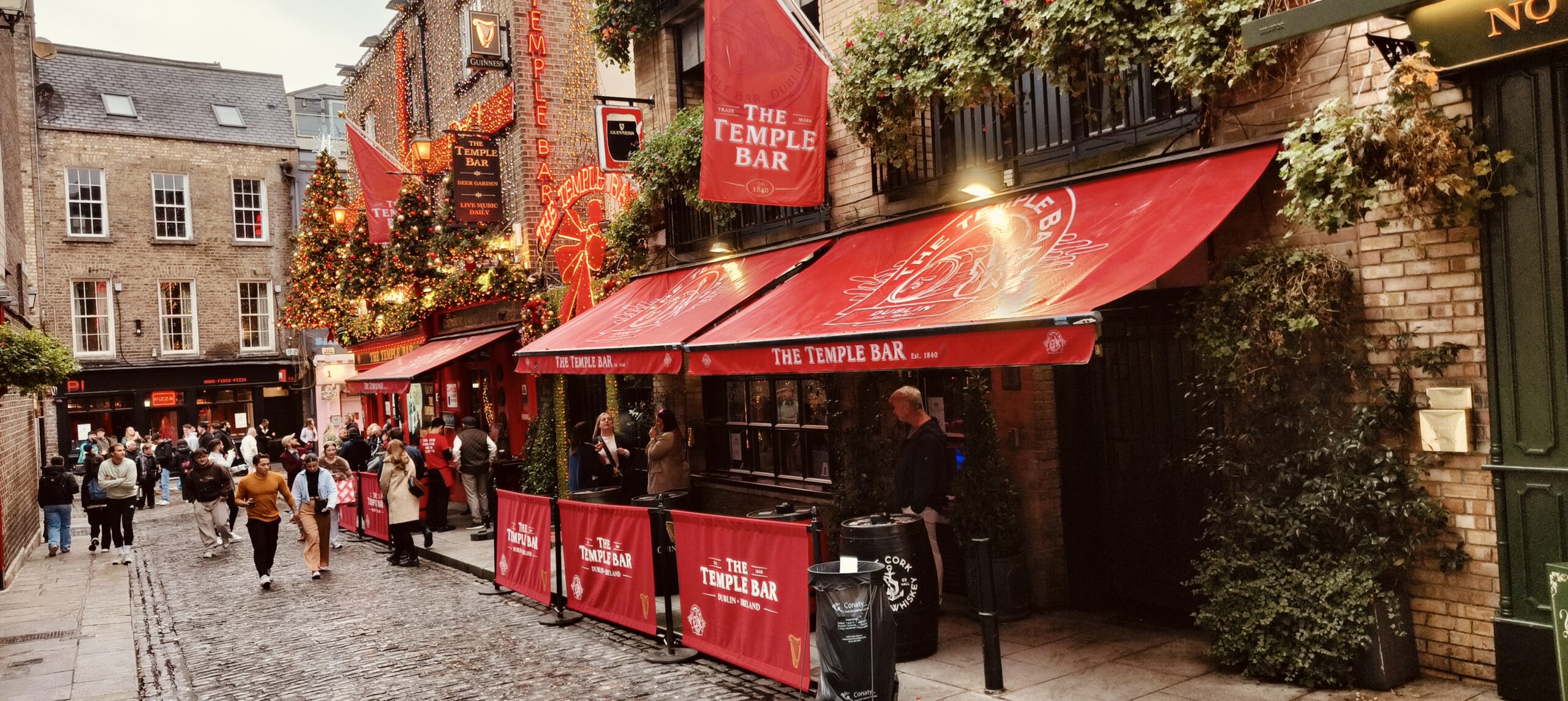
- Temple Bar & the Cultural Quarter — Dublin’s creative quarter, over-touristed but irreducible: the cobbled lanes between the Liffey and Dame Street, with the Irish Film Institute, the Gallery of Photography, the Project Arts Centre, and the Friday and Saturday food market in Meeting House Square. The tourist element is real and can be avoided by arriving at lunchtime on a weekday.
Pubs, Music & Dublin Nights
- Trad Music at Mulligan’s, the Cobblestone, or the Swan — Traditional Irish music sessions happen in Dublin pubs every night, but the finest are in the least obvious places: Mulligan’s on Poolbeg Street (the finest old-Dublin pub atmosphere in the city), the Cobblestone in Smithfield (the most musicianly trad sessions in Dublin), and the Swan Bar on Aungier Street (unchanged since 1897, with no speakers and no music — just conversation). Choose by what you want from an evening.
- The Palace Bar & Davy Byrne’s — The two great literary pubs of central Dublin: the Palace Bar on Fleet Street (where Patrick Kavanagh drank and where the Irish Times journalists have gathered for 80 years) and Davy Byrne’s on Duke Street (where Leopold Bloom ate a gorgonzola sandwich on Bloomsday, 16 June 1904, in James Joyce’s Ulysses). Both serve excellent pints; both are historical experiences in their own right.
- Bloomsday, 16 June — The annual celebration of James Joyce’s Ulysses, set entirely on 16 June 1904 in Dublin: people dress in Edwardian costume and follow Leopold Bloom’s route through the city, stopping at Davy Byrne’s, the Martello Tower at Sandycove, and the literary landmarks of the novel. The James Joyce Centre organises guided walks; the entire day is free and extraordinary.
- The National Concert Hall, Earlsfort Terrace — The principal concert hall of Ireland, in the former University College Dublin, with the RTÉ National Symphony Orchestra and Chamber Choir performing a full season September to June. The summer Proms series (July–August) includes lunchtime concerts. The finest classical music venue in Ireland.
- IMMA (Irish Museum of Modern Art), Kilmainham — The national institution for modern and contemporary art in Ireland, housed in the Royal Hospital Kilmainham — the finest 17th-century building in Dublin. The permanent collection and the temporary exhibitions are consistently excellent; the formal garden courtyard and the meadow walks on the grounds are among the finest public outdoor art spaces in the city.
Eastern Ireland & the Ancient East
- Newgrange & the Winter Solstice, County Meath — A Neolithic passage tomb of 3,200 BC — 500 years older than Stonehenge and 1,000 years older than the Great Pyramid — built with such precision that the rising sun of the winter solstice enters through the roof box and illuminates the inner chamber for 17 minutes. The lottery for the solstice sunrise is oversubscribed by tens of thousands; the guided tour at any other time of year gives access to the chamber. The most important prehistoric site in Ireland and one of the most significant in Europe.
- Brú na Bóinne UNESCO Valley, County Meath — The Boyne Valley Neolithic complex: Newgrange, Knowth (the largest passage tomb in Ireland, with the greatest concentration of megalithic art in Europe — over 250 decorated stones), and Dowth. Together, they constitute the most significant prehistoric cultural landscape in Ireland and one of the finest in the world.
- Hill of Tara, County Meath — The seat of the High Kings of Ireland from at least the Iron Age, with the Mound of the Hostages (a Neolithic passage tomb at its centre), the Lia Fáil (the Stone of Destiny on which kings were inaugurated), and a view that takes in a fifth of Ireland on a clear day. The most politically and spiritually charged hilltop in Irish history.
- Glendalough, County Wicklow — A 6th-century monastic settlement in a glacial valley in the Wicklow Mountains, founded by St Kevin who lived in a cave above the upper lake: the round tower (29 metres, the finest in the country), the cathedral ruins, St Kevin’s Church, and the extraordinary quality of the valley itself — two lakes, oak woods, and the mountain above — make it the most complete early Christian heritage landscape in Ireland.
- Powerscourt Estate & Gardens, County Wicklow — The finest formal garden in Ireland: 47 acres of terraced lawns, statuary, a Japanese garden, a pet cemetery, and the Powerscourt Waterfall (the highest in Ireland at 121 metres) on a separate estate, an hour south of Dublin. The Palladian house interior (a boutique hotel) and the garden together constitute the finest country estate experience near Dublin.
- Rock of Cashel, County Tipperary — The most dramatic ecclesiastical ruin in Ireland: a cluster of Romanesque and Gothic buildings — a round tower, a 12th-century Romanesque chapel (Cormac’s Chapel, the finest Romanesque building in Ireland), a Gothic cathedral, the Hall of the Vicars Choral — on a limestone outcrop rising from the Tipperary plain. Best seen from the town below at dusk, when the lights on the ruins and the darkening sky produce the definitive Irish heritage image.
- Kilkenny City & Castle — Ireland’s finest medieval city: the black marble streets of the Medieval Mile, the 13th-century Kilkenny Castle (home of the Butlers of Ormonde), St Canice’s Cathedral with its climbable 6th-century round tower, and the finest collection of medieval architecture in Ireland. The Smithwick’s Experience at the medieval friary brewery and the Kilkenny Design Centre complete the finest single-city heritage day in Ireland.
- Hook Lighthouse & the Copper Coast, County Wexford — Hook Lighthouse, at the tip of the Hook Peninsula, is the oldest operational lighthouse in the world (built by monks in the 5th century, formalised as a lighthouse in the 13th). The Copper Coast UNESCO Geopark between Dungarvan and Tramore is the finest coastal geology drive in Ireland: copper mine ruins, sea stacks, boulder beaches, and the coloured bands of volcanic rock that gave the coast its name.
Cork & the South
- Cork City & the English Market — Ireland’s second city, the self-proclaimed “real capital,” with the English Market — a covered Victorian food hall in continuous operation since 1788, visited by Queen Elizabeth II in 2011, with the finest concentration of Irish artisan produce in the country: Gubbeen cheese, Gubeen chorizo, local butter, tripe and drisheen (the traditional Cork offal dish), and the finest fish counter in Ireland. The Shandon bells (the butter exchange steeple), the Crawford Art Gallery, and the independent bookshops and restaurants of MacCurtain Street complete the day.
- Blarney Castle & the Blarney Stone, County Cork — The 15th-century castle, 8 kilometres from Cork city, whose battlements contain the Blarney Stone — kissing which, by tradition (hanging upside down over the castle parapet, held by an attendant), confers the “gift of the gab” or eloquent speech. The castle, the grounds (with the Poison Garden, Rock Close, and the Witch’s Stone), and the tradition itself are worth the visit regardless of your stone-kissing intentions.
- Kinsale: Ireland’s Food Capital — The most beautiful harbour town in southern Ireland, with the finest concentration of excellent restaurants for its size in the country. The Good Food Circle of Kinsale (Ireland’s first dining trail) operates in a town of coloured Georgian facades, two historic star forts (the largest 17th-century forts in Ireland), and a harbour that combines sailing, good food, and considerable charm.
- Cobh (Cove) & the Titanic Connection, County Cork — The Victorian seaside town of Cobh (pronounced “Cove”) was the last port of call of the RMS Titanic before its fatal crossing. The Titanic Experience and the Cobh Heritage Centre in the original White Star Line offices, the extraordinary St Colman’s Cathedral (a 19th-century Gothic Revival masterpiece built on the hillside above the town), and the grave of Annie Moore — the first immigrant to pass through Ellis Island — give Cobh a historical depth that rewards several hours.
- Mizen Head & the Beara Peninsula — The southwesternmost point of Ireland, at the tip of the Mizen Peninsula, reached across a bridge over the sea cliffs: the finest cliff-edge headland experience in Munster, with the visitor centre in the old signal station. The Beara Peninsula to the north is even less visited and more beautiful: the Healy Pass (the finest mountain road in Munster), the Beara Way walking trail, and the Derreen Gardens are all exceptional.
Kerry & the Ring
- Skellig Michael, County Kerry — One of the most extraordinary places in the world: a pyramidal rock rising 218 metres from the Atlantic, 13 kilometres off the Kerry coast, with the ruins of a 6th-century monastery of extraordinary austerity — beehive cells, oratories, and a graveyard carved from the rock face — reached by climbing 618 steps cut into the cliff by the monks themselves. The boat trip across to the rock, and the ascent of the steps in a sea wind, produce an experience of radicality that no other heritage site in Ireland offers. Boats operate May to September; book months in advance.
- Ring of Kerry Scenic Drive — The 179-kilometre circular route around the Iveragh Peninsula: Ladies’ View (the finest panoramic view in Kerry, of the Upper Lake and the mountains), Moll’s Gap, Derrynane Beach, the Skellig Ring diversion to Portmagee, and the drive through the mountains above Killarney. Drive anticlockwise (anti-tour-bus direction) and stop at every viewpoint.
- Killarney National Park — Ireland’s oldest national park, with the three lakes (Upper, Muckross, and Lough Leane), the Torc Waterfall, Muckross House and Abbey, Ross Castle (a 15th-century tower house on the lake shore), and the last surviving herd of native red deer in Ireland. The jaunting car (a traditional horse-drawn cart, still the primary tourist transport in the park) and the boat trip on the Lough Leane between the wooded islands are the finest ways to experience it.
- Dingle Peninsula & Slea Head Drive — The most scenically dramatic peninsula in Ireland: the Slea Head Drive past beehive huts (clocháns) of the early Christian monks, the Blasket Island viewpoint, the stone Gallarus Oratory (an 8th-century boat-shaped stone church, perfectly dry after 1,300 years), and the view from Slea Head itself over the Blasket Islands and the open Atlantic. Better than the Ring of Kerry for intimacy and diversity.
- The Blasket Islands — The most westerly islands of Europe before New York: the Great Blasket was inhabited until 1953, and its small community produced three writers of extraordinary quality — Tomás Ó Criomhthain (The Islandman), Peig Sayers (Peig), and Muiris Ó Súilleabháin (Twenty Years A-Growing) — in a flowering of literature from a people facing extinction. The Blasket Centre in Dunquin and the summer ferry to the island itself give access to one of the most moving human stories in Ireland.
- MacGillycuddy’s Reeks & Carrauntoohil — The highest mountain range in Ireland, with Carrauntoohil (1,038 metres, the highest peak in Ireland) accessible by several routes from the Black Valley: a day’s serious hillwalking in a landscape of wild rock and corrie lakes that is the finest mountain scenery in Munster.
Clare & the Burren
- Cliffs of Moher — The most visited natural attraction in Ireland: 8 kilometres of sheer limestone cliffs rising to 214 metres above the Atlantic, with the light changing every quarter-hour from grey to gold depending on the cloud cover. The experience is proportional to the weather: in a westerly gale, standing at the unguarded O’Brien’s Tower end of the cliffs and feeling the spray is unlike anything in Ireland. Come early morning to have the cliff path to yourself.
- The Burren National Park — A 250-square-kilometre plateau of bare limestone pavement in County Clare, cracked into the distinctive clints and grikes that support a botanical impossibility: Arctic-alpine and Mediterranean plants growing side by side in the same limestone fissures, warmed by the Gulf Stream and cooled by the Atlantic altitude. The Burren in May, when the mountain avens and the spring gentian are in bloom, is the finest wildflower landscape in Ireland.
- Poulnabrone Dolmen, The Burren — A portal tomb of 3,600–3,200 BC, standing in the limestone pavement of the Burren: two large capstones balanced on uprights above a collapsed chamber, the oldest field monument in the county. The dolmen at sunset, with the Burren limestone spreading flat in every direction and no other structure visible, is one of Ireland’s most composed prehistoric images.
- Doolin & the Traditional Music Capital — The small coastal village of Doolin, below the Cliffs of Moher, has three pubs (O’Connor’s, Gus O’Connor’s, and McDermott’s) that together produce more consistent and more serious traditional music sessions per evening than any village in Ireland. The music here — fiddle, flute, concertina, bodhran — is played by musicians who take it seriously rather than performing it. The walk from Doolin along the cliff path to the Cliffs of Moher is the finest coastal walk in Clare.
- Ailwee Cave & the Burren Birds of Prey — A cave system in the Burren hills, with stalactites, river chambers, and the remains of Brown Bears who sheltered here 10,000 years ago. The adjacent Birds of Prey Centre has daily flying demonstrations of eagles, hawks, falcons, and owls — the finest falconry and raptor experience in the west of Ireland.
- Loop Head Peninsula, County Clare — The little-known peninsula at the southern tip of Clare, with the Loop Head Lighthouse (available as accommodation), the finest sea-stack walk in Clare at Kilkee, and the Spanish Point beach where survivors of the Armada were executed in 1588. The landscape between Carrigaholt and the headland is the finest unspoiled coastal scenery in Clare.
Galway: City of the Tribes
- Galway City Latin Quarter Walk — The cobbled lanes of the Latin Quarter between Shop Street and the Spanish Arch: the Galway City Museum (free, with the finest collection of Galway’s trading history), the medieval Spanish Arch (the last survivor of the 16th-century city wall), the Claddagh (the original fishing village outside the city walls, from which the Claddagh ring takes its name), and the quality of street music and street life that makes Galway the most alive small city in Ireland.
- Trad Music at Tigh Neachtain’s, Galway — The finest trad music pub in Galway: a small, dark, crowded pub on Cross Street with sessions most evenings and a quality of musicianship that reflects Galway’s exceptional concentration of traditional musicians. The Roisín Dubh venue on Dominick Street is the finest live music venue in Connacht for all genres.
- Galway Oyster Festival (September) — The annual celebration of the Galway native oyster at Clarenbridge and across the city each September: the World Oyster Opening Championship, the oyster-and-Guinness pairing that has been Galway’s signature combination for decades, and the street festival atmosphere in a city that needs no excuse for celebration.
- Galway International Arts Festival (July) — Two weeks in July each year, Galway becomes the finest arts festival city in Ireland: street performances, world theatre, major international visual art commissions, and the free outdoor events on Eyre Square and the Claddagh that make the festival one of the finest in Europe for breadth and accessibility.
Connemara & the West
- Connemara National Park & Diamond Hill — The national park covering the granite and bog landscape of northwest Connemara: the Diamond Hill loop (7.5 kilometres, a moderate climb to a summit of extraordinary views over the bogs, the Twelve Bens, and the Atlantic coast) is the finest half-day hike in Connacht. The park visitor centre gives the best introduction to the bog ecosystem.
- Kylemore Abbey, Connemara — A Victorian Gothic castle reflected in Pollacapull Lough, with the Victorian Walled Garden, the neo-Gothic church, and the story of Mitchell Henry who built it for his wife in the 1860s and lost her there within five years. Now a Benedictine monastery and school; the most photographed building in Connemara and entirely deserving of the attention.
- Sky Road, Clifden — The 12-kilometre loop from the colourful capital of Connemara along the clifftop above Clifden Bay and the Atlantic: the most dramatic coastal road in Connacht, with the quartzite hills of the Twelve Bens behind and the Aran Islands visible on clear days to the south.
- Aran Islands: Dún Aonghasa, Inishmore — The stone fortress of Dún Aonghasa, on the edge of a 100-metre cliff on Inishmore: a 3,000-year-old Iron Age promontory fort whose west wall terminates at the cliff edge above the open Atlantic, with no railing or barrier between the visitor and the 100-metre drop. The finest prehistoric monument in the west of Ireland. Take the ferry from Rossaveal or Doolin; hire a bicycle on the island.
- Connemara Pony Show, Clifden (August) — The annual show of the Connemara pony — the only native horse breed of Ireland, small, hardy, sure-footed, and of considerable character — in the show grounds outside Clifden each August. The most specifically Connemaran annual event and one of the finest agricultural shows in the west.
- Achill Island & Keem Bay — Ireland’s largest island, connected to Mayo by a road bridge: the dramatic Atlantic Drive, the deserted village of Slievemore (evacuated seasonally since the famine), and the extraordinary Keem Bay — a horseshoe of turquoise water enclosed by quartzite cliffs, accessible by a road that climbs the Atlantic face of the island. One of the finest small bays in the country, and the location of scenes from The Banshees of Inisherin.
Mayo, Sligo & the Northwest
- Croagh Patrick, County Mayo — Ireland’s holiest mountain: the 764-metre quartzite cone above Clew Bay, from whose summit St Patrick fasted for 40 days in 441 AD. The Reek Sunday pilgrimage (the last Sunday of July) brings 25,000 people up the rocky path, many barefoot; the view from the summit — Clew Bay and its 365 islands below, Clare Island and Achill to the west — is the finest from any summit in Connacht.
- Céide Fields, County Mayo — The oldest known field system in the world: a 5,000-year-old Neolithic farming landscape buried beneath the bog of North Mayo, with stone walls and farmhouses preserved under 4,000 years of peat. The visitor centre is excellent; the surrounding landscape — bog, sea cliffs (110 metres above the Atlantic), and complete silence — is the most remote heritage experience in Mayo.
- Downpatrick Head & Dún Briste, County Mayo — A spectacular sea stack standing 50 metres above the ocean at the edge of the county’s most dramatic headland: the isolated pillar of rock, separated from the mainland by the sea, with a ruined church and the Atlantic crashing against its base. The walk from Ballycastle to the headland is the finest short coastal walk in Mayo.
- Ben Bulben, County Sligo — The table mountain above Drumcliffe that W.B. Yeats made famous: a flat-topped limestone plateau with vertical sides, rising above Sligo Bay in a silhouette that is one of the most distinctive mountain profiles in Ireland. Walk its flanks from Glencar Lough, where the waterfall that Yeats wrote of still falls, and visit Drumcliffe churchyard — where Yeats is buried, with the inscription he chose himself: “Cast a cold eye / On life, on death. / Horseman, pass by!”
- Carrowmore Megalithic Cemetery, County Sligo — The largest megalithic cemetery in Ireland: over 60 passage tombs and stone circles spread across the drumlin landscape south of Sligo town, dating from 4,300 BC — the oldest megalithic monuments in Ireland and among the oldest in Europe. The site is free and open-access; the visitor centre explains the full significance of a landscape that is the most prehistoric in the west.
- Strandhill Beach & Surfing, County Sligo — The finest beach surf in the northwest: Strandhill faces the full Atlantic swell, with a consistent and powerful beach break that has produced some of Ireland’s finest surfers. The Shells Café on the seafront is the finest post-surf café in Connacht; the seaweed baths (a Sligo tradition since 1912) at Voya Seaweed Baths are the most restorative experience on the northwest coast.
Donegal: Ireland’s Wild Northwest
- Slieve League Cliffs, County Donegal — The highest accessible sea cliffs in Ireland and among the highest in Europe: 601 metres of sheer rock above the Atlantic, significantly higher than the Cliffs of Moher and considerably less visited. The Bunglass viewing point gives the finest cliff vista in Ireland; the walk along the cliff top from Bunglass to the One Man’s Pass (a narrow ridge requiring hands and nerve) is the finest coastal walk in Donegal.
- Glenveagh National Park, County Donegal — The wildest national park in Ireland: 16,000 hectares of bog, mountain, and the Glenveagh valley, with the Victorian Glenveagh Castle and its surprise walled garden in the valley’s interior. The park has the only golden eagle breeding population in Ireland, reintroduced after centuries of absence. No road through the park; access is by bus from the visitor centre.
- Sliabh Liag (Slieve League) by Boat — The sea approach to the Slieve League cliffs: a boat trip from Teelin pier at the base of the cliffs gives a perspective of the rock face — including the cave systems, the sea stacks, and the vertical striations of the geology — that the cliff-top walk cannot provide. The most dramatic single boat trip in Ireland.
- The Rosses & the Bloody Foreland, Donegal — The most remote region of the northwest: the archipelago of islands and inlets between Dungloe and Gweedore, with Bloody Foreland (the headland named for the extraordinary red colour of the quartzite in the setting sun), the Tory Island ferry, and the Irish-speaking (Gaeltacht) communities that have maintained the language in the most Atlantic corner of the country.
- Tory Island, County Donegal — An island 14 kilometres off the Donegal coast, Irish-speaking, with its own elected king (an honorary title maintained since ancient times), a school of naive painters (the Tory Island School, founded when the English artist Derek Hill began teaching on the island in the 1950s), and a community of extraordinary self-sufficiency. The daily ferry (weather permitting) is one of the finest short crossings in Ireland.
- Malin Head, County Donegal — The most northerly point of the island of Ireland: the headland above the village of Malin, with a 19th-century watchtower, the view of the Inishowen Peninsula stretching back to the south, and the Atlantic extending to Iceland 1,100 kilometres to the north. The most northerly accessible point of Ireland and one of the finest headlands in the country.
Northern Ireland
- Giant’s Causeway, County Antrim (UNESCO) — The most visited attraction in Northern Ireland: 40,000 interlocking hexagonal basalt columns formed by the cooling of lava 50–60 million years ago, stepping down to the sea in a formation so geometrically precise that legend attributed it to the giant Fionn MacCumhaill building a causeway to Scotland. Walk the lower path to the columns themselves; climb the headland above for the finest panoramic view of the full formation. UNESCO World Heritage Site.
- Causeway Coastal Route, County Antrim — The 200-kilometre coastal road from Belfast to Londonderry/Derry: Carrickfergus Castle, the Glens of Antrim, the Carrick-a-Rede rope bridge (the most spectacular rope bridge in Ireland, across a 30-metre sea chasm above the Atlantic), the Giant’s Causeway, Dunluce Castle (a ruined clifftop castle of dramatic beauty), and the Bushmills Distillery (the world’s oldest licensed distillery, 1608).
- Carrick-a-Rede Rope Bridge — A rope bridge spanning a 30-metre chasm between the mainland and a small island used by salmon fishermen for centuries: the walk across gives the finest vertical sea exposure of any short walk in Northern Ireland, with the Atlantic 23 metres below. Book online; the bridge is popular and sells out.
- Belfast City & the Titanic Quarter — Belfast has been transformed by the Good Friday Agreement’s peace dividend: the Titanic Belfast museum (the most visited tourist attraction in Northern Ireland, built on the slipway where the ship was constructed), the Cathedral Quarter’s vibrant arts and pub scene, the murals of the Falls and Shankill Roads (the most politically significant street art in the world), and a food scene centred on St George’s Market (the finest covered market in Northern Ireland) that makes Belfast one of the most rewarding cities in Ireland.
- Titanic Belfast — The £100 million museum on the site of the Harland and Wolff shipyard where the Titanic was built: nine galleries tracing Belfast’s shipbuilding history, the ship’s design and construction, and the night of 14–15 April 1912 in an immersive narrative of considerable power. The exterior — four ship’s bow-shaped towers of crystalline steel — is remarkable architecture; the interior is the finest museum in Northern Ireland.
- Mourne Mountains, County Down — The finest mountain range in Northern Ireland: a compact group of granite peaks above Newcastle, with the Slieve Donard (849 metres, the highest in Northern Ireland) walk along the Mourne Wall one of the finest long-distance hillwalks on the island. The Kingdom of Mourne has been compared in landscape character to the Lake District; the comparison is apposite.
- Derry/Londonderry Walls — The most complete walled city in Ireland: 17th-century city walls encircling the original Plantation city, with the finest surviving bastioned town fortifications in Ireland. The Guildhall (free, with an excellent exhibition on the history of Derry), the Bogside murals (the most significant political murals in Ireland, painted by the Bogside Artists to commemorate the civil rights events of 1968–72), and the Museum of Free Derry make it the most historically charged city walk in Northern Ireland.
Irish Food, Whiskey & Culture
- A Proper Irish Breakfast at a Guesthouse — The full Irish breakfast — back bacon, thick sausages, white and black pudding, egg, grilled tomato, mushrooms, soda bread, and butter — is Ireland’s greatest contribution to the morning meal. The versions in small family guesthouses in rural Ireland, with homemade soda bread still warm from the oven and butter from the local dairy, are considerably better than any hotel version.
- Guinness at the Gravity Bar, Storehouse, Dublin — The Guinness Storehouse is the most visited tourist attraction in Ireland. The self-guided tour through the history of the world’s most famous stout ends at the Gravity Bar on the 7th floor — a 360-degree glass-walled bar with the finest panoramic view of Dublin, and a pint of Guinness poured at the source. Booking online cuts the entry time significantly.
- Oysters at Clarenbridge or Galway — The Galway Bay native oyster (Ostrea edulis) is the finest in the world: eaten with a squeeze of lemon and a pint of Guinness, in the village of Clarenbridge where the oyster festival has been held since 1954, or at Moran’s of the Weir (a whitewashed pub at the edge of the bay, in operation for centuries). The combination — oyster, Guinness, Atlantic air — is one of the most specific and the most complete pleasures Ireland offers.
- Fresh Seafood Chowder at a West Coast Restaurant — The cream-based chowder of smoked haddock, mussels, and clams, served with brown soda bread and Irish butter: the finest simple lunch on the west coast. The Pie Maker in Westport, Moran’s of the Weir in Clarinbridge, and the restaurant at Fishy Fishy in Kinsale serve the finest versions in their respective regions.
- Irish Whiskey Distillery Tour: Midleton, Bushmills, or Teeling — Ireland has more whiskey distilleries in operation now than at any point in the last 100 years: the Midleton Very Rare distillery in Cork (home of Jameson and the finest single-pot stills in Ireland), the Bushmills Distillery in Antrim (the world’s oldest licensed distillery), and the Teeling Distillery in the Liberties of Dublin (the finest urban distillery experience in the city) all offer excellent guided tours. Irish whiskey is triple-distilled and lighter in character than Scotch; tasting the range of styles — single malt, single pot still, blended — in the country that invented it is a genuine education.
- Brown Bread & Irish Butter — The soda bread of Ireland — flour, buttermilk, bicarbonate of soda, no yeast — is the finest everyday bread in the British Isles when made properly. Eaten with Irish butter (Kerrygold is the best-known export; Murphy’s of Timoleague and the dairy butters of Cavan and Tipperary are better) and a slice of cheddar, it is the most essential Irish food. Find the best brown bread at small guesthouses, county-show tea rooms, and the Aran Island restaurants.
- Trad Music Session: An Primer — A trad session is not a performance but a conversation between musicians: a group playing together for their own pleasure, to which visitors are quietly welcome. The etiquette is simple — don’t interrupt, don’t request, do buy rounds. The finest sessions in Ireland happen in the smallest pubs: Doolin’s O’Connor’s, Tigh Neachtain in Galway, Matt Molloy’s in Westport, and the Cobblestone in Dublin are the most reliable addresses.
Adventure, Walking & the Outdoors
- The Wild Atlantic Way by Car or Campervan — The 2,500-kilometre driving route from Malin Head in Donegal to Mizen Head in Cork: the longest defined coastal route in the world, passing all the great landmarks of the Irish Atlantic coast. Allow at least two weeks; the finest sections are Clare–Galway–Mayo and Donegal.
- Kerry Way & Wicklow Way Long-Distance Walks — Ireland’s two finest long-distance walking routes: the Kerry Way (214 kilometres around the Ring of Kerry, entirely off-road, through the finest mountain and coastal scenery in Munster) and the Wicklow Way (132 kilometres from Dublin through the Wicklow Mountains to Clonegal, Ireland’s first waymarked walk). Both take 8–10 days; both are self-guided with accommodation at marked intervals.
- Surfing the Wild Atlantic Way — Ireland has the finest surfing in Europe: Bundoran (the “surfing capital of Ireland”), Strandhill, Lahinch, Inch Strand (Kerry), Mullaghmore (where the world’s biggest surfable waves periodically arrive from the Atlantic), and Achill Island’s Keel beach all offer consistent and powerful surf. Lahinch and Bundoran have the best surf schools for beginners.
- Sea Kayaking, Connemara or Donegal — The islands and sea inlets of Connemara and Donegal produce the finest sea kayaking in Ireland: the Inner Connemara route between the islands of the Gaeltacht coast, and the Donegal coast between Maghera and the Rosses, are the two finest multi-day sea kayaking environments in the country.
- Cycling the Great Western Greenway, Mayo — The longest off-road cycle path in Ireland: 42 kilometres from Westport to Achill Sound along the route of the former Midland Great Western Railway, through the Nephin Beg mountains and the bogs of west Mayo, with Mount Croagh Patrick visible to the south and the Atlantic islands to the west. The finest single-day cycling experience in the west of Ireland.
- Wild Swimming at a Martello Tower Pool, Dublin — The Forty Foot swimming pool at Sandycove, Dublin — a Martello tower promontory where James Joyce’s Ulysses opens, and where Dubliners have been swimming in the Irish Sea year-round since the 18th century — is Ireland’s finest urban swimming spot. December and January are the best months for the shock value of the cold; summer mornings for the atmosphere of the early swimmers.
- Dark Sky Stargazing: Mayo or Kerry — Ireland has two designated Dark Sky areas: the Mayo Dark Sky Park (in the Ballycroy National Park) and the Kerry International Dark Sky Reserve (around Killarney and the Iveragh Peninsula). The winter nights — from October to March — produce the finest conditions; the Milky Way is visible with the naked eye and the sky overhead is as dark as any in western Europe.
Literature, Heritage & Irish Culture
- The Literary Trail: Dublin & Beyond — Ireland has more Nobel Prize–winning writers per capita than any country on earth (Shaw, Yeats, Beckett, Heaney). The James Joyce Centre, the Shaw Birthplace, the Writers’ Museum on Parnell Square, the Seamus Heaney HomePlace in Bellaghy (the finest new literary heritage centre in Ireland), and the W.B. Yeats Memorial in Sligo together form the finest literary tourism network in Europe.
- Newgrange & the Book of Kells: Ireland’s UNESCO Heritage — Ireland has two UNESCO World Heritage Sites of extraordinary significance: the Brú na Bóinne valley (including Newgrange) and Skellig Michael. Both deserve an entire day; both reward repeated visits. They are respectively the oldest and the most remote significant monuments in Ireland.
- Irish Language Experience, Connemara Gaeltacht — The Irish-speaking communities of Connemara, Donegal, and Kerry maintain the oldest continuously spoken language in western Europe. Taking an Irish language course at Oideas Gael in Glencolmcille, Donegal, or visiting a Gaeltacht pub where the conversation at the bar is entirely in Irish, is the most direct encounter with the linguistic heritage that predates English on this island by millennia.
- Croke Park Stadium Tour & the GAA Museum, Dublin — The largest stadium in Ireland (82,300 capacity) and the spiritual home of the Gaelic Athletic Association: hurling and Gaelic football (the fastest field games in the world and entirely specific to Ireland) are played here in the All-Ireland Championships each summer. The stadium tour includes the pitch, the press box, and the underground players’ tunnel; the museum is the finest sporting heritage institution in Ireland.
- All-Ireland Hurling Final, Croke Park (August) — Attending the All-Ireland Hurling Final in Dublin in August is the finest sporting experience in Ireland: the fastest field sport in the world, played with wooden sticks (hurleys) and a leather-covered ball (sliotar) by athletes of extraordinary skill, in a 82,000-seat stadium of passionate county loyalty. Tickets are extremely difficult to obtain through normal channels; the atmosphere is unlike any other sporting event in the country.
Hidden Gems & Unexpected Ireland
- Lough Derg Pilgrimage, County Donegal — The most extreme religious pilgrimage in Ireland, practised since medieval times: three days on a small island in Lough Derg, in County Donegal, fasting entirely (one meal of dry toast and black tea or coffee per day), sleeping only one night, and walking barefoot on the stone penitential beds. Open June to August; entirely voluntary; the experience of radical simplicity is unlike any other in Ireland.
- The Beaghmore Stone Circles, County Tyrone — A complex of seven stone circles and twelve stone rows in the Sperrin Mountains of Tyrone, built between 2,000 and 1,200 BC and discovered beneath the peat in the 1940s: the most enigmatic and least-visited prehistoric landscape in Northern Ireland, entirely free to access, in a landscape of blanket bog and mountain that amplifies the quality of the silence.
- Clonmacnoise, County Offaly — The most important early Christian monastery in Ireland, founded by St Ciarán on the Shannon floodplain in 544 AD: the ruins of the cathedral, the temples, the two round towers, and the finest collection of early Christian carved grave slabs in Ireland, with the Shannon bending around the site to the west and the Esker Ridge behind. The most powerful early Christian landscape in Ireland.
- Cahir Castle, County Tipperary — One of the largest and best-preserved medieval castles in Ireland, on an island in the River Suir in the town of Cahir: the outer, inner, and middle wards, the keep, and the water gate all largely intact. Used as a filming location for Excalibur (1981) and various television productions; the most complete medieval fortification in Tipperary.
- The Aran Islands: Inishmaan & Inisheer — The quieter islands: while Inishmore receives most visitors, the middle island of Inishmaan (less than 200 residents, an intact Irish-speaking community, and the cottage where J.M. Synge spent summers between 1898 and 1902) and the smallest island of Inisheer (with the wreck of the Plassey on its beach) offer a genuinely different Aran Islands experience of extraordinary peace.
- Glendalough Hermitage Walk — The path above the upper lake in Glendalough, to St Kevin’s Cell — the tiny stone cell on a ledge above the lake where the saint lived as a hermit — and the Camaederry ridge above the valley, gives the most historically charged hillwalk in Wicklow. The view down on the monastic settlement from above, with the round tower visible in the valley, is the finest perspective on Glendalough available.
- Rathlin Island, County Antrim — The only inhabited island off the Northern Ireland coast: 8 kilometres from Ballycastle, with the RSPB West Light seabird centre (the finest puffin-watching in Ireland, 250,000 puffins from May to July), the cave where Robert the Bruce is said to have watched the spider that inspired his perseverance, and a community of 150 people who make the island the finest single-day island visit in Northern Ireland.
- The Gap of Dunloe, County Kerry — A dramatic glacial pass in the MacGillycuddy’s Reeks, accessible only on foot or by pony trap: 11 kilometres of mountain, lake, and valley between Kate Kearney’s Cottage and the Black Valley, with the limestone mountains crowding the narrow path and the lakes reflecting the clouds. The traditional combination is to take a pony trap through the Gap and a boat across the lakes to Killarney — the finest full day in Kerry.
- Cahersiveen & the Iveragh Heritage — The capital of the Iveragh Peninsula is notable for two things: the birthplace of Daniel O’Connell (the Liberator, the most important Irish political figure of the 19th century) and the Cahersiveen Old Church (built by mistake — the architect confused Cahersiveen with a similarly named African mission station and built a neo-Romanesque structure more suited to the Nile Valley). The combination of Daniel O’Connell’s birthplace, the extraordinary church, and the Skellig Ring drive to Portmagee make it the finest single day in the south of Kerry.
- Lough Key Forest Park, County Roscommon — A Victorian demesne landscape of woodland, islands, and the ruins of Rockingham House (a Nash-designed mansion burned in 1957 and demolished) on the shores of the most beautiful lake in Roscommon. The treetop walk, the bog gardens, and the rowing boat hire give the finest inland nature day in Connacht.
- The Wicklow Mountains at Dawn — A dawn drive from Dublin south on the R115 to Sally Gap and Glenmacnass waterfall — the highest in Wicklow — with the bog moors stretching in every direction in the early light and the mountains visible from the Dublin suburbs from the highest point. Twenty minutes from the city, an entire other Ireland.
- A Traditional Irish Music Session, Wherever You Find One — The finest trad session in Ireland is the one you stumble across unexpectedly: a Tuesday evening in a Clare village, three musicians who don’t know each other starting to play, and the music building — fiddle, flute, bodhrán — until the pub goes quiet and the room belongs entirely to the sound. This is Ireland at its most specific and its most unrepeatable, and no guidebook can tell you exactly where it will happen.
- Watch the Sunset from the Cliffs of Moher on a Clear Evening — Come in September or October, when the summer crowds have thinned and the westerlies have returned. Park at the south end, walk north along the cliff top to O’Brien’s Tower, and stand with your back to the visitor centre. The Atlantic spreads west to Newfoundland without interruption. The sun goes down through layers of cloud — grey, silver, amber, then the final gold that comes just before the dark. The Aran Islands are visible to the north, black silhouettes against the last light. A fulmar rides the updraft at eye level. Ireland, in this moment, is entirely itself: ancient, wild, improbably beautiful, and entirely worth the journey to the edge of the western world.
Quick Facts for Visitors
| Best time to visit | May–September (warmest, most daylight, all attractions open) |
| Wild Atlantic Way | April–October (winter is spectacular but some roads and ferries close) |
| Currency | Euro (€) in the Republic; British Pound (£) in Northern Ireland |
| Language | English (throughout); Irish (Gaeltacht areas of Donegal, Galway, Kerry) |
| Getting around | Car hire essential beyond Dublin and main cities; public transport limited in rural areas |
| Republic/Northern Ireland | No border controls since the Good Friday Agreement; same island, two currencies |
| Capital | Dublin (Republic); Belfast is the capital of Northern Ireland |
| Ideal trip length | 5–7 days for Dublin and one region · 10–14 days for a Wild Atlantic Way circuit · 3 weeks for the full island |
| What to pack | Rain jacket, always. The weather can change in 20 minutes and the light when it rains is extraordinary |
Ireland is a country where the weather is part of the experience, not an obstacle to it. The light after rain on a Connemara bog, the sea cliffs in a southwest gale, the mist lifting from the valley at Glendalough to reveal the round tower — these are not inconveniences. They are the thing itself. Come prepared for everything, and Ireland gives you everything in return.