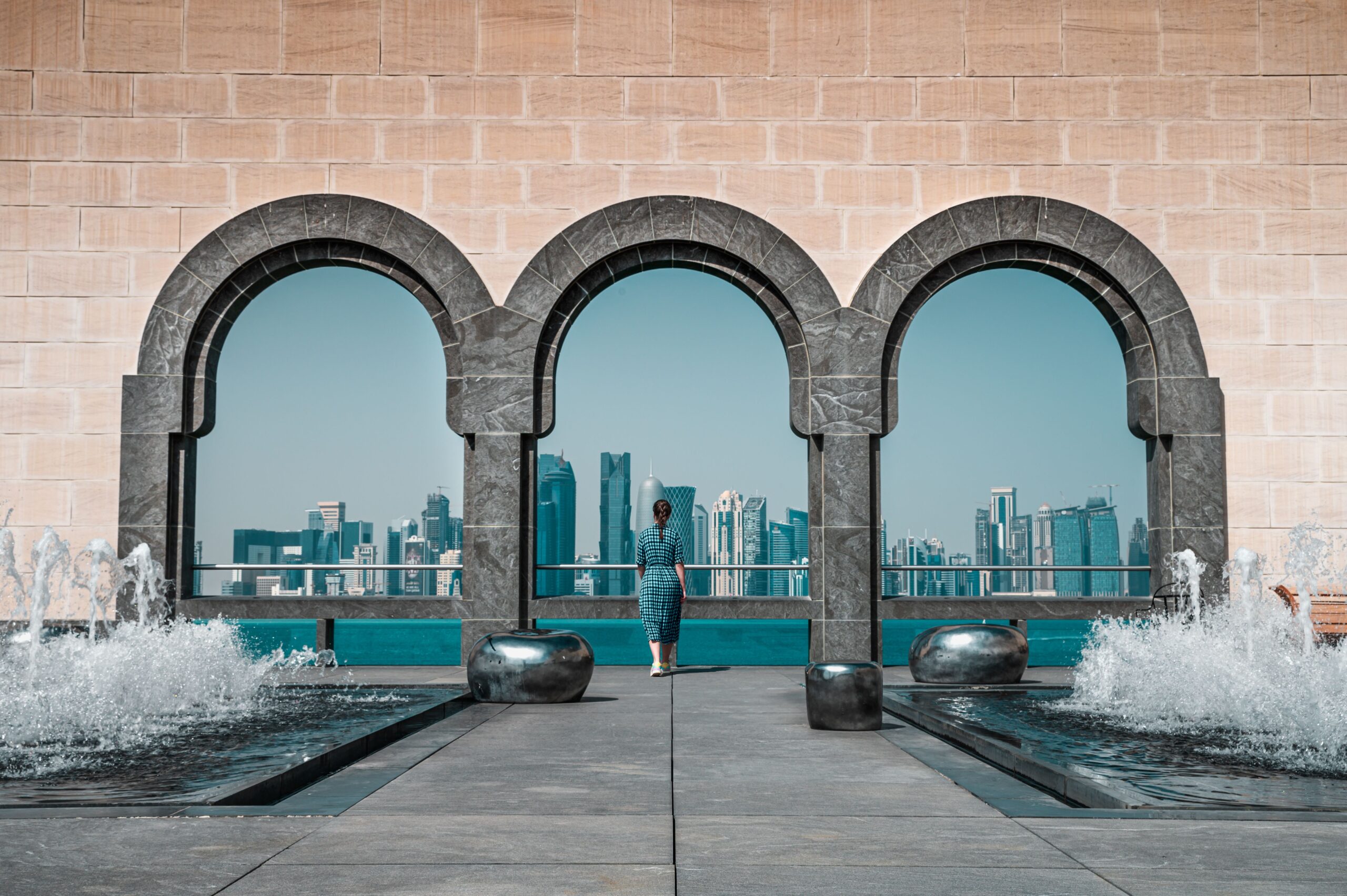
Qatar is the most concentrated destination in the Arabian Peninsula. A peninsula smaller than Connecticut, it has invested the revenues of the world’s third-largest natural gas reserves into a cultural and architectural ambition that has produced, in the space of twenty years, one of the greatest collections of Islamic art in the world, a world-class modern art museum designed by Jean Nouvel, a network of heritage sites that includes the Arabian Peninsula’s only UNESCO-listed archaeological site, a falcon hospital that treats more birds than any facility on earth, and a food scene that encompasses everything from a centuries-old souq spice stall to restaurants by the world’s most celebrated chefs.
Qatar is also — and this is the part that most first-time visitors underestimate — genuinely beautiful beyond its skyline. The desert in the south contains the Inland Sea, where sand dunes meet the Gulf in a landscape of extraordinary desolation and drama. The northwest coast has mangrove forests, ancient fortified towns, and the silence of a coast that has been quietly accumulating history since before the first European ships reached the Arabian Gulf. The Zekreet Peninsula has limestone formations that look like they were arranged by a surrealist. And the Pearl — the artificial island — is exactly as glamorous, implausible, and enjoyable as it sounds.
This guide covers 101 things to do across Qatar — from the world’s greatest collection of Islamic art to a camel race at dawn.
Doha: The Capital
Museums & Cultural Landmarks
- Museum of Islamic Art (MIA) — The most important collection of Islamic art in the world, housed in one of the finest museum buildings of the 21st century: I.M. Pei’s last great work, completed in 2008 — a building of geometric limestone rising from a man-made island in Doha Bay, inspired by the ablutions fountain of the Ibn Tulun Mosque in Cairo. The collection spans 1,400 years of Islamic civilisation from Spain to China: the Nishapur metalwork, the Mamluk glassware, the Safavid carpets, the Mughal jade, and the Fatimid rock crystals. The atrium alone — five storeys of geometric light — justifies the visit before a single object is examined.
- National Museum of Qatar — Jean Nouvel’s 2019 masterwork: a building designed in the form of the desert rose crystal (gypsum crystals that form in the desert sand), with 539 interlocking discs of concrete and metal enclosing galleries that tell the story of Qatar from its geological formation through the pearl-diving era to the present. The building is one of the most architecturally ambitious museum structures in the world; the collection inside — filmed oral histories, immersive environments, and material culture from the peninsula — is the finest introduction to Qatari identity available.
- Mathaf: Arab Museum of Modern Art — The most comprehensive collection of modern Arab art in the world, in the Education City complex: over 9,000 works representing the full range of Arab artistic practice from 1840 to the present, from the Egyptian moderns of the 1920s through the Abstract Expressionists of Khartoum to contemporary practitioners from Morocco to Iraq. The only institution that attempts a comprehensive narrative of the modern Arab art world.
- 3-2-1 Qatar Olympic and Sports Museum — One of the finest sports museums in the world, built to celebrate Qatar’s sporting heritage from its pearl-diving and falconry traditions to the hosting of the 2022 FIFA World Cup. The interactive galleries — with simulators for Olympic sports, the full history of the Olympic Games, and the 2022 World Cup retrospective — are the most technically sophisticated museum experience in Qatar.
- Qatar National Library — Rem Koolhaas’s 2018 building in Education City: a vast open space of books and light beneath a floating vault of aluminium, housing 1 million volumes, the Qatar Foundation’s Heritage Library of rare manuscripts, and an architectural experience of the finest contemporary Gulf institutional design. The Heritage Library’s collection of Ottoman maps and manuscripts is extraordinary.
- Msheireb Museums, Downtown Doha — A complex of four restored merchant houses in the Msheireb heritage district — the original heart of Doha’s commercial life — housing museums dedicated to the history of the city, the period of British influence, and the life of Mohammed bin Jassim (the founder of modern Qatar). The Msheireb Downtown Doha development surrounding them is the most important urban heritage project in Qatar.
- Sheikh Faisal Bin Qassim Al Thani Museum — A private museum of extraordinary breadth and idiosyncrasy, 30 kilometres outside Doha in Al Samriya: the personal collection of Sheikh Faisal, assembled over 50 years, filling an entire fort complex with cars (500+), Islamic manuscripts, Qatari coins, jewellery, textiles, furniture, weapons, and archaeological finds. The most personal and the most eclectic museum in Qatar, with an Arabian oryx sanctuary in the grounds.
Souq, Corniche & Heritage Doha
- Souq Waqif — The restored traditional market at the centre of Doha: the finest souq in Qatar, with mud-brick and barasti-style architecture rebuilt over the modern street grid, selling spices, fabrics, falconry equipment, Al Hajar dates, Qatari handicrafts, and the full range of Middle Eastern goods. The evening atmosphere — the smell of frankincense and cardamom coffee, the falcons on their perches, the lanes filled with families — is the most specifically Qatari experience in the capital.
- Falcon Souq, Souq Waqif — Attached to the main souq, the Falcon Souq is the largest in the Arabian Peninsula: dozens of dealers displaying peregrines, sakers, and gyrfalcons on their padded perches, with price tags that reflect the bird’s hunting lineage and speed. Simply walking through is a free education in falconry culture; the adjacent Qatar Falcon Hospital (the world’s largest) is available for visits.
- Doha Corniche — The 7-kilometre waterfront promenade curving around Doha Bay, with the West Bay skyline ahead and the dhow harbour behind: the finest evening walk in the city, best at sunset when the towers turn gold and the light on the water changes every minute. The Corniche’s public spaces — with families, joggers, and kite-flyers — are the most democratic outdoor experience in Qatar.
- Al Koot Fort (Doha Fort) — The small whitewashed fort at the edge of Souq Waqif, built in the 19th century and used as a police headquarters until 1978, now a museum of Qatari heritage. The most immediately accessible historical building in central Doha and the finest view of the souq from its battlements.
- Al Bidda Park & the Heritage Village — The landscaped park along the Corniche between the Museum of Islamic Art and the West Bay, with the Heritage Village at its centre: a reconstructed traditional Qatari village of barasti (palm-frond) huts, wind towers, and a pearl-diving boat, with craftspeople demonstrating traditional weaving and pottery. The park’s lawns and fountains are the finest free outdoor space in central Doha.
- Dhow Harbour, Old Doha Port — The working dhow harbour adjacent to the Corniche, where traditional wooden dhows are still loaded with goods for trade across the Gulf and occasionally the Indian Ocean. The harbour is most active in the early morning, when the fishing boats return, and in the late afternoon when the dhow cruises depart for sunset tours of the bay.
- Barzan Towers, Umm Salal Mohammed — Two 19th-century watchtowers on the outskirts of Doha, used by the Al Thani ruling family to observe the movement of enemy forces across the flat peninsula. The towers are the best-preserved examples of traditional Qatari defensive architecture in the capital region, with the surrounding mud-brick fort compound providing the most intact pre-oil Qatari heritage landscape near the city.
- Qasr Al Watan–style Architecture Walk, West Bay — The West Bay district — Qatar’s financial and diplomatic centre — contains the most concentrated collection of 21st-century architectural ambition in the Gulf: the Tornado Tower (spiral floors that create a twisting form), the Burj Qatar (a Jean Nouvel–designed tapering cylinder), the Palm Tower, and the Convention Centre Tower. Walk the waterfront from the MIA to the Pearl for the finest sequence of contemporary Gulf architecture available in a single evening.
Doha’s Contemporary Art Scene
- Fire Station — Artist in Residence — The former Doha fire station, converted into one of the finest contemporary art centres in the Gulf: a programme of 20 annual residencies for Qatari and international artists, with permanent open studios and an exhibition programme that makes it the most process-focused art space in Qatar. Free to visit; the studios are open during the week.
- Katara Cultural Village — The cultural district on the bay north of Doha, with an open-air amphitheatre, a film festival, concert venues, galleries, the Islamic Art Conference Centre, and a permanent programme of cultural events from theatre to classical music. The replica Qatari village at its northern edge and the beach at its southern end make it a complete cultural and leisure destination.
- Lusail City & the Lusail Stadium — The new city north of Doha, built around a marina on the Gulf coast, with the 89,000-seat Lusail Stadium (used for the 2022 World Cup final and now repurposed as a multi-use venue), the Lusail Marina promenade, and the emerging residential and cultural districts of Qatar’s most ambitious urban development project.
- Qatar Museums Gallery Al Riwaq — The large-format exhibition space near the MIA, used for major international touring exhibitions and Qatari art events. The most significant single-exhibition venue in Qatar, hosting the largest-scale visual art presentations in the country.
- Richard Serra’s East-West / West-East, Brouq Nature Reserve — Four massive steel plates, each over 14 metres tall, installed by the American sculptor Richard Serra in a desert valley in the Brouq Nature Reserve (Zekreet region): one of the most significant permanent outdoor art installations in the world, accessible only by 4WD across the desert. The plates are aligned so that they frame corridors of sky and desert; the experience of standing between them is unlike any museum encounter with Serra’s work.
The Pearl & Modern Doha
- The Pearl-Qatar Promenade — The artificial island of reclaimed land north of Doha, shaped to echo the peninsula’s pearl-diving heritage, with the Porto Arabia marina (the largest in Qatar), the Qanat Quartier (Venetian-style canal architecture), and the upscale restaurants and boutiques of Medina Centrale. Walk the marina promenade in the evening, when the boats are illuminated and the restaurants spill onto the water’s edge.
- Qanat Quartier, The Pearl — The most theatrical piece of urban design in Qatar: a recreation of a Venetian canal district on the Arabian Gulf, with painted facades, arched bridges, and gondola-style water taxis on the internal canal. Surreal, extravagant, and surprisingly charming — the most photographed residential architecture in Doha.
- Dinner at Porto Arabia, The Pearl — The circular harbour of Porto Arabia, lined with restaurant terraces facing the water, contains the finest concentration of upscale dining in Qatar: Japanese, Italian, Lebanese, and Gulf cuisine at tables immediately above the marina. The evening light on the water and the illuminated boats make it one of the finest dinner settings in the country.
- Banana Island Resort Day Pass — The small coral island a short ferry ride from Porto Arabia, with a luxury resort, pristine beach, water sports, and the cleanest sea swimming accessible from Doha. The day-pass programme opens the resort’s beach and facilities to non-residents; the ferry crossing across the Gulf adds to the occasion.
The Desert: Qatar’s Wild Heart
- Khor Al Adaid — The Inland Sea — Qatar’s most extraordinary natural landscape: a natural inlet where the salt water of the Gulf penetrates deep into the sand desert of the south, creating a body of open water entirely surrounded by towering dunes up to 40 metres high. Accessible only by 4WD (the drive requires crossing loose sand), the Inland Sea produces one of the most dramatic desert-meets-sea landscapes in the Arabian Peninsula. Sunset from the dune crest above the water, with the surface reflecting the orange sky, is Qatar’s finest natural spectacle.
- Dune Bashing, Mesaieed — The red and gold dunes south of Mesaieed, on the road to the Inland Sea, offer the finest 4WD dune-bashing experience in Qatar: experienced drivers navigate the faces and crests of the dune field, with vehicles tilting at angles that seem impossible for the passengers’ comfort. The most consistently exhilarating adventure activity in the country.
- Sandboarding, Mesaieed Dunes — Boarding down the face of a 30-metre dune on a sandboard: the desert equivalent of skiing, available from operators based in Mesaieed and Al Wakrah. The combination of the descent, the fine red Qatari sand, and the silence of the desert makes it the finest active outdoor experience available near Doha.
- Desert Overnight Camp, Al Khawr — Sleeping in a traditional-style Bedouin camp in the Qatar desert: tents with rugs and cushions, a dinner of grilled meat and Arabic rice, a fire, and the extraordinary clarity of the desert sky at night — the Gulf peninsula’s light pollution is concentrated on the coast, leaving the interior exceptionally dark. The most immersive cultural experience available in Qatar.
- Stargazing, Qatar Interior — The desert interior of Qatar, away from Doha and the industrial strip of Mesaieed, has some of the clearest and darkest skies in the Gulf region. The Angels Stargazing Spot near the Inland Sea has dedicated infrastructure for amateur astronomy; the Milky Way is visible with the naked eye on moonless nights.
- Dahl Al Misfir (Cave of Light) — A natural gypsum cave in the Doha-Wakra desert belt, discovered in 1981, with translucent white gypsum walls that glow when lit — giving the cave its name. Safe pathways and QR codes explaining the geology make it accessible to all visitors; the experience of standing inside a naturally illuminated gypsum cave in the middle of the Arabian desert is entirely unexpected.
- Camel Riding, Al Shahaniya — The Al Shahaniya camel racing track, 35 kilometres west of Doha, also operates a camel farm and riding programme: riding a camel across the desert scrub at the Qatar interior pace — slow, swaying, improbably high — is one of the most specifically Qatari physical experiences available to visitors.
- Qatar Desert Wildflowers (January–March) — After the brief winter rains, the Qatari desert blooms with short-lived wildflowers: Tribulus, Zygophyllum, and the extraordinary carpet of yellow Rhanterium suaveolens that transforms the gravel plains of the interior from beige to gold in February. Driving the interior roads in late January or February after rain is the most seasonally specific natural experience in Qatar.
Northern Qatar: Heritage & Nature
- Al Zubarah Archaeological Site (UNESCO) — Qatar’s only UNESCO World Heritage Site: the ruins of an 18th-century pearling and trading town on the northwest coast, with the walled town plan, residential structures, mosques, and the canal system that supplied fresh water, all preserved beneath the sand and now partially excavated. The adjacent Al Zubarah Fort (1938) houses an interpretation centre; the scale of the ruined city — extending for kilometres beneath the sand — is only comprehensible from the air or from the fort’s battlements.
- Al Zubarah Fort — The most photogenic fort in Qatar: a square mud-brick fortification with cylindrical corner towers, built in 1938, standing alone in the flat coastal scrub of the northwest against a wide sky. The interior contains the UNESCO interpretation centre; the exterior — photographed against the blue Gulf sky — is the quintessential Qatar heritage image.
- Al Thakira Mangroves, Al Khor — The largest mangrove forest in Qatar, in the sheltered lagoon north of Al Khor: a network of channels through the grey-green canopy of Avicennia marina, with grey herons, flamingos, and marine species in the tidal waters. Kayaking through the mangroves — available from operators at the Al Khor marina — is the finest eco-tourism experience in Qatar and the most complete contrast to the urban experience of Doha.
- Purple Island (Bin Ghannam Island), Al Khor — A small island in the Al Khor lagoon connected to the mangroves, whose name derives from the Murex snails that were harvested here in antiquity to produce the purple dye of the Roman Empire (murex purple, more valuable than gold by weight). The island has walking trails through its mangrove edges and ancient harvesting pits; the remains of the Murex processing are still visible.
- Al Khor Heritage Village & Port — The old fishing and pearling port of Al Khor, 50 kilometres north of Doha, with its traditional barasti houses and fort tower, was the second-most important settlement in Qatar before the oil era. The heritage village and the small archaeological museum contain the finest collection of pre-oil Qatar material culture outside Doha.
- Al Jassasiya Rock Carvings — Over 900 ancient rock carvings on the northeastern coast of Qatar, incised into low limestone outcrops above the tideline: petroglyphs of dhow boats (the finest concentration of boat carvings in the Gulf), fish traps, oryx, and geometric patterns dating from an uncertain pre-Islamic period. Free to visit; the coastal setting adds to the atmosphere. The most archaeologically significant landscape in Qatar outside Al Zubarah.
- Al Ruwais & the Northern Tip — The northernmost settlement in Qatar: a small fishing village with an intact barasti house, a tiny fort, and a view across the Hawar channel to Bahrain. The drive north from Al Khor to Al Ruwais passes through the quietest and most agricultural part of Qatar — date farms, camel fields, and the flat salt-flat coast that stretches to the Bahraini border.
- Al Thaqab Fort, Near Al Zubarah — An 18th-century coastal fortification northeast of Al Zubarah, accessible by a rough track, with its original coral-stone construction largely intact. The surrounding coast has nesting sea turtles (loggerhead and hawksbill) in season; the fort itself is unrestored and powerfully atmospheric.
Western Qatar: Zekreet & The Rock Formations
- Zekreet Peninsula Rock Formations — The most dramatic geological landscape in Qatar: white limestone formations eroded by wind and water into mushroom shapes, arches, and towers across the desert plateau of the Zekreet peninsula. The “umbrella rocks” — limestone caps balanced on narrower pedestals — are the most photographed natural formation in Qatar and the finest landscape for dawn photography in the country.
- Film City (Ghost Village), Zekreet — A purpose-built desert village used as a location for Arabic film and television productions, abandoned between shoots and standing empty in the Zekreet desert: traditional-style mud-brick towers, houses, and souq lanes in a ghost-village state that is simultaneously a film set and a meditation on the impermanence of built things. Free to explore; entirely surreal.
- Richard Serra Sculpture Trail, Brouq — The approach to Serra’s East-West / West-East installation, through the limestone outcrops and desert valleys of the Brouq Nature Reserve, is itself a geological and artistic journey. The reserve protects the finest limestone karst landscape in Qatar; the Serra plates are the destination but the drive is the experience.
- Ras Abrouq Peninsula Walk — The white limestone headland at the western edge of the Zekreet region, jutting into the Gulf, with the finest coastal rock formations in Qatar: arches, sea-carved platforms, and the extraordinary colours of the limestone against the turquoise water. The walk from the road to the headland tip takes 45 minutes; bring water.
- Al Reem Biosphere Reserve — The protected desert reserve in the northwest: the largest protected area in Qatar, with sand gazelles, Arabian oryx (reintroduced after extinction in the wild), and the houbara bustard — the most prized quarry of Gulf falconry. Visitor access is by guided tour only; the combination of rare wildlife and the extreme simplicity of the landscape is unique in Qatar.
Qatari Heritage, Culture & Traditions
- Falconry Demonstration, Qatar Falcon Hospital — The world’s largest falcon hospital, adjacent to Souq Waqif, treats up to 70,000 birds annually from across the Gulf and beyond. Public tours visit the wards, the flight testing hall, and the recovery areas, with handlers demonstrating the traditional relationship between the falconer and the bird — a UNESCO Intangible Cultural Heritage tradition practised continuously in Qatar for over 1,000 years.
- Camel Racing, Al Shahaniya — The Al Shahaniya camel racing track, 30 kilometres west of Doha, hosts races from October to March with robot jockeys (the small robotic riders that replaced child jockeys in 2004, operated by radio control from the owner’s vehicle racing alongside the track) in a spectacle of extraordinary speed and technical surrealism. The races at dawn, with the camels at full speed and the owner vehicles creating a parallel rush alongside the track, are one of the finest sports spectacles in Qatar.
- Dhow Sunset Cruise, Doha Bay — Traditional wooden dhows depart from the Old Doha Port each evening for one- to two-hour sunset cruises across Doha Bay: the best perspective of the Museum of Islamic Art from the water, the West Bay skyline at golden hour, and the specific atmosphere of the Gulf on a still evening, with the call to prayer audible from the shore.
- Pearl Diving Experience — Qatar’s wealth was built entirely on pearl diving before the discovery of oil in the 1940s. A guided pearl-diving experience in the waters of the northern Gulf — with traditional diving equipment, the wooden dhow, and the procedures that Qatari divers followed for centuries — is available through heritage tour operators. The most direct cultural connection to pre-oil Qatar.
- Traditional Majlis Experience — The majlis (sitting room for guests) is the cornerstone of Qatari social life: a room where guests are received, coffee (qahwa) and dates are served, and conversations range from trade to politics to poetry. Visiting an Emiri Cultural Centre or a heritage house for a hosted majlis experience — with incense, Arabic coffee, and a guide explaining the cultural protocols — is the most direct encounter with the living tradition of Qatari hospitality.
- Souq Waqif Spice Market & Herb Vendors — The spice lanes of Souq Waqif contain the finest concentration of Gulf spice culture in Qatar: bukhoor (wood chips soaked in perfume oil, burned on charcoal), oud (the extraordinarily expensive agarwood resin), frankincense from Oman and Somalia, saffron from Iran, sumac, dried limes, and the full range of Arabic spice blends. Simply walking these lanes — with the complex aromatic layers building at every step — is a cultural education.
- Qatari Wedding Traditions at a Heritage House — Several Doha heritage organisations offer evenings in which traditional Qatari wedding ceremonies (the henna night, the women’s dances, the traditional dress) are demonstrated and explained. The most intimate available encounter with Qatari domestic cultural life.
Eating Qatar: Food & Hospitality
- Machbous (Spiced Rice with Meat) — The national dish of Qatar: slowly spiced rice cooked with chicken, lamb, or fish in a broth of dried limes, cardamom, cloves, and cinnamon, served with a side of daqous (tomato and chilli sauce) and yoghurt. Found at every Qatari family restaurant, the food market at Souq Waqif, and the traditional restaurants of the Msheireb district.
- Harees (Wheat and Meat Porridge) — A slow-cooked dish of wheat and chicken or lamb, cooked for hours until the grain and meat merge into a thick, nourishing porridge — served at Ramadan iftars, wedding celebrations, and the communal meals of the Qatari working week. Find it at the traditional restaurants of Souq Waqif, particularly during Ramadan.
- Arabic Coffee (Qahwa) & Dates — The fundamental ritual of Qatari hospitality: lightly roasted, cardamom-spiced Arabic coffee served in small handleless cups (finjan) with Medjool or Khalas dates. The qahwa is refilled until you shake the cup to indicate you have had enough; the protocol is gentle and the combination — slightly bitter, highly aromatic coffee against the caramel richness of a ripe date — is one of the finest pairings in any food culture.
- Balaleet (Sweet Vermicelli with Egg) — The Qatari breakfast: a sweet dish of thin vermicelli noodles cooked with cardamom, rose water, and saffron, topped with a savoury fried egg — a sweet-and-savoury combination unique to Gulf cooking. Found at traditional Qatari breakfast restaurants and at the food stalls of Souq Waqif.
- Street Food at Souq Waqif — The food stalls of the souq’s night market: Lebanese manakish (flatbread with zaatar and cheese), Iranian-style kebabs, Egyptian koshari (lentils, rice, and pasta in tomato sauce), Pakistani haleem (slow-cooked meat and lentil porridge), and the Iraqi-style tikka grills. The most diverse and the most affordable eating in Qatar.
- Fine Dining, Doha West Bay — Qatar has invested in world-class restaurant culture: Nobu Doha, ZUMA, CUT by Wolfgang Puck, and the restaurants of the Four Seasons and St Regis hotels. The combination of the Gulf setting, the international staff, and the quality of the ingredients sourced via Qatar’s logistics infrastructure makes Doha’s fine-dining scene one of the finest in the Gulf.
- Iftar at a Traditional Restaurant, Ramadan — Experiencing the breaking of the fast at sunset during Ramadan in Qatar — at one of the traditional iftar tents set up by hotels and the Katara Cultural Village, or at a family restaurant — is the most culturally specific and the most emotionally resonant dining experience available in the country. The combination of the call to prayer, the breaking of the fast, the food, and the collective sigh of release is entirely Qatari.
- Luqaimat (Honey Dumplings) — The fried dough balls drizzled with date syrup and sesame seeds — the street sweet of the Gulf, sold at Ramadan fairs and traditional markets — are one of the finest small food experiences in Qatar. The version at the Souq Waqif night market, fresh from the fryer, is the standard to find.
Art, Architecture & the 21st-Century Gulf
- I.M. Pei’s MIA Island at Sunrise — The Museum of Islamic Art, on its man-made island promontory in Doha Bay, seen at sunrise from the Corniche path before Doha wakes: the limestone geometry gradually revealed in the first light, the bay still and empty, the West Bay towers invisible in the morning haze. The finest architectural moment in Qatar, free, and available every morning.
- Jean Nouvel’s National Museum of Qatar at Dusk — The desert rose building seen from the approach road as the sun sets: the concrete discs change colour from white to amber to deep copper as the light falls across their angles. The best view is from the parking area’s western edge — no ticket required for the exterior, and the exterior is as moving as the interior.
- Jean Nouvel’s Tower, West Bay — The Burj Qatar (formerly QIPCO Tower) — a tapered cylinder of machined steel mesh that Jean Nouvel designed to evoke the minaret form — is the most distinctly architectural skyscraper in Doha. Visible from the Corniche and the marina, it is best seen at night when it is internally illuminated.
- Msheireb Downtown Doha Heritage Quarter — The most architecturally sophisticated urban development in Qatar: a regeneration of the old commercial heart of Doha as a pedestrian quarter of traditional-style buildings with ground-floor souqs, the Msheireb Museums, and the finest integration of heritage architecture and contemporary urban design in the Gulf. Free to walk; the museums charge for entry.
- Education City Campus Architecture — The Qatar Foundation’s Education City north of Doha is a campus of extraordinary architectural ambition: Rem Koolhaas’s Qatar National Library, the Hala Atelier (by Arata Isozaki), the Weill Cornell Medical College building, and the Qatar Foundation Headquarters (by Arata Isozaki) constitute the finest concentration of international architectural talent in a single educational campus in the world.
Beaches, Water & the Gulf
- Al Wakrah Beach & Promenade — The beach resort town south of Doha, with a beautifully restored traditional waterfront (the finest heritage promenade outside the capital), a family beach with clear Gulf water, and the Al Wakrah Souq — a smaller, less touristy version of Souq Waqif. The waterfront of Al Wakrah at sunset is the finest heritage townscape outside Doha.
- Simaisma Beach & Camping — The long sandy beach north of Doha on the east coast, where Qatari families camp on weekends from November to March: simple beach camping with a fire, fishing from the shore, and the kind of casual Gulf family life that is entirely invisible to visitors who stay in Doha. The beach itself — clean, shallow, and facing the open Gulf — is the best free beach near the capital.
- Fuwairit Turtle Beach — The finest sea turtle nesting beach in Qatar: loggerhead sea turtles nest on the northern east coast beaches between May and September, with hatchlings emerging from August onwards. The natural turtle nesting programme is protected; guided night visits are available through the Ministry of Environment.
- Al Karaana Lagoon & Flamingos — The tidal lagoon south of Doha on the west coast, where hundreds of flamingos feed year-round on the shallow flats, visible from the highway between Doha and Al Wakrah. The lagoon is one of the finest free birdwatching sites in Qatar — no infrastructure, no entrance fee, and a concentration of wading birds that rivals managed reserves.
- Kite Surfing & Windsurfing, Al Wakrah — The southeastern coast of Qatar below Al Wakrah experiences consistent northerly winds (the shamal) from November to April, producing the finest kite-surfing conditions in Qatar. Several schools operate from the Al Wakrah beach during the season.
- Snorkelling, Fuwairit & Ras Laffan Coast — The northern coast of Qatar has the finest nearshore coral in the country: low reefs with sea grass beds, rays, reef fish, and sea turtles in water of reasonable clarity. The best free snorkelling is at the Fuwairit beach and the small rocky headlands of the northeast coast.
- Sunset Dhow from the MIA Waterfront — The traditional dhow boat that departs from the MIA park jetty at sunset takes passengers on a 90-minute loop of Doha Bay, past the heritage corniche, under the towers of West Bay, and back past the glowing MIA building — with a full moon rising over the city skyline on the right nights. The most romantic and the most Qatari evening experience in the capital.
Adventure & Active Qatar
- Quad Biking, Inland Sea Desert — The landscape around the Inland Sea and the Mesaieed dune fields provides the finest quad biking terrain in Qatar: accessible dune ridges and wide flat desert stretches, available from operators at the Inland Sea access point. Best in the cooler months (October to March).
- Kayaking, Al Thakira Mangroves — Paddling through the narrow channels of the Al Thakira mangrove forest at dusk, when the herons and flamingos are most active and the light filters through the canopy in angles that make the water glow — available from the Al Khor marina with English-speaking guides. The finest nature experience in Qatar.
- Fishing, Qatar Waters — Traditional and sport fishing trips depart from multiple Gulf-coast locations: the prized species are the shari (Sobaity sea bream), the hammour (brown-spotted reef cod), and the zubaidy (silver pomfret). The fishing culture of Qatar predates the oil era by centuries; joining a working fishing trip is a direct connection to the country’s original livelihood.
- Indoor Skiing & Snow — Gondola Mall in Al Wakra houses a ski slope — the only skiing in Qatar — with a 400-metre run, a snow park, and penguins (as with Ski Dubai, the penguins are an apparently non-negotiable feature of Gulf indoor ski facilities). A remarkable experience of snow in a country where the ambient temperature exceeds 40°C for five months of the year.
- Desert Golf, Doha Golf Club — The finest golf course in Qatar: the Doha Golf Club’s championship course, with the contrast of lush fairways against the sandy desert terrain beyond the perimeter. The course hosted the Qatar Masters for years; the evening round (when the heat is manageable) is the finest way to experience Qatar’s desert landscape from a manicured interior.
Events & Qatar’s Cultural Calendar
- Qatar Grand Prix (Formula 1) — October — The Qatar Grand Prix at the Lusail International Circuit, one of the Gulf’s most spectacular night races, has been part of the Formula 1 calendar since 2021. The circuit, designed for high-speed motorcycles and adapted for F1, produces some of the fastest lap times on the calendar; the atmosphere — desert air, track lights, the sound of the engines — is entirely specific to this part of the world.
- Doha Film Institute’s Ajyal Film Festival (November) — The annual film festival organised by the Qatar Foundation’s Doha Film Institute: a programme of Arab and international cinema, with retrospectives, panels, and industry events that has made it the most significant film culture event in the Gulf. The screenings at Katara Cultural Village’s outdoor amphitheatre are the finest in the festival.
- Qatar International Food Festival (March) — An annual celebration of Qatar’s extraordinary food diversity, held at the Corniche and various venues across Doha: Qatari traditional food, the Gulf street food culture, and international cuisines prepared by the city’s resident communities. The finest introduction to Qatar’s underrated food culture in a single event.
- Qatar National Day (18 December) — The national holiday celebrating Qatar’s unification under Sheikh Jassim bin Mohammed Al Thani in 1878: military parades, fireworks over the Corniche, camel pageants, and a city-wide atmosphere of national celebration that is the finest introduction to Qatari collective identity. The dhow parade in the bay and the fireworks over the MIA are the visual highlights.
- Souq Waqif Spring Festival (March–April) — The annual festival of traditional arts, food, and culture at Souq Waqif: falconry demonstrations, heritage crafts, traditional music, camel beauty contests, and the full range of Qatari cultural expression in the most authentic market setting in the capital.
- Qatar Racing Season (Camel & Horse) — October to March — The full Gulf racing season: camel racing at Al Shahaniya (Fridays and Saturdays), horse racing at Al Rayyan (the finest horse racing in Qatar, with international bloodstock), and the annual Qatar Prix de l’Arc de Triomphe (a major international horse race at Al Rayyan, drawing European bloodstock). Free to attend for most events; the atmosphere is local and entirely unmediated by tourism.
Day Trips & Beyond Doha
- Full Northern Qatar Circuit (Al Zubarah, Al Thakira, Al Khor) — The standard full-day heritage road trip from Doha: drive north through Al Khor (mangroves and heritage village), continue to the Al Thakira mangroves for a kayak, and end at Al Zubarah Archaeological Site and fort in the late afternoon. The finest single day out from Doha combining heritage, nature, and the Qatar that exists beyond the capital.
- Full Southern Qatar Circuit (Inland Sea, Mesaieed Dunes) — The adventure road trip: drive south through the industrial port of Mesaieed to the dune field, engage a 4WD for the crossing to the Inland Sea, and spend the afternoon among the dunes at the water’s edge. Return along the coast road to Al Wakrah for dinner at the heritage waterfront.
- Bahrain Day Trip by Road (King Fahd Causeway) — The 25-kilometre causeway connecting Qatar’s western coast to Bahrain’s eastern shore (via Saudi Arabia) was partially supplanted as the primary crossing by the direct Doha–Manama flight, but the causeway drive — across open Gulf water on an elevated highway — is still an extraordinary piece of engineering. Bahrain’s medieval fort, the National Museum, and the gold souq are a half-day from the Qatar border.
Hidden Qatar & Unexpected Discoveries
- Dahl Al Misfir at Midday — The gypsum cave’s characteristic glow is strongest at midday, when the diffused light through the porous walls creates an ambient illumination without direct sunlight. Visiting at noon rather than morning or evening produces the most otherworldly light quality and the fewest other visitors.
- Al Jassasiya by Moonlight — The rock carvings of Al Jassasiya, on the northeastern coast, are most atmospheric in the late afternoon or under a full moon: the low light raking across the limestone surface makes the carved boat forms and geometric patterns stand out more clearly than in overhead sun, and the sound of the Gulf below adds a dimension no museum can replicate.
- Al Khor Island (Purple Island) by Kayak — The island reached by kayak through the Al Thakira mangroves: a small, uninhabited island of mangrove forest and mud flat with ancient Murex-processing pits, accessible only from the water. The combination of the mangrove paddle and the island arrival makes it the finest natural adventure experience in Qatar.
- Camel Dairy, Al Shahaniya — Qatar’s camel dairy farms produce camel milk, camel cheese, and camel-milk chocolate: available at the Friday market at Al Shahaniya and at select Doha retailers. Visiting a working camel dairy — watching the milking, tasting the fresh milk, and understanding the role of the camel in Qatari pastoral culture — is the most specifically Gulf agricultural experience available.
- Desert Architecture: Walled Desert Villages — The abandoned desert settlement of Al Jumail on the northwestern coast — a cluster of coral-stone houses, a mosque, and a fort abandoned in the mid-20th century — is the most intact pre-oil Qatari village in the country, free to explore, with a coastal setting of considerable drama.
- Qatar Living Architecture: Wind-Tower Houses — Traditional Qatari houses used the barjeel (wind tower) as a passive cooling system: the towers capture the prevailing breeze and channel it down into the rooms below. The restored wind-tower houses of the Msheireb Museums and the heritage district north of Souq Waqif preserve the finest examples of this architecture; walking between them in the old quarter is the most architecturally specific heritage walk in Qatar.
- Sheikh Mohammed Centre for Cultural Understanding Equivalent: Qatar Foundation’s Cultural Programmes — The Qatar Foundation’s Education City campus runs regular cultural orientation programmes open to non-Qataris: Arabic language workshops, Islamic art history lectures, and cultural exchange sessions that provide the most direct and most intellectually serious engagement with Qatari culture available to visitors.
- Marafeq Qatar Industrial Village — The industrial heritage of Qatar’s transformation from pearl-diving to petrochemical giant is concentrated at the Ras Laffan Industrial City in the north: the world’s largest liquefied natural gas facility, visible from the sea as an extraordinary complex of towers, flares, and illuminated infrastructure. Guided industrial heritage tours are available; the scale of the facility — the physical form of Qatar’s wealth — is extraordinary to comprehend.
- Al Maha Sanctuary Wildlife Drive — The wildlife sanctuary near Mesaieed protects a breeding population of Arabian oryx, sand gazelles, and other Gulf desert species in a managed reserve south of Doha. The evening drive through the sanctuary, with the oryx silhouetted against the sunset, provides the most accessible wildlife encounter in Qatar.
- Hamad International Airport Terminal Art — Hamad International Airport (regularly voted the world’s best airport) is a museum of contemporary art in function: Urs Fischer’s enormous yellow bear sculpture, the orchid garden, and the commissioned works throughout the terminal make the arrival experience in Qatar one of the most aesthetically considered in the world. Allow extra time before departure to see it properly.
- Traditional Qatari Textile Weaving (Sadu) — The Sadu weaving tradition of Qatar — geometric patterns woven on a ground loom in wool and camel hair, used for tent panels, cushions, and saddlebags — is a UNESCO Intangible Cultural Heritage. The Sadu House in Doha’s cultural district offers workshops; the products are among the most genuinely Qatari crafts available to purchase.
- Desert Astronomy, Qatar Astro Club — The Qatar Astronomy Society operates regular stargazing events at dark sites in the Qatar interior, with telescopes and guided programmes. The combination of the Gulf’s clear winter skies and the desert horizon makes Qatar one of the best places in the Gulf region for naked-eye and telescope astronomy.
- Al Wakrah Heritage Waterfront at Night — The restored heritage promenade of Al Wakrah, 15 kilometres south of Doha, is the finest coastal heritage townscape outside the capital: traditional houses, the old fort, fishing boats, and a waterfront that feels genuinely unchanged in character since the early 20th century — unlike anything in Doha itself. Come after dark, when the lights on the waterfront and the boats in the harbour create the finest reflection on the Gulf available in Qatar.
- Lusail City at Dawn — Qatar’s newest city, north of Doha: the 88,000-seat Lusail Stadium, the marina, and the emerging city streets before the working day begins — in the extraordinary low-angled winter light of the Gulf, with the steel and glass of the stadium catching the first sun and the bay completely still. The physical evidence of Qatar’s ambition at its most monumental, in the hour before it fills with people.
- Stand at the Edge of the Inland Sea at Dusk — Drive south through the Mesaieed dunes in the late afternoon. Park at the crest of the highest accessible dune above Khor Al Adaid. Wait. The sun drops behind you and the shadow of the dune line creeps across the water below, turning the salt water from blue to silver to the deep rose of the last light. The desert is entirely silent. The Gulf extends to the horizon. Between the water and the sky and the sand, you are at the edge of the Arabian Peninsula, at the tip of a peninsula smaller than a large county, in a country whose ambition has briefly made it one of the most significant small states on earth, and it is here — not at the museums, not at the formula 1 circuit, not on the 80th floor of a glass tower — that Qatar becomes most entirely itself: quiet, ancient, magnificent, and looking south towards the open sea.
Quick Facts for Visitors
| Best time to visit | October to April (15–30°C, clear, low humidity) |
| Summer | May to September — extreme heat (40–45°C); indoor attractions only; significantly fewer crowds |
| Currency | Qatari Riyal (QAR) — pegged to the US Dollar |
| Language | Arabic (official); English universally spoken in business and tourism contexts |
| Getting around | Doha Metro (excellent for central Doha) · Uber/Careem (most practical) · Car hire (essential beyond Doha; 4WD required for desert) |
| Visa | Free visa on arrival or e-visa for over 100 nationalities, including USA, UK, EU, India |
| Dress code | Modest dress in public; swimwear at pools and beaches |
| Alcohol | Available in licensed hotel bars and restaurants |
| Ideal trip length | 3–4 days for Doha highlights · 5–7 days to include desert, north coast, and Zekreet |
| Ramadan | Experiencing Ramadan in Qatar adds a cultural dimension unavailable at other times of year |
Qatar is a country where the superlatives are genuine but the surprises are better. Come for the Museum of Islamic Art and stay for the Inland Sea. Come for the souq and stay for the mangroves. Come for the skyline and stay for the camel race at dawn in a flat desert that has been here since before the first city rose from the sand.