Scotland refuses to be summarised. A country of fewer than six million people occupying the northern third of Britain contains within it some of the most dramatic landscapes in Europe, the world’s most complex and debated whisky culture, two great cities with entirely distinct personalities, a chain of Atlantic islands that feel closer to Iceland than to London, prehistoric monuments older than the Egyptian pyramids, the world’s most dramatic coastal driving route, and a literary, musical, and sporting culture so self-aware it has become its own mythology.
Scotland rewards the curious and the patient. The places that stay with you — a mist-filled glen at dawn, a dram of 25-year Speyside beside a loch, a Highland Games in a village that holds one every summer — are not always the ones on the map. They are the ones that happen when you slow down enough to let Scotland find you.
This guide covers 101 things to do across the whole country: Edinburgh and Glasgow, the Highlands and Islands, the Borders and the Northeast, the whisky regions, the hiking trails, and the quieter places that most visitors never reach.
Edinburgh: The Capital
The Old Town & Royal Mile
- Edinburgh Castle — The fortress on the volcanic rock at the head of the Royal Mile, inhabited continuously since the Iron Age, is Scotland’s most visited attraction. The Scottish Crown Jewels, the Stone of Destiny, the Great Hall, and the One O’Clock Gun — fired every day except Sunday since 1861 — make it the richest single site in the country. Come for the Changing of the Guard; return for the Edinburgh Military Tattoo in August.
- Royal Mile Walk: Castle to Palace — The spine of the Old Town, running from the castle esplanade down to the Palace of Holyroodhouse along a ridge of medieval tenements, closes, and wynds. Every close has a story: the Deacon Brodie’s tavern (the inspiration for Jekyll and Hyde), Mary King’s Close (a sealed underground street), Gladstone’s Land (a restored 17th-century tenement). Walk it slowly, turn into every close, and allow three hours.
- Palace of Holyroodhouse — The official residence of the King in Scotland, at the foot of the Royal Mile, with the oldest parts dating to 1501. Mary Queen of Scots’s apartments — where her secretary Rizzio was stabbed 56 times in front of her — are preserved in startling detail. The Abbey ruins in the grounds, roofless since 1768, are among the most atmospheric spaces in Edinburgh.
- Arthur’s Seat — The 251-metre extinct volcano at the edge of Holyrood Park, rising directly from the city to give a 360-degree panorama of Edinburgh, the Firth of Forth, and the Lothian hills. The ascent from Holyrood takes 45 minutes; go at sunrise or sunset and understand why Edinburgh’s relationship with its geography is unlike any other capital city in Europe.
- Greyfriars Kirkyard — The most atmospheric churchyard in Scotland, with graves from the 16th century to the present, the statue of Greyfriars Bobby (the Skye terrier who reputedly guarded his owner’s grave for 14 years), and the Covenanters’ Prison — a corner of the yard where 1,200 Presbyterian prisoners were held in the open for five months in 1679. Claimed to be the most haunted graveyard in the world. Free, open daily.
- St Giles’ Cathedral — The High Kirk of Edinburgh, on the Royal Mile, with the intricate fan vaulting of the Thistle Chapel — built for the Knights of the Most Ancient and Most Noble Order of the Thistle, Scotland’s highest order of chivalry — as the finest piece of Gothic stone carving in modern Scotland. The stained glass and the medieval choir stalls are equally fine.
- Camera Obscura & World of Illusions — A Victorian optical device on the Royal Mile, projecting a live panoramic image of Edinburgh onto a viewing table — technology unchanged since 1853. The optical illusion floors below it are excellent value; the rooftop view from the tower is free with admission and is one of the finest in the Old Town.
- Real Mary King’s Close — An underground network of streets and rooms sealed beneath the Royal Mile since the 17th century, accessible only by guided tour. The Close was not, as legend says, sealed due to plague — but the history of the families who lived here is extraordinary, and the physical space is unlike anything else in the city.
- Scottish National Museum, Chambers Street — Scotland’s greatest museum, free to visit, with collections spanning natural history, science and technology, world cultures, and Scottish history from the Mesolithic to the present. The Lewis Chessmen, Dolly the sheep, and the Maiden (Edinburgh’s pre-guillotine guillotine) all live here. Allow a full day.
- Victoria Street & the Grassmarket — The curving cobbled street descending from the Royal Mile to the Grassmarket — brightly coloured shopfronts, independent boutiques, second-hand bookshops, and the building that inspired Diagon Alley — is the most photographed street in Edinburgh. The Grassmarket below was the city’s public execution ground until 1784; it is now ringed with bars and restaurants.
The New Town & Beyond
- Princes Street Gardens & the Scott Monument — The sunken gardens in the valley between the Old and New Towns, with the 61-metre neo-Gothic Scott Monument rising from the eastern end — the tallest monument to a writer in the world. Climb its 287 narrow steps for a vertiginous view of the castle, the Old Town, and the Firth of Forth. The gardens are free; the climb is not.
- Scottish National Gallery — One of the finest small national galleries in Europe, in a neo-classical building at the foot of the Mound, with outstanding collections of Scottish masters, Dutch Golden Age, and Impressionist paintings. Raeburn’s The Skating Minister, Vermeer’s Christ in the House of Martha and Mary, and Monet’s Haystacks are among the highlights. Free.
- Scottish National Portrait Gallery — The world’s first purpose-built portrait gallery, in a Victorian Gothic building on Queen Street, housing the faces of Scottish history from Mary Queen of Scots to David Hume, from Robert Burns to modern Scotland. The extraordinary frieze in the entrance hall — a frieze of Scottish history carved in stone — is one of the finest decorative interiors in Edinburgh.
- Calton Hill — The hill at the east end of Princes Street, with the unfinished National Monument (the 12 Corinthian columns that earned Edinburgh the title “Athens of the North”), Nelson’s Monument, and the City Observatory. The view from the summit at dusk — the castle, Arthur’s Seat, the Firth, and the New Town — is the finest free panorama in the city.
- Edinburgh Festival Fringe (August) — The world’s largest arts festival, transforming the entire city every August for three weeks: 3,000 shows in 300 venues, from stand-up comedy and experimental theatre to opera, dance, and circus. The Fringe has launched more careers and produced more extraordinary work than any other festival on earth. Book ahead; the free shows on the Royal Mile are the best introduction.
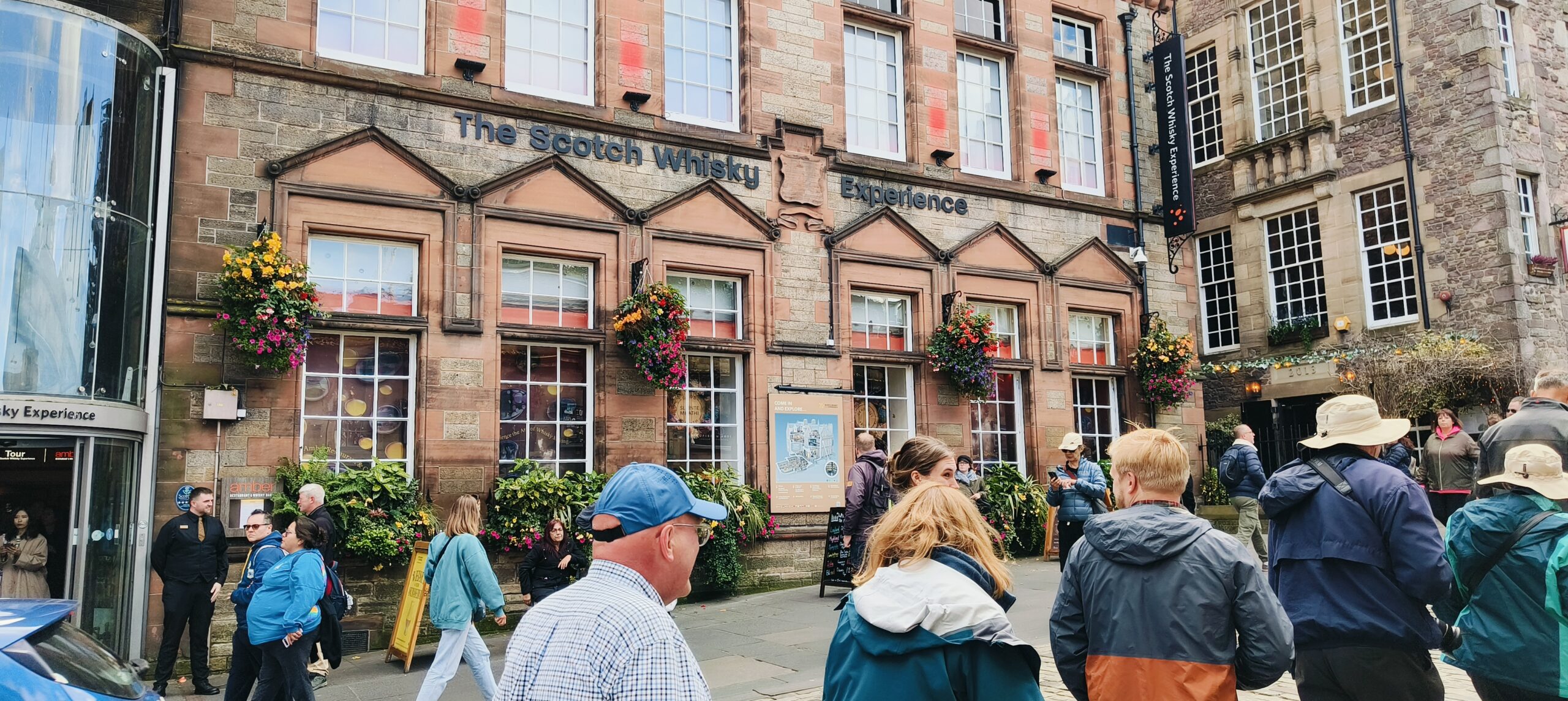
- Scotch Whisky Experience, Royal Mile — A guided immersive experience in the world of Scotch whisky, at the top of the Royal Mile, with a whisky sensory tour, the world’s largest collection of Scotch whisky (3,384 bottles), and a tutored tasting programme that covers the five whisky regions and their distinct characters.
- Scottish Parliament Building, Holyrood — Enric Miralles’s controversial and extraordinary 2004 building at the foot of the Royal Mile — a cascade of leaves, boats, reversed L-shapes, and glass in grey Caithness stone — is worth a visit both for the architecture and for the experience of sitting in the public gallery during debates. Guided tours available; public gallery free.
- Victoria Street to Dean Village Walk — One of Edinburgh’s finest half-day walks: from Victoria Street through the Grassmarket and the Cowgate, along the Water of Leith walkway to the Dean Village — a preserved 17th-century grain-milling village in a gorge below the New Town, entirely invisible from the streets above.
Glasgow: The Real Scotland
- Kelvingrove Art Gallery & Museum — Scotland’s most visited free attraction and one of the finest civic museums in Europe: 22 themed galleries displaying 8,000 objects ranging from Salvador Dalí’s Christ of Saint John of the Cross to a Spitfire hanging from the ceiling. The building alone — red sandstone, Spanish Baroque, beside the Kelvin River — is worth the journey from Edinburgh.
- Glasgow Cathedral & Necropolis — The only medieval cathedral in mainland Scotland to have survived the Reformation intact, in continuous use since the 7th century, with the finest Early Gothic interior in Scotland. The Necropolis — a Victorian garden cemetery on the hill behind — has over 3,500 monuments, and the view from its summit over the cathedral and the city is extraordinary.
- Mackintosh at the Willow, Sauchiehall Street — Charles Rennie Mackintosh’s masterpiece of tearoom design, restored and reopened, with the Room de Luxe — silver and purple, with high-backed chairs and leaded mirrors — as the most recognisable interior in Glasgow. Tea and scones in the Room de Luxe is a proper Glasgow afternoon.
- The Burrell Collection, Pollok Country Park — One of the greatest art collections assembled by a single individual — shipping magnate Sir William Burrell, who left it to Glasgow on condition it be housed outside the city to protect the works from pollution. The collection covers 8,000 objects from ancient Mesopotamia to Degas and Cézanne, in a purpose-built gallery in the ancient woodland of Pollok. Entirely free.
- Riverside Museum & the Tall Ship — Zaha Hadid’s zinc-clad building on the Clyde houses the finest transport museum in Scotland, with the full range of Glasgow’s shipbuilding and engineering heritage, vintage trams and cars, and the restored 1896 sailing ship Glenlee moored outside. Free.
- The Glasgow School of Art (Mackintosh Building) — Currently undergoing long-term restoration after two devastating fires, the building designed by Mackintosh in 1897 remains the defining work of Scottish architectural genius. Access is limited but changing; check current tour availability. The adjacent Reid Building by Steven Holl is worth visiting independently.
- Merchant City & the Lanes — Glasgow’s creative quarter, between the cathedral and the city centre, with independent restaurants, bars, galleries, and the weekend Barras market nearby. The Merchant City Food Festival in autumn and the West End Festival in summer are among the finest urban festivals in Scotland.
- West End & Byres Road — Glasgow’s bohemian neighbourhood: the University of Glasgow’s Gothic towers rising above Kelvingrove Park, Byres Road’s independent cafés, bookshops and food market, and the Botanic Gardens with their Victorian glasshouses. The finest neighbourhood in Glasgow for a slow morning.
- Pollok House, Pollok Country Park — A Georgian manor house in the country park south of the city, housing an outstanding collection of Spanish Old Masters — Goya, El Greco, Murillo — bequeathed by the Maxwell family alongside the Burrell Collection. The walled garden and the Highland cattle in the adjacent fields complete an improbable afternoon in the middle of a major city.
The Highlands: Mountains & Glens
- Glencoe — The most dramatic glen in Scotland: a six-kilometre valley of volcanic rock, waterfalls, and cloud shadow, with the Three Sisters rising on the south side and the Aonach Eagach ridge on the north. The site of the 1692 Massacre of Glencoe — where 38 MacDonalds were killed by Campbell soldiers billeted among them — gives it a historical gravity that the landscape amplifies. Walk the valley floor at any weather; the bleaker, the better.
- Ben Nevis — Britain’s highest mountain at 1,345 metres, with a tourist path (the Mountain Track) from Glen Nevis that takes four to six hours return in good conditions. The summit is clear on perhaps 50 days a year; come prepared, and understand that 1,000 mountain rescue operations have been conducted here. The view when it clears — Ireland, Northern England, and the full Highland panorama — justifies everything.
- Loch Ness & the Great Glen — The longest and deepest loch in Scotland, containing more freshwater than all lakes in England and Wales combined, running through the Great Glen from Inverness to Fort William. The monster has not been found — or conclusively disproved. The drive along the southern shore on the B852 is infinitely more scenic than the main A82.
- Eilean Donan Castle — The most photographed castle in Scotland and one of the most recognisable in the world: a 13th-century fortress on a tidal island at the meeting of three sea lochs in the western Highlands, connected to the shore by an arched bridge. Best seen from the road in early morning or at sunset, when the light on the mountains behind is extraordinary.
- Cairngorms National Park — Britain’s largest national park and its wildest, with Britain’s only arctic-alpine plateau ecosystem, ancient Caledonian pine forests, red squirrels, ospreys, capercaillie, and the highest mountain range in Britain above 1,000 metres. The Park is as large as Luxembourg and the finest area for serious walking and wildlife watching in the UK.
- The Cairngorm Plateau & Loch Avon — The high plateau of the Cairngorms, accessible by mountain railway or on foot from Aviemore, is Britain’s closest equivalent to an Arctic landscape: snowfields in July, dotterel on the plateau, and the hidden Loch Avon in the corrie below — one of the most remote and beautiful lochs in Scotland.
- Inverness & Culloden Battlefield — The Highland capital is the base for exploring the northern Highlands. Eight kilometres east, on Drummossie Moor, the Battle of Culloden (1746) — where the Jacobite rising under Bonnie Prince Charlie was finally crushed in 60 minutes — is commemorated by the National Trust’s exceptional visitor centre. The moor itself, with its grave markers, is one of the most sobering places in Scotland.
- Glen Affric — The most beautiful glen in Scotland, according to many who have walked them all: a deep valley of ancient Caledonian pines, lochs, and river pools west of Inverness, with Scots pine trees that are direct descendants of the original post-glacial forest. The walk from the car park to the loch and back is one of the finest half-days in the Highlands.
- The Commando Memorial & Spean Bridge — A bronze monument on a hilltop at Spean Bridge, with the view of Ben Nevis and the Grey Corries behind, commemorating the 2,500 Allied Commandos trained in the western Highlands during World War II. The setting — mountain, sky, and the bronze figures facing north — is the finest war memorial in Scotland.
The North Coast 500 & Far North
- Drive the North Coast 500 (NC500) — Scotland’s answer to Route 66: a 500-mile circular driving route from Inverness along the west coast, around Cape Wrath and John O’Groats, and back down the east coast. The NC500 passes single-track roads above sea cliffs, deserted white-sand beaches, ancient brochs, Highland villages, and some of the wildest and emptiest landscapes in Europe.
- Bealach na Bà (Pass of the Cattle) — The highest road in mainland Scotland, climbing from Loch Kishorn to the Applecross Peninsula via a series of hairpin bends with a 20% gradient and a summit of 626 metres. The view from the top — Skye, Raasay, the Outer Hebrides, and the Inner Sound — is the finest available from a road in Britain. Drive it from east to west for maximum drama.
- Smoo Cave, Durness — A vast sea cave on the north coast near Durness, carved by the sea and the Allt Smoo river, with a waterfall visible inside the second chamber. The largest sea cave entrance in Britain, accessible on foot from the beach, with boat tours into the inner chambers in summer.
- Cape Wrath — The most northwesterly point of the British mainland, accessible only by ferry and minibus from the Keoldale crossing, with a lighthouse, military firing ranges (open to walkers in season), and cliffs of 230 metres dropping to the sea. The remoteness is the point; this is genuinely the end of the road.
- Duncansby Head & the Stacks — More dramatic than John O’Groats a few kilometres to the west, Duncansby Head’s clifftop walk reveals the Duncansby Stacks — three sea-stack columns of Devonian sandstone rising from the breaking sea at the very corner of the British mainland. The finest coastal walking in the far north.
- Dornoch & the Cathedral — A small, dignified royal burgh on the Dornoch Firth, with Scotland’s most northerly cathedral (1224), golf at Royal Dornoch (consistently ranked among the top five courses in the world), and the atmosphere of a Scottish town entirely unaffected by tourist development. The last witch-burning in Scotland took place here in 1727.
- Sandwood Bay — The most remote and most beautiful beach in mainland Britain: four miles of pink sand backed by dunes and Stac Pollaidh, accessible only by a four-mile walk from the end of a single-track road near Blairmore. No facilities, no crowds, and the Atlantic rollers arriving unbroken from Canada.
The Isle of Skye & the Inner Hebrides
- The Quiraing, Isle of Skye — A landslip on the Trotternish Ridge of northern Skye that created a landscape of pinnacles, cliffs, and plateaux unlike anything else in Britain. The 6.8-kilometre circular walk passes the Needle (a 37-metre rock spire), the Prison (a massive rock block), and the Table (a flat-topped plateau of extraordinary drama). Go in the early morning for the mist.
- Old Man of Storr, Skye — The most recognisable rock formation in Scotland: a 49-metre basalt monolith on the Trotternish Ridge, visible from miles across the Sound of Raasay, reached by a 45-minute climb from the car park below. The surrounding pinnacles of the Storr Forest are equally extraordinary.
- Fairy Pools, Glen Brittle, Skye — A series of crystal-clear mountain pools fed by waterfalls from the Cuillin above, connected by a path along the Allt Coir’ a’ Mhadaidh river. The water is achingly cold; the setting — mountain walls, black rock, and turquoise water — is among the most beautiful in Scotland. Arrive before 9am.
- The Cuillin Ridge, Skye — The finest mountain range in Britain: a 12-kilometre ridge of black gabbro above Glen Brittle, with 12 Munros (peaks above 914 metres) and rock scrambling that is the most technical on the British mainland. The traverse of the entire ridge — two days, with some pitches requiring ropes — is the finest mountaineering objective in Britain outside winter.
- Portree, Skye — The capital of Skye, a coloured-harbour town of extraordinary prettiness on a sheltered bay below the Trotternish hills. The coloured houses on the harbourfront, the evening light on the water, and the quality of the seafood restaurants make it the finest small town on the Scottish islands.
- Talisker Distillery, Carbost, Skye — The island’s oldest distillery (1830), in a corrugated-iron building on Loch Harport below the Cuillin. Talisker’s character — smoky, maritime, with a wave of peppery heat — comes directly from the sea air. Guided tours available; the Talisker 18 is one of Scotland’s finest expressions.
- Kilt Rock & Mealt Falls, Skye — The Kilt Rock viewpoint on the east coast of the Trotternish shows basalt columns arranged in a vertical pattern that resembles a pleated kilt, with the Mealt Falls plunging directly over the cliff edge to the sea below. Best in a westerly wind, when the spray blows back up the cliff face.
- Islay: The Whisky Island — The southernmost of the Inner Hebrides, Islay (pronounced “eye-la”) has nine working distilleries producing the most heavily peated whiskies in Scotland — Ardbeg, Laphroaig, Lagavulin, Bowmore, Bruichladdich, Caol Ila, Kilchoman, Bunnahabhain, and Ardnahoe. A tour of three or four distilleries combined with the island’s wildlife (golden eagles, barnacle geese, seals) and the cross of Kildalton (8th century, the finest Celtic cross in Scotland) makes it one of the finest three-day trips from Glasgow.
- Isle of Mull & Fingal’s Cave (Staffa) — Mull is the most accessible of the larger Hebridean islands, a two-hour ferry from Oban. The boat trip from Mull to the uninhabited island of Staffa passes the puffin colony on Lunga before reaching Fingal’s Cave — a sea cave of hexagonal basalt columns that inspired Mendelssohn’s Hebrides Overture. The acoustic of the sea inside the cave is extraordinary.
- Glencoe Winter: Skiing & Ice Climbing — The Glencoe Mountain ski area, with runs above the glen, is the oldest ski resort in Scotland. In hard winters, the waterfalls freeze on the Three Sisters, and the Rannoch Wall of the Buachaille Etive Mor becomes one of the finest winter climbing venues in Britain.
Orkney & Shetland: The Northern Isles
- Skara Brae, Orkney — A Neolithic settlement preserved under sand for 5,000 years, exposed by a storm in 1850, with stone furniture — beds, dressers, hearths — still in place inside eight linked dwellings. Older than Stonehenge, older than the Egyptian pyramids, and better preserved than almost anything from the same period anywhere in the world. A UNESCO World Heritage Site and the finest prehistoric site in Britain.
- Ring of Brodgar & the Ness of Brodgar — A Neolithic stone circle of 27 surviving stones (originally 60) on a narrow isthmus between two lochs in the heart of Orkney Mainland, part of the Heart of Neolithic Orkney UNESCO World Heritage Site. The Ness of Brodgar, between the Ring and the Standing Stones of Stenness, is the most significant active Neolithic excavation in Europe — a temple complex of unprecedented scale being uncovered every summer.
- Highland Park Distillery, Kirkwall, Orkney — The world’s most northerly Scotch whisky distillery (75 years before Wolfburn opened), in continuous operation since 1798, producing a Viking-influenced heavily peated Highland malt with a distinctive heather-honey sweetness. The Magnus Eunson tour includes seven drams — the finest distillery tour experience on the northern islands.
- Maeshowe & the Viking Graffiti — A 5,000-year-old Neolithic chambered cairn aligned with the midwinter sunset, containing — in its inner chamber — the largest collection of Viking runic inscriptions in the world, left by Norse crusaders sheltering here in the 12th century. The inscriptions include “Crusaders broke into this mound” and multiple references to treasure. Free with admission; book guided entry.
- The Old Man of Hoy, Orkney — A 137-metre sandstone sea stack off the northwest coast of Hoy — Britain’s tallest sea stack — visible from the Stromness-to-Scrabster ferry, where its extraordinary vertical profile against the ocean is one of the most dramatic coastal images in Scotland. A serious rock climb; most visitors see it from the ferry or the cliffs of St John’s Head.
- Lerwick & the Up Helly Aa Festival, Shetland — Shetland’s capital and the last Tuesday in January: Up Helly Aa is Europe’s largest fire festival, a Viking fire celebration in which 1,000 costumed guizers carry flaming torches through Lerwick and burn a replica longship. The event is entirely Shetlandic, entirely extraordinary, and requires planning a year ahead to attend.
- Mousa Broch, Shetland — The best-preserved Iron Age broch (stone tower) in the world, on the uninhabited island of Mousa, reached by small boat from Sandwick. The tower, built around 100 BC, stands to its original height of 13 metres. Summer evening boats go to watch the storm petrels returning to their nests in the broch walls after dark — one of the finest wildlife experiences in Britain.
The Outer Hebrides
- Callanish Standing Stones (Calanais), Lewis — A cruciform arrangement of 50 standing stones on the western shore of Lewis, erected around 2900 BC — predating Stonehenge and Avebury — in a landscape of peat bog and Atlantic sky. The newly upgraded visitor centre (2026) provides the finest interpretation of any Scottish prehistoric site. At the spring and autumn equinoxes, the moon rises directly through the main avenue.
- Harris Tweed Weaving, Isle of Harris — Harris Tweed — the only fabric in the world with its own Act of Parliament — is still woven by hand on pedal looms in the cottages of Lewis and Harris. Visit an active weaver in their home workshop to see the cloth being made, and buy direct. The cloth produced here has been worn by Hollywood stars, royal families, and every serious jacket wardrobe in the world.
- Luskentyre Beach, Harris — Consistently voted one of the finest beaches in the world: a vast arc of white sand and turquoise water on the southwest shore of Harris, with the mountains of North Harris rising behind and the island of Taransay offshore. In the right light, it is indistinguishable from a Caribbean beach, except for the temperature and the Atlantic wind.
- Butt of Lewis Lighthouse & the Atlantic Edge — The northernmost point of the Outer Hebrides: a Victorian lighthouse on a headland of black gneiss where the Atlantic crashes in from Iceland with nothing between. The birdlife — gannets, fulmars, skuas — and the sense of elemental exposure are immense. One of the great edge-of-the-world viewpoints in Britain.
Whisky: Scotland’s Liquid Landscape
- Speyside Whisky Trail: Glenfiddich, Macallan & the Malt Whisky Trail — The valley of the River Spey in Moray contains more malt whisky distilleries per mile than anywhere on earth. The Malt Whisky Trail connects eight distilleries — Glenfiddich, The Macallan, Strathisla, Glen Grant, Glenlivet, and others — in a single well-signposted route. Glenfiddich in Dufftown (the world’s best-selling single malt) offers the finest visitor experience; The Macallan’s new £140m visitor centre is architecturally extraordinary.
- Tasting Islay Whiskies on the Island — Drinking Ardbeg’s Ten Year Old, Lagavulin 16, and Laphroaig Quarter Cask on the island that made them — ideally in the distillery’s own tasting room or in a pub in Bowmore — produces a completely different understanding of peated whisky than the same drams drunk anywhere else. The terroir argument for whisky is never more convincing than on Islay.
- Distillery Dinner at Balmacaan or Glenmorangie House — Several Scottish distilleries now offer accommodation and multi-course dinners pairing their whiskies with local ingredients. Glenmorangie House in the Highlands and the Craigellachie Hotel in Speyside offer the most complete whisky-and-food immersion experiences in Scotland.
- Single Cask Tasting at an Independent Bottler — Scotland’s independent bottlers — Gordon & MacPhail, Signatory, Berry Bros & Rudd, Douglas Laing — select and bottle single casks from distilleries across the country, often producing expressions unavailable from the distillery directly. A tasting at Gordon & MacPhail’s Elgin shop is a masterclass in what Scotch can be.
- The Scotch Whisky Auction, Edinburgh — The rare whisky market has made bottles from closed distilleries — Port Ellen, Brora, Rosebank — into objects of extraordinary value. Scotch Whisky Auctions in Edinburgh and online regularly achieve five-figure sums for single bottles. The catalogue is a piece of Scottish industrial archaeology.
Castles, History & Heritage
- Stirling Castle — Scotland’s most strategically important castle — the gateway between the Highlands and the Lowlands — with the finest Renaissance palace in Scotland built by James V, the painted ceiling of the King’s Presence Chamber, and a view of the Wallace Monument and the Ochil Hills. The castle overlooks the site of Bannockburn (1314), where Robert the Bruce defeated Edward II of England.
- Bannockburn Heritage Centre & Battlefield — The site of Scotland’s most significant military victory, where Robert the Bruce’s army defeated an English force three times its size in 1314, securing Scottish independence for the next three centuries. The NTS visitor centre has an excellent interactive battle simulation; the field itself is unremarkable but powerfully charged with national meaning.
- Rosslyn Chapel, Midlothian — The 15th-century chapel near Edinburgh, famous for its extraordinary carved stone — the Apprentice Pillar, the green men, the corn motifs — and its association with the Knights Templar and the Holy Grail (as popularised by The Da Vinci Code). The carving is genuinely exceptional regardless of the theories. Fifteen minutes from Edinburgh by bus.
- Dunnottar Castle, Stonehaven — A ruined cliff-top castle on a promontory above the North Sea, separated from the mainland by a deep ravine, where the Scottish Crown Jewels were hidden from Cromwell’s army in 1652 and smuggled out by a local woman in her laundry basket. The approach along the cliff path from Stonehaven is one of the most dramatic in Scotland.
- Glamis Castle, Angus — The most complete and inhabited castle in Scotland: still the seat of the Earls of Strathmore, birthplace of Princess Margaret (the Queen’s sister), and childhood home of the Queen Mother. The Pink Tower, the Italian Garden, and the ghost of the Monster of Glamis make it among the most atmospheric great houses in Britain. Guided tours include rooms not open on self-guided visits.
- Doune Castle, Perthshire — A 14th-century castle used as a film and television location for Monty Python and the Holy Grail, Game of Thrones, and Outlander. Beyond the popular culture associations, it is one of the finest and best-preserved medieval tower houses in Scotland, with the original Great Hall roof intact.
Landscapes, Wildlife & the Outdoors
- The West Highland Way — Scotland’s most famous long-distance walking route: 96 miles from Milngavie (north of Glasgow) to Fort William, through Loch Lomond, Rannoch Moor, and Glencoe. Completed in five to eight days, it is the finest introduction to the diversity of the Scottish landscape available in a single continuous walk.
- Rannoch Moor — The largest expanse of blanket bog in Britain: 50 square miles of desolate, beautiful, treeless moorland in the heart of the southern Highlands, crossed by the West Highland Railway and the A82. The view from the train crossing Rannoch Station — with nothing visible in any direction but bog, lochs, and sky — is one of the great railway views in Europe.
- Loch Lomond & the Trossachs National Park — Scotland’s first national park, containing Britain’s largest expanse of freshwater (Loch Lomond), the Trossachs hills, and the Rob Roy country of Aberfoyle and Balquhidder. The eastern shore road of Loch Lomond is crowded; the west shore is quiet and beautiful. Ben Lomond (974m), a straightforward Munro, is Scotland’s most southerly and most climbed.
- Osprey Watching at Loch of the Lowes, Dunkeld — One of Scotland’s most accessible wildlife watching experiences: ospreys nesting at the Scottish Wildlife Trust reserve at Loch of the Lowes, with nest cameras, telescopes, and a visitor centre. The birds return from West Africa each April; the first fishing flight of the season draws crowds. Other excellent osprey sites are at the Cairngorm Ospreys reserve at Loch Garten.
- Red Squirrel Trail, Formartine & Buchan — Scotland has 75% of Britain’s red squirrel population, and the native pine forests of Speyside, Deeside, and Perthshire are the finest places to see them. The Galloway Forest Park in the southwest and the Landmark Forest in Carrbridge both offer reliable sightings.
- Sea Eagle Watching, Mull — The white-tailed eagle — Europe’s largest bird of prey, with a wingspan of 2.4 metres — was reintroduced to Scotland and is now most reliably seen on Mull and the western islands. Guided sea eagle boat tours from Tobermory on Mull offer some of the finest raptor encounters in Britain.
- Whale Watching, Mull & the Hebrides — Minke whales, humpbacks, and occasionally blue whales are regularly sighted in the Hebridean waters between Mull and the Outer Hebrides. Basking sharks — the world’s second-largest fish — are common in these waters from May to September. Multiple operators in Tobermory and Oban run specialist wildlife cruises.
Food, Drink & Scottish Culture
- Haggis, Neeps & Tatties on Burns Night — Scotland’s national dish — sheep’s offal with oatmeal, onion, and spices, cooked in a stomach and served with mashed turnip and potato — is magnificent when properly made and nothing like its reputation. Burns Night (25 January) celebrates Robert Burns with haggis, whisky, poetry, and the Address to a Haggis in every home and restaurant in the country.
- Cullen Skink at a Harbour Café, Cullen — The smoked haddock and potato soup originating in the Moray Firth town of Cullen is the finest bowl of soup in Scotland and a first-class argument for the existence of Scottish cuisine. The original recipe — cream, smoked haddock, potato, onion — should be eaten beside a harbour with the smell of the sea.
- Scottish Langoustines at a West Coast Restaurant — The Norway lobster (langoustine) fished from the west coast sea lochs is among the finest crustacean in the world and is almost entirely exported to France and Spain. Eating them freshly boiled with mayonnaise at a quayside restaurant in Tarbert, Oban, or Portree — paying a fraction of what they cost in Paris — is one of the great pleasures of Scotland.
- Arbroath Smokies at the Market, Arbroath — The Arbroath Smokie — a hot-smoked haddock with EU protected status — is produced only in Arbroath, on the Angus coast. Bought directly from a smokehouse at the market, eaten warm from the paper, it is the finest smoked fish in Scotland.
- Breakfast at a Scottish B&B — The full Scottish breakfast — fried egg, back bacon, Lorne sausage (square sausage), black pudding, white pudding, potato scone, grilled tomato, and toast with thick-cut marmalade — is the finest breakfast in Britain and the best preparation for a day on a Scottish hill.
- Highland Games: Tossing the Caber — Highland Games take place across Scotland from May to September — at Braemar (where the King attends), Cowal, and dozens of village venues. Watching the caber toss (a 19-foot pine trunk flipped end over end), the hammer throw, the tug of war, the Highland dancing, and the pipe bands in a field somewhere in the Highlands is one of the most genuinely Scottish experiences available.
- Traditional Music Session at a Scottish Pub — In the right pub — the Sandy Bell’s in Edinburgh, the Seafield Inn in Cullen, the Ardsheal House in Glencoe, or any pub in Skye — a traditional music session simply begins. Fiddles, whistles, accordions, bodhráns, and occasionally an uilleann pipe. No announcement, no stage, no ticket. The best way to end an evening in Scotland.
Hidden Gems & Unexpected Scotland
- The Kelpies, Falkirk — Two 30-metre steel horse-head sculptures by Andy Scott beside the Forth & Clyde Canal — the largest equine sculptures in the world, representing the heavy horses of Scotland’s industrial heritage. Free to walk around; dramatically lit at night and one of Scotland’s finest pieces of public art.
- Galloway Forest Park & the Dark Sky Park — The largest forest park in Britain, in the southwest corner of Scotland, and one of the first Dark Sky Parks in Europe. The night sky here — away from any major light source — is among the darkest in the UK, with the Milky Way visible to the naked eye on clear nights. The Dark Sky Observatory at Clatteringshaws opened in 2026.
- The Secret Bunker, Fife — A classified Cold War bunker under a Fife farmhouse, now open as a museum, where 300 government and military personnel would have controlled what remained of Scotland after a nuclear strike. The 100-foot descent into the bunker, the preserved operations rooms, and the matter-of-fact horror of the exhibits make it one of the most sobering museums in Scotland.
- Pittenweem & the East Neuk of Fife — The string of fishing villages on the southern coast of Fife — Crail, Anstruther, Pittenweem, St Monans, Elie — constitute the finest concentration of traditional Scottish coastal architecture in the country. Eat the fish and chips at the Anstruther Fish Bar (voted best in Britain multiple times) and walk the coastal path between the villages.
- Glen Etive & the Road to Nowhere — The single-track road down Glen Etive from the A82 at the top of Glencoe, running 14 miles to the head of Loch Etive through one of the emptiest and most beautiful glens in Scotland. James Bond drove it in Skyfall. It ends at a small jetty where there is nothing but mountain, loch, and sky.
- Shetland Ponies on Shetland — The Shetland pony — bred for its extreme hardiness in the roughest Atlantic climate in Britain, small enough to pass through mine shafts but immensely strong — is native to the islands and seen throughout them in the crofting landscape. Petting one in a field beside a dry-stone wall on a windswept Shetland hillside is one of Britain’s most cheerful wildlife encounters.
- The Falconry Centre, Drummond Castle or Kinnaird — Scotland has a long tradition of falconry — the Highlands were once patrolled by peregrine falcons kept by clan chiefs. Several centres — at Drummond Castle in Perthshire and Kinnaird Estate in Angus — offer tutored falconry experiences with golden eagles, Harris hawks, and peregrine falcons.
- Reindeer in the Cairngorms — Britain’s only free-ranging reindeer herd lives in the Cairngorm Mountains above Aviemore, introduced from Scandinavia in 1952. The daily hill trip to visit the herd — offered by the Cairngorm Reindeer Centre — is the most unusual and most consistently joyful wildlife encounter in Scotland.
- Riding the West Highland Railway: Fort William to Mallaig — The Jacobite Steam Train runs the West Highland Line from Fort William to Mallaig via the Glenfinnan Viaduct (the Harry Potter viaduct) in a journey of 41 miles through Loch Shiel, the Rough Bounds of Knoydart, and the western seaboard. The finest scenic railway journey in Britain, best done on a clear day in summer.
- Glenfinnan Viaduct at Dawn — The 21-arch curved viaduct over the Finnan valley, built in 1901 and seen by hundreds of millions as the backdrop to the Hogwarts Express, is best experienced at dawn or dusk when the steam train is not running and you have the curved structure in the morning mist entirely to yourself.
- Swimming in a Highland Loch — Wild swimming in Scotland is cold, perfectly clear, and entirely transformative: the dark water of a Highland loch on a summer morning, with no one within sight, a mountain reflected in the surface, and the cold going from shock to exhilaration in the space of 30 seconds. Loch Morlich at Aviemore, Loch Tummel in Perthshire, and any of the Cairngorm lochs are the finest.
- Watch the Aurora Borealis from the Scottish Highlands or Islands — Scotland is at one of the most southerly latitudes at which the northern lights are regularly visible. The darkest and clearest nights from October to March, in the far north — on Lewis, in Caithness, on the Orkney or Shetland shores — bring the Aurora with a frequency that no other UK location matches. Stand on a beach on the north coast of Scotland, watching the green curtains move across the sky above the black water, and understand that Scotland has always been, in the end, about the sky and the sea and the immense, indifferent, extraordinary beauty of the natural world beyond the roads.
Quick Facts for Visitors
| Best time to visit | May–September (long days, warmest weather, events season) |
| Winter | October–March — Aurora, Christmas markets, empty landscapes; prepare for weather |
| Currency | British Pound Sterling (£) |
| Language | English · Scottish Gaelic (spoken in the Western Isles) |
| Getting around | Car hire essential for the Highlands and Islands · Trains between cities · CalMac ferries to the islands |
| Capital | Edinburgh |
| Ideal trip length | 5–7 days for Edinburgh and the Highlands · 10–14 days to include the islands |
| Munros | 282 mountains above 914 metres — baggers collect them obsessively |
| Midges | Tiny biting flies, peak June–August in the west; bring repellent or accept them |
Scotland does not require good weather to be magnificent. The mist on the Cuillin, the sleet across Rannoch Moor, the sea spray on the Duncansby cliffs — the country is at its most itself in the kind of conditions that drive visitors back to their cars. Stay out in it. Scotland rewards those who do.