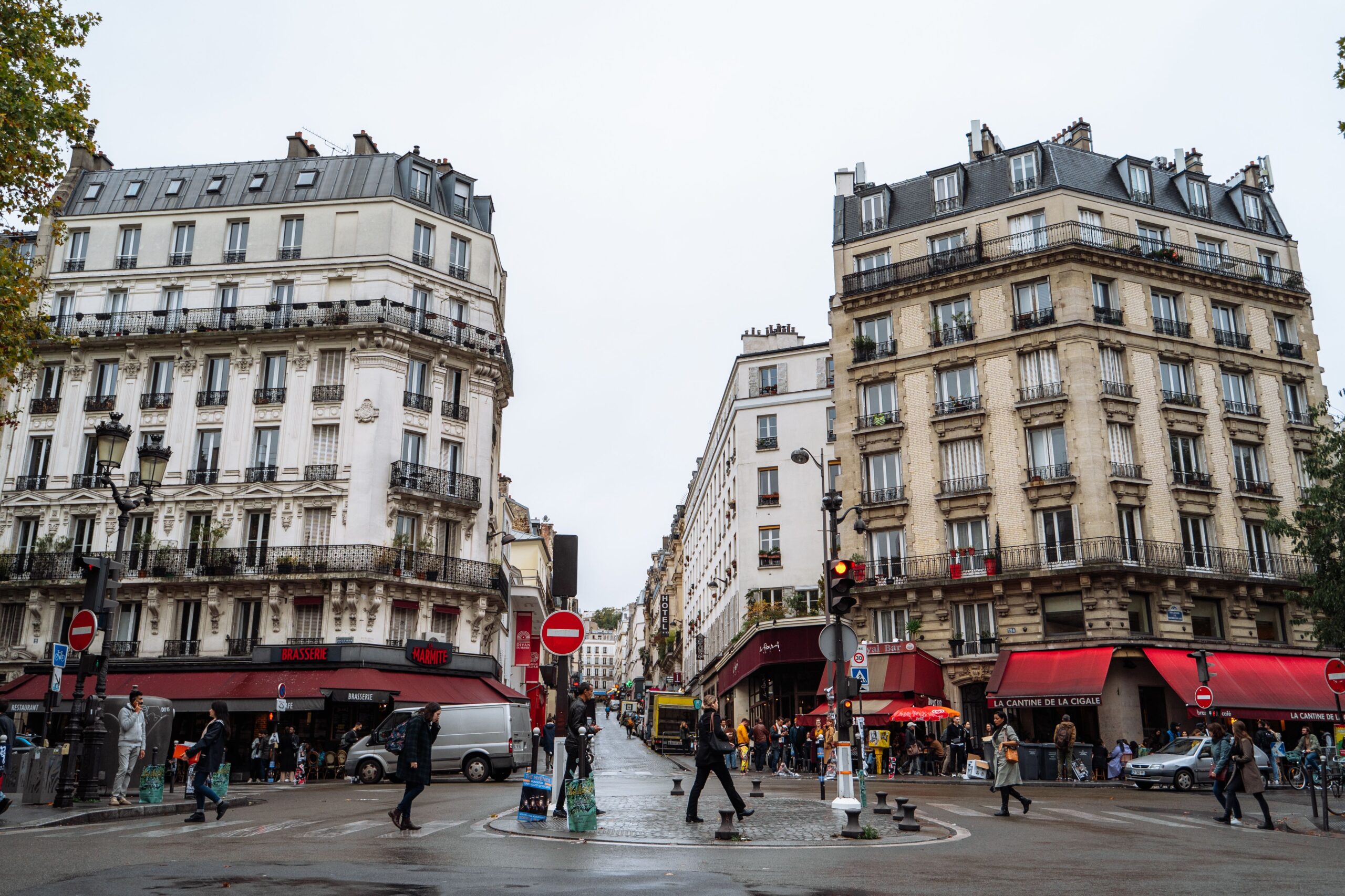
There is a word in French — dépaysement — that means the feeling of being in a foreign place, of being refreshed and disoriented simultaneously by the unfamiliar. Paris is the only city in the world that produces its opposite: the feeling, however many times you return, that you are coming home. The Seine, the rooftops, the smell of a boulangerie at seven in the morning, the specific quality of Haussmannian light in September — Paris imposes itself on your nervous system and stays there.
It is also, of course, one of the most visited cities on earth, which means it requires a particular kind of attention to experience properly. The tourist Paris — the Eiffel Tower, the Louvre, the Champs-Élysées — is real and worth your time. But the Paris that stays with you is found elsewhere: in the covered passages of the 2nd arrondissement, in a zinc bar on the Rue de Lappe, in the Parc des Buttes-Chaumont at golden hour, in the canal at Canal Saint-Martin on a Sunday afternoon when the city slows to something almost human.
This guide covers both Parises — all 101 of them.
The Iconic City: What You Come For First
- Notre-Dame de Paris — After five years of extraordinary restoration following the devastating fire of April 2019, the cathedral reopened in December 2024, more magnificent than many Parisians had ever seen it. The nave, rebuilt in pale limestone of a freshness that makes the medieval Gothic feel startlingly new, the rose windows, and the vaulted choir produce an experience more moving — precisely because of what was nearly lost — than anything the cathedral offered before the fire. Entry is free; timed reservations are available online and strongly recommended.
- Eiffel Tower — The most recognised structure in the world: Gustave Eiffel’s 330-metre iron lattice tower, built as a temporary exhibition structure in 1889 and now the symbol of an entire city. The first platform (57 metres) gives the finest perspective of Paris’s urban geometry; the summit (276 metres) gives the horizon. At night, when it illuminates in gold and the twinkling light show runs on the hour, it is exactly as romantic as every photograph suggests. Book timed-entry tickets months in advance; queues without them exceed 90 minutes.
- The Louvre — The world’s most visited museum and the world’s largest: 35,000 works across 400 rooms of a former royal palace. The Mona Lisa, the Venus de Milo, the Winged Victory of Samothrace, the Egyptian antiquities, the Dutch and Flemish masters, the Grande Galerie of Italian painting — an inexhaustible collection that rewards a lifetime of visits. Come for the Italian paintings and leave the Mona Lisa until last; the surrounding works are more rewarding and less crowded. Book tickets and a specific entry time online.
- Musée d’Orsay — The world’s finest collection of Impressionist and Post-Impressionist art, housed in a converted Beaux-Arts railway station on the Left Bank. Monet, Renoir, Degas, Cézanne, Gauguin, Seurat, Van Gogh, Toulouse-Lautrec — the full story of the most influential artistic revolution in Western history, in rooms of extraordinary natural light. The clock room on the upper level, with its view through the clock face over the Seine, is one of the finest interior views in Paris.
- Sacré-Cœur & Montmartre — The white-domed basilica of Sacré-Cœur crowns the Butte Montmartre, the highest point in Paris, with a panoramic view of the city spreading south. Arrive at dawn to have it almost to yourself. Then descend into the backstreets of the old village: the Place du Tertre (touristy, but irreducible), the vineyard, the Musée de Montmartre, and the quieter streets to the north — Rue Lepic, Avenue Junot — where the residential Montmartre of Amélie Poulain still survives.
- Arc de Triomphe & the Champs-Élysées — Napoleon’s triumphal arch at the centre of the Place Charles de Gaulle, with 12 avenues radiating from its base, is best experienced from the top (reached by a free staircase, no lift) for the extraordinary Haussmannian geometry of the avenues spreading to every horizon. The Champs-Élysées itself is more monument than shopping street now; walk it once, at dusk, and find somewhere more interesting for dinner.
- Versailles — The Palace & Gardens — The most ambitious royal project in European history: Louis XIV’s palace at Versailles, 30 minutes by RER from Paris, with the Hall of Mirrors, the Royal Apartments, and 800 hectares of formal gardens. The gardens are free on most days; the palace is not. Come on a weekday morning in autumn when the queues are shortest and the light on the golden gates is best. The Grandes Eaux Musicales (fountains set to Baroque music) on weekend afternoons in summer are worth planning around.
- Sainte-Chapelle — The most perfect Gothic interior in France: a 13th-century royal chapel on the Île de la Cité, its upper chapel almost entirely composed of 1,113 stained-glass windows depicting 1,800 scenes from the Old and New Testaments. On a sunny morning, the light through the windows — blue, crimson, gold — transforms the interior into a jewel box. Arrive at opening to have it almost to yourself. Twenty minutes from Notre-Dame; book online.
- Centre Pompidou — Renzo Piano and Richard Rogers’s inside-out building on the Plateau Beaubourg — its mechanical and structural systems expressed on the exterior in coloured ducts and escalators — still shocks, still works, still feels like a provocation after nearly 50 years. The Musée National d’Art Moderne inside is the finest collection of 20th-century art in Europe: Matisse, Braque, Léger, Kandinsky, Duchamp, Picasso, Bourgeois, Koons. The rooftop view over the city is free with museum admission.
- Père Lachaise Cemetery — The most famous cemetery in the world: 43,000 graves spread across 44 wooded hectares in the 20th arrondissement, containing the remains of Oscar Wilde, Jim Morrison, Edith Piaf, Frédéric Chopin, Honoré de Balzac, Marcel Proust, Gertrude Stein, and hundreds of other cultural figures. The tombs range from modest marble slabs to elaborate neo-Gothic monuments; the chestnut-lined paths are beautiful year-round. Free; a map at the entrance is essential.
The Left Bank & the Latin Quarter
- Luxembourg Gardens (Jardin du Luxembourg) — The finest public garden in Paris: 23 hectares of gravel paths, ornamental lawns, the central octagonal pond with its model sailboats, the Medici Fountain, the beehives, the orchards, and the afternoon light through the chestnut trees that Hemingway, Sartre, and half the writers of the 20th century found conducive to work. Come with a book and a sandwich and give it the afternoon it deserves.
- Musée Rodin — The former studio and residence of Auguste Rodin, in a Rococo mansion and garden in the 7th arrondissement: The Thinker and The Gates of Hell in the garden, the marble The Kiss inside, and the full range of Rodin’s working methods in the studio rooms. The garden with a café in the rose pergola, on a spring afternoon, is one of the most civilised hours Paris offers.
- Musée de Cluny (National Museum of the Middle Ages) — The finest collection of medieval art in France, in a 15th-century abbey built over the Roman baths of the 2nd century (still visible in the basement): the extraordinary Lady and the Unicorn tapestries (six panels, late 15th century, of breathtaking delicacy), the Golden Rose, and the medieval jewellery and decorative arts collection. One of the most quietly extraordinary museums in Paris, in a building of extraordinary historical depth.
- Shakespeare and Company Bookshop — The most famous bookshop in the world, on the Left Bank opposite Notre-Dame, founded in its current incarnation in 1951 by George Whitman in the spirit of Sylvia Beach’s original. Poets, novelists, and travellers have slept in the back rooms for seven decades in exchange for working a shift. The shelves are arranged in no particular order; finding a book here is an act of discovery. The café next door is excellent.
- Rue Mouffetard & the Latin Quarter — The oldest market street in Paris: a steep, narrow lane in the 5th arrondissement descending from the Contrescarpe square to the church of Saint-Médard, lined with produce merchants, cheese shops, oyster stalls, and boulangeries. The Saturday morning market here is the finest small food market on the Left Bank and the best introduction to the daily rhythm of French domestic life.
- Panthéon — The neoclassical mausoleum on the Left Bank containing the remains of France’s greatest citizens: Voltaire and Rousseau (buried within metres of each other despite spending their lives in mutual contempt), Victor Hugo, Émile Zola, Marie Curie, and most recently, in the crypt — the French Resistance hero Missak Manouchian and his wife. The Foucault Pendulum, still swinging in the central nave, demonstrates the rotation of the earth.
- Institut du Monde Arabe Rooftop — Jean Nouvel’s 1987 building on the Seine — its south facade a grid of mechanical apertures modelled on Arabic geometric screens — has a rooftop terrace café with one of the finest and least-known views of central Paris: Notre-Dame, the Île de la Cité, and the Seine spread below. Free to access the terrace; the collection inside is excellent.
- Musée Picasso, Le Marais — The finest collection of Picasso’s personal work — the paintings he kept rather than sold — in a 17th-century mansion in the Marais, donated by his estate in lieu of inheritance taxes. The blue period, the pink period, the Cubist years, the Surrealist decade — a complete arc of one of the most fertile creative lives of the 20th century.
Le Marais: The Historic Heart
- Place des Vosges — The oldest planned square in Paris, built for Henri IV in 1612: 36 identical redbrick pavilions with arcaded ground floors enclosing a formal garden of gravel paths, fountains, and linden trees. Victor Hugo lived at No. 6 for 16 years (now a free museum). The arcades on a rainy afternoon contain some of the best galleries and restaurants in the Marais. Entirely free; entirely beautiful.
- Le Marais Walking Tour — The most historically layered neighbourhood in Paris: the Jewish Quarter (Rue des Rosiers, with the Jo Goldenberg deli and the Mémorial de la Shoah), the medieval lanes preserved by their centuries of use as a commercial district, the Place des Vosges, and the now-fashionable streets of vintage boutiques, concept stores, and natural wine bars. The Marais rewards walking without a map.
- Mémorial de la Shoah — The main Holocaust memorial and museum in France, in the heart of the Jewish Quarter on Rue Geoffroy l’Asnier, with the Wall of Names listing the 76,000 Jews deported from France, the underground crypt containing soil from concentration camps, and a documentary exhibition on the history of Jews in France and the Vichy government’s role in deportation. Free; profoundly important.
- Musée Carnavalet — History of Paris — Two 16th-century mansions in the Marais, recently renovated, tracing the complete history of Paris from prehistoric times to the 21st century: the room from Proust’s cork-lined bedroom, the desk of Voltaire, revolutionary-era paintings, and Belle Époque photographs. Free; among the finest city history museums in Europe.
- Centre Pompidou Piazza — The public plaza in front of the Centre Pompidou is a free performance space year-round: street musicians, living statues, skateboarders, portrait artists, and the city’s most democratic outdoor stage. The view of the inside-out building from the plaza — with the escalator tubes rising in glass above — is one of the most radical architectural encounters available in Paris.
Montmartre: The Village Above the City
- Rue Lepic & the Backstreets of Montmartre — The market street that descends the Butte from the Moulin de la Galette to Blanche, with a Saturday morning produce market, the original café of Amélie Poulain (now a café called Les Deux Moulins), and the residential streets that are entirely the domain of the Montmartrois neighbourhood. Picasso, Toulouse-Lautrec, Matisse, and Renoir all worked within 500 metres of this street.
- Musée de Montmartre — The studio building on Rue Cortot where Renoir, Utrillo, and Suzanne Valadon all worked, now housing a museum of Montmartre’s artistic history with views over the vineyard and the Sacré-Cœur. The garden, the café, and the collection of Toulouse-Lautrec posters make it the finest small museum in the 18th arrondissement.
- Moulin Rouge — The original cabaret on the Boulevard de Clichy, opened in 1889 and made famous by Toulouse-Lautrec’s posters and the invention of the modern cancan. The evening shows (dinner or show only) are expensive and theatrical in equal measure; the exterior and the history are entirely free. The neighbourhood of Pigalle around it — once seedy, now one of the most interesting food and bar districts in Paris — has transformed completely in the past decade.
- Villa Léandre, Montmartre — A cobblestoned cul-de-sac off Avenue Junot, hidden in the residential quiet of the Butte: a row of private Art Deco houses with small front gardens, entirely silent, entirely beautiful, ten minutes from Sacré-Cœur and entirely unknown to most visitors. One of Paris’s finest hidden streets.
- Au Lapin Agile — The oldest surviving cabaret in Paris, in a small pink building on Rue des Saules at the northern edge of Montmartre’s vineyard, where Picasso, Apollinaire, and Modigliani performed and drank in the first decade of the 20th century. Evening shows of French song and poetry continue in the original room; the atmosphere is entirely unlike the tourist cabarets of Pigalle.
The Seine, the Islands & the Riverbanks
- Île Saint-Louis — The smaller of the two Seine islands: a single residential street (Rue Saint-Louis en l’Île) of 17th-century mansions, with a church, a handful of restaurants, three ice cream shops (Berthillon — the finest glace in Paris — has its original shop here), and the specific atmosphere of an island that has resisted all commercial pressure for 400 years. Walk it on a Sunday morning before the cafés open.
- Seine Riverbank Walk: Notre-Dame to the Eiffel Tower — The Left Bank’s riverside promenades — the Quai Saint-Michel, the Quai de Montebello, the Quai d’Orsay — and the UNESCO-listed bouquinistes (second-hand book stalls on the parapets) make the 4-kilometre walk from Notre-Dame to the Trocadéro the finest free walk in Paris. Do it at dusk; then cross to the right bank and walk back.
- Bateaux-Mouches Night Cruise — The glass-topped river boats that ply the Seine between the Alma bridge and the Île Saint-Louis illuminate the riverbanks with searchlights as the city glows from within. Kitsch, yes. Entirely worth it, also yes. The illuminated facades of the Musée d’Orsay, the bridges, Notre-Dame, and the Eiffel Tower from the water at night are sights that no other transport mode provides.
- Pont des Arts & the Seine Bridges — The footbridge between the Louvre and the Institut de France is the finest place in Paris to be at golden hour: the light on the water, the Île de la Cité visible east, the dome of the Institut west, and the Seine flowing under seven bridges simultaneously visible from the parapet. The padlocks were removed in 2015; the bridge is simply beautiful now.
- Promenade Plantée (Coulée Verte) — The world’s first elevated park, built on a disused 19th-century railway viaduct above the Rue de Lyon in the 12th arrondissement: 4.5 kilometres of garden walkway passing over rooftops, through parks, and above the streets of Paris. Opened in 1993, it inspired New York’s High Line. The Viaduc des Arts beneath it houses design studios and craft workshops.
Neighbourhood Paris: Beyond the Monuments
- Canal Saint-Martin, 10th Arrondissement — The 4.5-kilometre canal connecting the Canal de l’Ourcq to the Seine through the eastern arrondissements: iron footbridges, lock gates, tree-lined towpaths, and a neighbourhood of independent cafés, natural wine bars, vintage shops, and the most convincingly local atmosphere available to visitors in Paris. Sunday afternoons, when the canal-side is lined with Parisians picnicking, are the best time.
- Belleville & Ménilmontant — The neighbourhood that contains Paris’s best view of the Eiffel Tower (from the Parc de Belleville, surrounded by local families rather than tourists), the finest concentration of studio-gallery spaces in the city, and a food culture — Chinese, North African, Vietnamese — that reflects the most genuinely cosmopolitan part of Paris. The Belleville Brûlerie roasts what many consider the finest coffee in the city.
- Butte-aux-Cailles, 13th Arrondissement — A working-class village neighbourhood that survived Haussmann’s demolitions, with narrow lanes of 19th-century houses, a permanent street art culture, a community swimming pool (Piscine de la Butte-aux-Cailles, opened 1924, still in operation), and a concentration of small restaurants and bars that serve the neighbourhood rather than tourists.
- Oberkampf & Bastille — The neighbourhood between République and Bastille in the 11th: the finest concentration of neo-bistros, natural wine caves, and independent restaurants in Paris. The Rue Oberkampf and the Rue de la Roquette are the spines; the lunch and dinner culture here is more genuine and more interesting than anything on the tourist circuit.
- Pigalle & South Pigalle (SoPi) — The former red-light district between Montmartre and the Grands Boulevards has become the finest food and bar neighbourhood in Paris north of the Seine: wine bars of exceptional quality (Le Syndicat, La Fourmi), restaurants by young chefs, and the extraordinary Marché Saint-Pierre (the finest fabric and haberdashery market in Paris) at its base.
- Parc des Buttes-Chaumont, 19th Arrondissement — The most dramatic park in Paris: a former gypsum quarry transformed by Baron Haussmann in 1867 into a landscape of cliffs, a lake, a suspension bridge, and the Temple de la Sibylle on an island 30 metres above the water, with one of the finest views of Montmartre and the northern city available from any point in the capital. The most local large park in Paris.
- Batignolles & Monceau, 17th Arrondissement — The village-within-the-city northwest of the Gare Saint-Lazare: Parc Monceau (with its colonnaded ruins, its lake, and its extraordinary collection of mature plane trees), the Batignolles Saturday organic market (the finest farmers’ market in Paris), and a neighbourhood of residential calm that feels deliberately removed from tourist Paris.
The Covered Passages: 19th-Century Paris Preserved
- Galerie Vivienne — The most beautiful of the surviving covered passages: a Neoclassical arcade of mosaic floors, painted ceilings, and elegant shopfronts between the Rue Vivienne and the Rue des Petits-Champs. The wine merchant Legrand Filles et Fils (established 1905) and the bookshop Librairie Jousseaume are the finest stops. In the afternoon, when the light falls through the glass roof, it looks exactly as it did in 1826.
- Passage des Panoramas — The oldest surviving covered passage in Paris (1800), in the 2nd arrondissement: the most wonderfully eccentric of all the passages, with a vintage stamps and coins dealer, old theatrical memorabilia shops, and restaurants serving the kind of lunchtime steak-frites that have been served in these arcades since the July Monarchy. The most authentic and the least restored.
- Galerie Véro-Dodat — The finest and the darkest of the passages: a Romantic arcade of mahogany columns, painted ceiling panels, and black-and-white tiled floors, established in 1826 for the wholesale lace trade and now housing antique dealers, a doll restoration workshop, and a silence that feels completely separate from the streets outside.
- Passage Jouffroy & Passage Verdeau — Two connected passages behind the Musée Grévin wax museum: Jouffroy with its toy shops, Indian art dealer, and the Hôtel Chopin (the finest period accommodation in the passages); Verdeau with its antique books, vintage photography, and old illustrated magazines. The passage network in the 2nd arrondissement is the finest concentrated heritage walk in Paris.
Art Museums: Paris’s Extraordinary Depth
- Musée de l’Orangerie — Two oval rooms in the Tuileries, designed by Monet himself, housing the Nymphéas (Water Lilies) cycle: eight enormous canvases wrapping the walls of the two oval rooms in a continuous panorama of water, light, and reflection. The most immersive encounter with a single artist’s vision available in Paris. Below ground: a superb collection of Cézanne, Renoir, Matisse, and Picasso from the Walter-Guillaume collection.
- Fondation Louis Vuitton — Frank Gehry’s glass-and-steel sail structure in the Bois de Boulogne, opened in 2014: the finest purpose-built contemporary art museum in Paris, with a collection of major international works and a programme of temporary exhibitions that consistently rivals the largest institutions. The building, with its 12 glass “sails,” is as remarkable as the art inside.
- Musée Marmottan Monet — The largest Monet collection in the world, in a private hunting lodge in the Bois de Boulogne: Impression, Sunrise (the painting that gave Impressionism its name), 300 Monet canvases, and the most intimate and least-crowded experience of the artist available anywhere. Come on a weekday afternoon.
- Palais de Tokyo — Paris’s principal venue for contemporary and cutting-edge visual art: a vast Brutalist space on the Trocadéro, open until midnight on weekdays, with the most adventurous temporary exhibitions programme in the city. Open until midnight Thursdays; the late-evening crowd is among the most interesting in Paris.
- 59 Rivoli Artist Collective — A six-storey Haussmannian building on the Rue de Rivoli opposite the Louvre, squatted in the 1990s and subsequently legalised by the city, housing over 30 artists’ studios open to the public on weekends. The most direct encounter with working contemporary artists in Paris, in a building of considerable improbability.
- Petit Palais — Musée des Beaux-Arts de la Ville de Paris — The smaller of the two Belle Époque palaces built for the 1900 Exposition Universelle, housing the city’s own fine arts collection: Courbet, Cézanne, early Van Gogh, and the finest Art Nouveau decorative arts collection in Paris. Free admission; almost always possible to see The Kiss by Rodin in the garden without queuing.
Food: The Real Reason You’re Here
- Croissant at a Neighbourhood Boulangerie — The proper Parisian croissant — butter-laminated, crescent-shaped, with a shattering crust and a soft, layered interior — is not found in tourist cafés. Find the neighbourhood boulangerie by the queue: Du Pain et des Idées on the Canal Saint-Martin, Boulangerie Utopie in Oberkampf, Maison Landemaine near the Gare du Nord. Eat it standing at the counter at 8am with a café crème.
- Steak-Frites at a Proper Bistro — The French bistro steak — entrecôte or steak haché, grilled to the correct level of pink, with a pile of crisp twice-fried frites — is the most honest expression of Parisian cooking. Le Relais de l’Entrecôte (no reservations, permanent queue; sauce Béarnaise, unlimited refills), Au Boeuf Couronné in the Villette, and Chez Georges near the Palais Royal are the definitive addresses.
- French Onion Soup at a Brasserie — The Paris brasserie is one of the great institutions of European café culture: large, noisy, mirrored, brass-railed, and serving the same menu at any hour of the day or night. The French onion soup (soupe à l’oignon gratinée) — slow-cooked onion broth, crouton, and a crown of molten Gruyère — is the brasserie’s winter signature. Brasserie Lipp on Saint-Germain, La Coupole in Montparnasse, and Le Grand Colbert near the Bibliothèque Nationale are the finest survivors.
- Oysters at the Marché des Enfants Rouges — The oldest covered market in Paris (1615) in the Marais, with the finest concentration of prepared food stalls in the city: the Moroccan couscous counter, the Creole stall, the Italian charcuterie, and the oyster bar where you eat Breton fines de claire standing up with a glass of Muscadet at noon on a Saturday. The most completely Parisian lunch available for under €20.
- Le Bouillon Racine & the Bouillon Tradition — The Parisian bouillon — a workers’ dining room serving classical French cooking at affordable prices — underwent a revival in the 2010s. Bouillon Chartier (1896, now a monument), Bouillon Racine (a Belle Époque jewel in Saint-Germain), and Bouillon République are the finest: full meals of oeufs mayonnaise, pot-au-feu, and île flottante for €20 a head in rooms of considerable beauty.
- A Paris Market Morning: Marché d’Aligre — The finest market in Paris for price, quality, and atmosphere: the Marché d’Aligre in the 12th arrondissement has both an indoor covered section (Marché Beauvau) and an outdoor flea market, operating every morning except Monday. The North African spice stalls, the French produce vendors, and the café at the market’s edge for a coffee after shopping constitute the most local market morning available in the city.
- Crêpes & Galettes in Montparnasse — The Bretons who staffed the Gare Montparnasse brought their crêperies with them: the streets around the station have the finest concentration of Breton restaurants in Paris, serving buckwheat galettes (savoury, with ham and Comté cheese or smoked salmon) and butter-and-lemon crêpes with hard Breton cider in bistro-style dining rooms.
- Wine at a Natural Wine Cave — Paris’s natural wine movement — low-intervention wines of extraordinary diversity — is concentrated in the bars of the 11th arrondissement (La Cave de Belleville, Septime La Cave, Le Siffleur de Ballons) and increasingly across the city. A mid-afternoon hour in a natural wine bar, with a glass of pet-nat and a plate of charcuterie, is the finest argument for the Paris wine culture at its most current.
- Cheese at Fromagerie Barthélémy, Rue de Grenelle — The finest fromagerie on the Left Bank, aging its own cheeses in the cellar beneath the shop: Norman Camembert at perfect ripeness, Comté of various vintages, Époisses that wafts through the street. Buying a selection here and eating it on a bench in the Luxembourg Gardens is the most Parisian possible picnic.
- Chocolat Chaud at Angelina, Rue de Rivoli — The Belle Époque tearoom beneath the Tuileries arcades, famous since 1903 for its African hot chocolate: thick, almost pudding-like, served with a bowl of whipped cream and a Mont Blanc pastry (chestnut cream and meringue). Expensive, theatrical, and entirely worth the queue on a grey Paris morning.
- Baguette Tradition from a Neighbourhood Baker — The legally protected baguette de tradition — made only with flour, water, salt, and yeast, without additives — is the finest bread in the world and entirely unremarkable to the Parisian who buys it every day. Buy one from the boulangerie nearest your hotel, break off the end (le quignon) on the walk back, and eat it plain. There is nothing better.
Paris After Dark: Culture, Music & Night Life
- Opéra Garnier — Charles Garnier’s preposterous, magnificent 1875 opera house: a wedding cake of marble, gilded bronze, velvet, and Chagall’s painted ceiling dome (a 1964 replacement of the original). Attending a performance of the Paris Opera Ballet or the Opéra National de Paris here is one of the great cultural experiences of European city life. Day visits to the auditorium and the Grand Foyer are possible when no rehearsal is scheduled.
- Philharmonie de Paris, La Villette — Jean Nouvel’s concert hall (2015) in the 19th arrondissement, housing the Orchestre de Paris and a year-round programme of classical, world, and jazz music in the finest acoustic in France. The terrace above the main hall gives a remarkable view of Paris’s northern skyline.
- Jazz at Le Caveau de la Huchette — A cellar jazz club in the Latin Quarter, operating in the same vaulted space since 1946, with live jazz and swing dancing on a tiny floor every night of the week. The musicians are consistently excellent; the atmosphere — candle-lit, intimate, the walls sweating with decades of music — is entirely unlike anything else in Paris.
- Théâtre du Châtelet & Comédie-Française — The two great institutions of Parisian theatrical life: the Comédie-Française (founded by Louis XIV in 1680, the oldest national theatre company in the world, performing Molière and Racine in the original Salle Richelieu) and the Châtelet (the largest theatrical venue in central Paris, hosting opera, musicals, and international productions).
- Cinéma le Grand Rex — Europe’s largest cinema, a 1932 Art Deco fantasyland seating 2,700, with a ceiling of artificial stars and Mediterranean village facades around the auditorium walls. The programm of recent releases, classic French cinema, and the annual Paris Halloween season make it the most atmospheric movie theatre in the city.
- Bastille Day (14 July) — The French national holiday: a military parade on the Champs-Élysées in the morning (arrive before 9am for a viewing position), free concerts at the Place de la Concorde in the afternoon, and the Feu d’Artifice (fireworks display) from the Trocadéro at 11pm, with the Eiffel Tower as the centrepiece. The most spectacularly French evening of the year.
- Fête de la Musique (21 June) — Every 21 June, the summer solstice, every public space in France becomes a free concert venue: parks, courtyards, bridges, and streets fill with musicians of every genre from midnight to midnight. In Paris, the concentration of performances — from classical string quartets in the Marais courtyard to DJ sets on the Oberkampf rooftops — is extraordinary.
Gardens, Parks & Open-Air Paris
- Tuileries Garden & the Orangerie — The formal garden running from the Louvre to the Place de la Concorde, designed for Louis XIV by Le Nôtre, with its circular fountains, gravel allées, and the view of the obelisk at one end and the Louvre at the other. The outdoor café with green iron chairs and the view of the Orangerie in autumn light is a Parisian classic.
- Palais Royal Gardens — The private garden of the Palais Royal, enclosed by three sides of 18th-century arcades (housing art galleries, a specialist stamps and coins market, the legendary jewellers and antiquarians of the Galerie de Valois), with the Daniel Buren striped columns in the courtyard and the most aristocratic atmosphere of any open space in central Paris. Free; entirely beautiful.
- Jardin des Plantes — The national botanical garden of France, established in 1626 as the Royal Medicinal Garden, with the Grande Galerie de l’Évolution (the natural history museum’s finest room — a 19th-century cast-iron nave of endangered species), a zoo, a geology museum, and the alpine garden. The most scientifically serious park in Paris.
- Bois de Boulogne by Bicycle — The 846-hectare former royal hunting forest west of the 16th arrondissement, with 35 kilometres of cycling paths, the Longchamp racecourse, the Fondation Louis Vuitton, the rose garden, and the Pré Catelan restaurant. Hire a Vélib’ from the nearest docking station and spend a morning in the forest.
- Parc Monceau in Autumn — The English-style garden in the 8th arrondissement with its colonnaded rotunda, its Egyptian pyramid, its Dutch windmill, and its extraordinary collection of mature plane trees turning gold and amber in October. The most atmospheric garden in Paris in the late afternoon of an October day.
Architecture & the Built City
- Haussmmann’s Paris: A Walking Tour — The Second Empire transformation of Paris in the 1850s–1870s under Baron Haussmann — the cutting of the great boulevards through the medieval city, the standardisation of building heights and stone facades, the unification of the roofline — created the most coherent urban landscape of any major city in the world. Walk the Boulevard Saint-Germain, the Rue de Rivoli, and the grandes boulevards understanding that this is the result of a single, controversial design decision of extraordinary consequence.
- Art Nouveau Paris: Guimard’s Metro Stations — Hector Guimard’s cast-iron and glass metro station canopies (1900), with their organic plant forms and sinuous lines, are the finest decorative infrastructure in any city in the world. The entrances at Abbesses and Arts-et-Métiers are the most intact; the Salle des Échanges beneath the Bourse de Commerce (now the Pinault Collection) is the finest interior.
- 29 Avenue Rapp: The Art Nouveau Masterpiece — Jules Lavirotte’s 1901 apartment building in the 7th arrondissement is the most exuberant piece of Art Nouveau architecture in Paris: every centimetre of the facade covered in ceramic tiles, sculptural figures, and botanical motifs in a riot of biological form. Free to view from the street; regularly cited as the most architecturally extravagant residential facade in Paris.
- La Défense & the Grande Arche — The modern business district west of Paris, with the Grande Arche de la Défense (a hollow cube large enough to contain Notre-Dame within it, aligned with the historical axis of Paris through the Arc de Triomphe) and the finest concentration of late 20th-century commercial architecture in Europe. Worth a half-morning for the scale and the view back down the Grand Axe towards the Louvre.
Day Trips from Paris
- Mont Saint-Michel — The tidal island abbey off the Normandy coast, four hours from Paris by TGV and shuttle, with a Benedictine monastery of extraordinary presence rising from the sand flats and surrounded at high tide by the sea. One of the great medieval monuments of Europe and one of the most visited sites in France.
- Loire Valley Châteaux — The Renaissance châteaux of the Loire Valley — Chambord, Chenonceau, Amboise, Azay-le-Rideau — are two hours from Paris by TGV, concentrated in the river valley that was the preferred location of the French Renaissance court. A full-day circuit covers Chambord (the largest, most extravagant) and Chenonceau (the most beautiful, bridging the Cher river).
- Giverny: Monet’s Garden — Claude Monet’s garden at Giverny, 90 minutes from Paris, the source of the Nymphéas paintings now in the Orangerie: the water lily pond, the Japanese bridge, the flower garden, and Monet’s house (with its yellow dining room and blue kitchen). Open April to November; come in May when the wisteria is in bloom.
- Champagne: Reims & Épernay — The cathedral city of Reims, 45 minutes from Paris by TGV, with the Gothic cathedral where French kings were crowned for 1,000 years, and Épernay — the capital of Champagne — 20 minutes south, with the Avenue de Champagne’s great houses (Moët & Chandon, Taittinger, Pommery) and their kilometres of chalk cellars.
- Château de Fontainebleau — The royal palace 60 minutes south of Paris, the most complete of all the French royal residences: every French monarch from Louis VII to Napoleon III used it, and the interior — the Gallery of François I, the Ballroom, the Diana Gallery — is arguably more historically layered than Versailles with a fraction of the crowds.
Bookshops, Markets & Shopping
- Bouquinistes on the Seine — The 200-odd green metal stalls of the second-hand booksellers on the quays of the Seine — stretching 3 kilometres along both banks — have been there since the 16th century and are now classified as Intangible Cultural Heritage by UNESCO. Old postcards, vintage maps, 1960s French paperbacks, and the occasional extraordinary find make browsing them the finest free shopping experience in Paris.
- Saint-Ouen Flea Market (Puces de Saint-Ouen) — The world’s largest antiques market: 2,500 dealers in 14 covered markets north of the Périphérique at Porte de Clignancourt, operating Friday to Monday. Furniture, silverware, vintage clothing, Art Deco objects, industrial salvage, and the extraordinary concentration of human material culture in one enormous site. Allow a full morning; arrive before noon.
- Galeries Lafayette & Printemps, Boulevard Haussmann — The two Belle Époque department stores that defined Parisian luxury retail: Galeries Lafayette with its extraordinary Byzantine-Art Nouveau dome (free to admire; the food hall in the basement is the finest in the city), and Printemps with its seven-dome Art Nouveau stained-glass ceiling. The rooftop terraces of both have excellent and free views of the Paris skyline.
- Marché Bastille (Thursday & Sunday) — The largest street market in Paris, on the Boulevard Richard-Lenoir above the Canal Saint-Martin basin, with 150 stallholders selling the full range of French regional produce: Breton butter, Burgundian wine, Alsatian charcuterie, Norman Camembert, and the seasonal fruit and vegetables of each French region. Sunday mornings are the finest.
- Rue du Faubourg Saint-Antoine, 11th — The old cabinetmakers’ street, running from the Place de la Bastille to the Rue du Faubourg, lined with workshops that produced the furniture of the Ancien Régime and now house some of the finest contemporary furniture designers in Paris. The Viaduc des Arts beneath the Promenade Plantée provides the most concentrated design shopping in the city.
Hidden Paris: The City Most Visitors Miss
- Arènes de Lutèce — The Roman amphitheatre of Lutetia — 1st–2nd century AD — buried under the medieval city and rediscovered during Haussmann’s demolitions in the 1860s. Now a free public park in the 5th arrondissement, used for boules, football, and quiet afternoons by the Latin Quarter’s residents and students. One of the most improbable urban spaces in Paris.
- Square du Vert-Galant, Île de la Cité — The tip of the Île de la Cité, below the equestrian statue of Henri IV on the Pont Neuf: a narrow garden almost at river level, with the Seine flowing on both sides and the view of the bridges from the water’s edge. In good weather, one of the finest places to sit in all of Paris.
- Musée Gustave Moreau, 9th Arrondissement — The studio-apartment-museum of the Symbolist painter Gustave Moreau, preserved intact on the Rue de la Rochefoucauld: the extraordinary double-height studio with thousands of paintings, the intimate apartment below with its personal photographs and furniture, and the spiral staircase connecting them. One of the most completely personal museum experiences in Paris.
- Passage Brady: Covered India — A covered passage in the 10th arrondissement connecting the Rue du Faubourg Saint-Denis and the Boulevard de Strasbourg: entirely colonised by Indian and South Asian restaurants, spice shops, and sari sellers since the 1970s. The most immersive immigrant neighbourhood experience in Paris, in a 19th-century arcade entirely transformed by its inhabitants.
- Laundromat Speakeasy, Rue Marcadet — Near the République metro, a working laundromat with a front-loading machine that opens a secret door to a bar upstairs. The combination of industrial laundrette and excellent cocktails is Paris’s most charming absurdity.
- Musée de la Chasse et de la Nature, Le Marais — The Museum of Hunting and Nature in a 17th-century mansion in the Marais: one of the finest collections of European trophy hunting culture alongside contemporary installations by Damien Hirst and others in a mix that is stranger, funnier, and more thoughtful than any other museum in Paris. Almost entirely unknown to most visitors.
- La Pagode, 7th Arrondissement — A Japanese pagoda built in 1896 as a ballroom for the wife of the Bon Marché department store’s owner, serving briefly as a cinema and now restored as a cultural space. The garden pavilion and the pagoda structure in a quiet street of the 7th are entirely unexpected; the building is Paris at its most eccentrically private.
- Butte Bergeyre, 19th Arrondissement — A tiny residential hilltop neighbourhood in the 19th arrondissement, accessible only by steep stairs, with cobbled village lanes, small private gardens, and the finest view of the Eiffel Tower not in any guidebook — framed between terraced houses, with the whole city below and no tourists anywhere.
- Les Catacombes — The ossuary beneath the 14th arrondissement, containing the arranged remains of six million Parisians whose graves were transferred here from the overflowing city cemeteries in the 18th century: walls and arches of skulls and tibias, arranged with an aesthetic attention that is either profound or disturbing, or both simultaneously. Book in advance; the queues on unbooked days exceed two hours.
- Promenade des Vendanges, Montmartre Vineyard — In October, the Montmartre vineyard (one of the last surviving within the city boundary) holds its annual harvest festival: a street parade, wine tasting, and the bottling of the vineyard’s production in a neighbourhood celebration that transforms the Butte for a weekend.
- Sainte-Chapelle at 3pm on a Sunny Day — The stained glass of Sainte-Chapelle shifts through its full range of colour at different hours. The afternoon light on a clear day, when the rose window in the west facade catches the sun directly, turns the upper chapel into a colour experience of overwhelming intensity. The difference between a cloudy morning and a sunny afternoon is the difference between a good visit and an unforgettable one.
- Sunset from the Trocadéro Steps — Not from the terrace, where the crowds are densest, but from the steps below the terrace, facing west, where the Eiffel Tower is framed between the Chaillot palace wings in the classic view and the sun sets behind the tower at a point that varies through the year. Arrive 30 minutes before sunset; leave 30 minutes after, when the light show begins.
- An Afternoon in a Paris Café, Doing Nothing — Find a café — not a tourist café, but a neighbourhood one: zinc bar, brown banquettes, a handwritten specials board, and the smell of coffee and cigarette smoke lingering from the terrace. Order a un café or a glass of Côtes du Rhône. Take out whatever you’re reading. Let the afternoon pass. Watch the regulars. Note the waiter’s economy of movement. Listen to the street. This is what Paris is for — not the ticking of boxes but the practice of being present in one of the finest cities on earth. The French have a philosophy for it. They call it être bien dans sa peau: being comfortable in one’s own skin. It requires a café, a glass of something, and time enough to let the city do its work.
- Walk the Périphérique at Dawn — On your last morning, wake before the city does and walk the bridges over the périphérique — the ring road that marks the boundary between Paris and its suburbs — at dawn, when the trucks are moving and the light is grey and the city is assembling itself for another day. From the Porte de Vanves to the Porte d’Orléans, from the Porte de Montreuil to the Canal de l’Ourcq. Paris without its public face. Paris as a working city, before the tourists and the photographers arrive. Paris still putting on its coat. And then the light comes, and the cafés open, and someone places a wicker basket of croissants on a counter somewhere, and Paris remembers what it is and what it has always been, without effort or affectation, permanently and magnificently itself.
Quick Facts for Visitors
| Best time to visit | April–June and September–October (mild, light, cultural season) |
| Summer | July–August — warm; many Parisians leave; fewer queues at museums; busier tourist sites |
| Winter | November–March — cold; quieter; excellent museum conditions; Christmas lights |
| Currency | Euro (€) |
| Language | French (English spoken in tourist contexts; make the effort in French regardless) |
| Getting around | Métro (the finest urban railway in Europe) · Vélib’ bike share · Walking |
| Must-book | Eiffel Tower, Louvre, Sainte-Chapelle, Versailles — all require advance booking |
| Notre-Dame | Reopened December 2024 after restoration; free entry; timed reservations recommended |
| Ideal trip length | 3–4 days for the essentials · 7 days to explore the neighbourhoods properly |
| Arrondissements | Paris has 20; the most rewarding for visitors are the 1st–7th (classic) and 10th–11th (local) |
Paris is the only city that has never needed to be anything other than what it is. It does not try to be modern or relevant or surprising. It tries only to be Paris — which is, by any measure, more than sufficient. Go slowly. Eat lunch at noon. Drink wine. Walk everywhere you can. And come back.