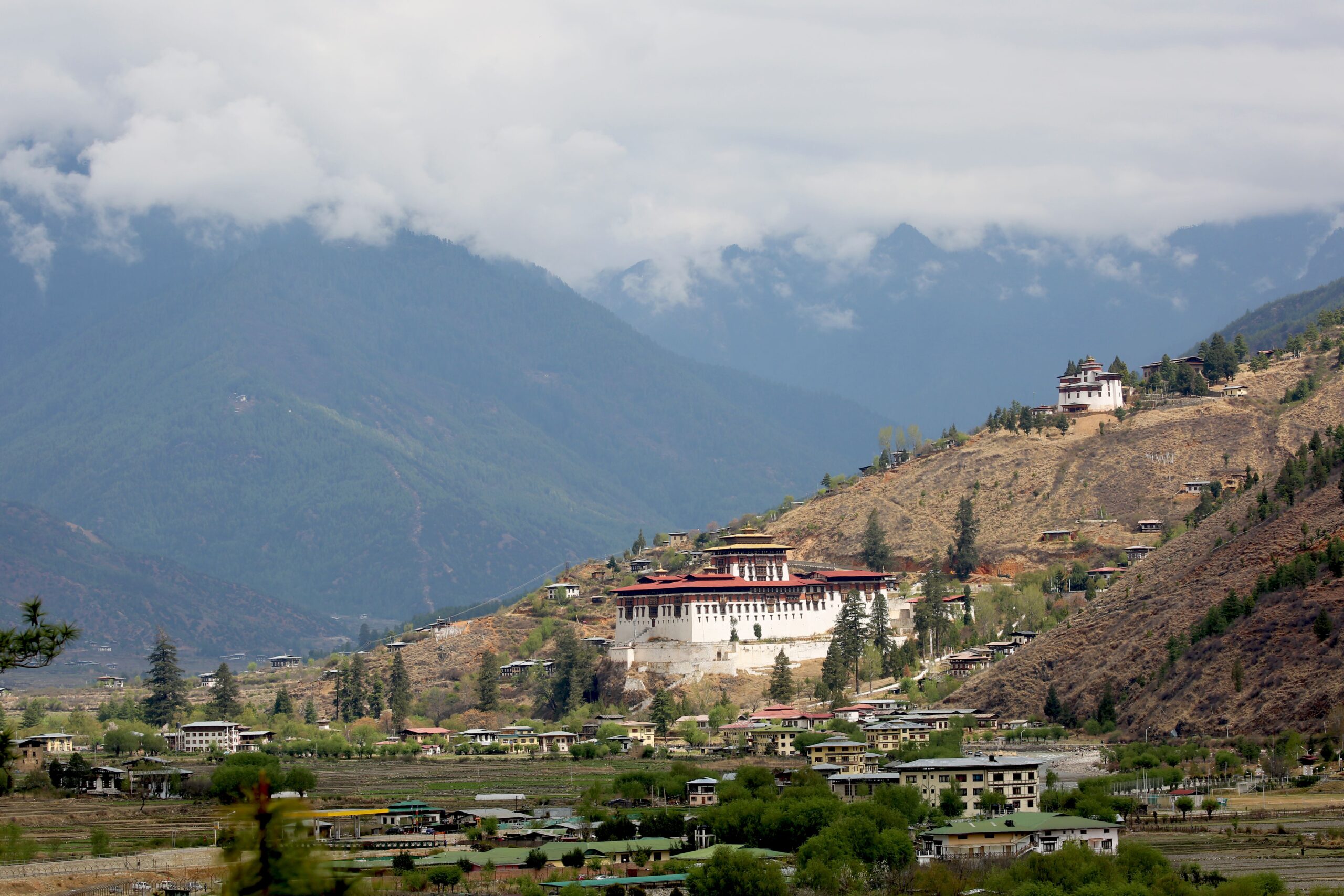
Bhutan measures its success not in GDP but in Gross National Happiness. It is the only carbon-negative country in the world. It has never been colonised, never suffered the particular cultural erasure that comes with occupation, and has chosen — with remarkable deliberateness — to allow fewer than 300,000 visitors per year into a country that could easily handle ten times that number. What this means in practice is that you arrive in a kingdom of extraordinary intentionality: the architecture is governed by traditional design codes, the forests are constitutionally protected at 60% of the land surface, the monasteries are living religious institutions rather than museums, and the mountains are so close that their snowfields are visible from the capital’s streets on any clear morning.
The Land of the Thunder Dragon is a small country — roughly the size of Switzerland — packed between the Himalayas and the Indian plains. But the density of the experience it offers is unlike anywhere else on earth. This guide covers 101 things to do across Bhutan’s valleys, dzongs, temples, trekking trails, and the living culture that has kept this extraordinary kingdom intact.
Paro: Gateway to the Kingdom
Tiger’s Nest & the Sacred Valley
- Paro Taktsang (Tiger’s Nest Monastery) — The defining image of Bhutan and one of the most extraordinary religious sites on earth: a cluster of four temples and eight caves clinging to a sheer granite cliff face 900 metres above the Paro Valley floor, accessible only by a trail through blue pine forest that climbs 1,000 metres before descending to the monastery itself. Guru Rinpoche — who brought Buddhism to Bhutan — is said to have flown here on the back of a tigress and meditated in these caves for three months. The approach through the prayer flags, the mist-wreathed cliff, and the monastery’s painted interiors constitute an experience that no other trek in the Himalayas replicates. Allow five to six hours return; early morning departure is essential.
- Paro Dzong (Rinpung Dzong) — The great fortress-monastery above the Paro town, reflected in the Pa Chhu river below and connected to it by a traditional covered cantilever bridge (the Nyamai Zam). One of the finest dzongs in Bhutan, with whitewashed walls, timber-framed interiors, and the Paro Tsechu festival held in its courtyard each spring. Used as a filming location for Bernardo Bertolucci’s Little Buddha (1993); the dzong has changed almost nothing since.
- Paro Tsechu Festival (Spring) — The most famous festival in Bhutan: five days of masked cham dances performed in the Rinpung Dzong courtyard by monks in brocade costumes, accompanied by cymbals, trumpets, and long horns. On the final day, a thangka (sacred painting) of enormous size — the Guru Rinpoche Thondrel — is displayed at dawn before the sun reaches it, to be seen is to be blessed. The most concentrated visual and spiritual experience in the Bhutanese calendar.
- Drukgyel Dzong — The ruined fortification at the top of the Paro valley, built in 1646 to commemorate the defeat of a Tibetan invasion, from which the snowfields of Mount Jhomolhari (7,326 metres) are visible on clear mornings. The dzong was accidentally destroyed by fire in 1951; the ruins are now preserved and have their own poignant beauty.
- Paro Town Walk — The most charming small town in Bhutan: a single main street of traditional painted wooden shophouses, the covered bazaar, the old cantilever bridge over the river, and the pace of a mountain market town that has barely changed in scale or character in 50 years. The Friday and Saturday bazaar days bring farmers from the surrounding valleys.
- Ugyen Pelri Palace, Paro — The private palace of the Paro Penlop (governor), built in 1930 in traditional Bhutanese architectural style and considered one of the finest examples of traditional palace architecture in the country. The palace grounds are not open to visitors, but the exterior — visible from the road — is among the finest pieces of vernacular architecture in Paro.
- National Museum of Bhutan (Ta Dzong) — The former watchtower above Rinpung Dzong, converted into the national museum in 1968, with collections of Bhutanese thangka paintings, religious artefacts, textiles, postal stamps (Bhutan’s stamps are famous worldwide for their innovation), and natural history specimens. The building’s circular architecture and the views from its upper galleries are as interesting as the collection.
- Jangtsa Dumtseg Lhakhang — A cylindrical temple on the road north from Paro town, one of the most unusual architectural forms in Bhutan — a stupa-like structure built to subdue underground demons — with interior murals of extraordinary vividness depicting the Buddhist heavens and hells. One of the most visually striking small temples in the Paro valley.
- Kyichu Lhakhang — One of the oldest and most sacred temples in Bhutan, built in 659 AD by the Tibetan Emperor Songsten Gampo — one of 108 temples he constructed across the Himalayas to subdue a demon. The original 7th-century temple is still intact; the adjoining temple was built by the Queen Mother in 1968. The sacred orange tree in the courtyard is said to bear fruit year-round.
- Bondey Valley Farm Walk — The Bondey area south of Paro has the most intact traditional farming landscape near the valley: terraced rice and wheat fields, traditional farmhouses with their characteristic rammed-earth walls and timber-framed upper floors, and the pace of agricultural life that has characterised Bhutan for centuries. Walking between the farms and engaging with local families over butter tea is the most quietly human experience in the valley.
Thimphu: The Capital
Dzongs, Monuments & Culture
- Tashichho Dzong — The seat of the Royal Government of Bhutan and the summer residence of the Je Khenpo (the Chief Abbot of Bhutan), on the north bank of the Wang Chhu river in Thimphu. The white-painted dzong, with its golden roofs and red-and-white towers, is the most photographically dramatic in the country and houses the offices of the King. Entrance is restricted to late afternoon on weekdays, when the civil servants have left.
- Buddha Dordenma (Great Buddha Statue) — A 54-metre gilded bronze statue of Buddha Shakyamuni on the Kuenselphodrang ridge above Thimphu, the largest sitting Buddha in the world, containing 125,000 smaller bronze and gilded Buddha images within. The statue was consecrated in 2015 for the 60th birth anniversary of the Fourth King. The views over the Thimphu valley from the plinth are the finest available from the capital.
- Memorial Chorten (Thimphu Chorten) — A whitewashed stupa in the centre of Thimphu, built in 1974 in memory of the Third King, surrounded throughout the day by local residents performing kora (circumambulation) — spinning prayer wheels, murmuring mantras, and maintaining a living religious practice that has nothing to do with tourism. The most authentic daily ritual visible in the capital, and entirely free.
- Folk Heritage Museum, Thimphu — A restored traditional three-storey Bhutanese farmhouse in the heart of Thimphu, showing the complete material culture of rural Bhutanese life: hand-operated millstones, butter churns, woven baskets, the hearth where the family gathers, and the storage rooms of the agricultural household. The most complete domestic heritage museum in the country.
- Textile Museum (Royal Textile Academy) — Bhutanese weaving is among the finest in Asia, and the Royal Textile Academy on Chubachu road houses the most comprehensive collection of traditional Bhutanese textiles in the country: the kira (women’s dress), the gho (men’s robe), and the extraordinary ceremonial fabrics woven with silk and gold thread in patterns specific to each region, family, and occasion.
- Simply Bhutan Living Museum — An interactive cultural centre near the Memorial Chorten, where visitors can try on the gho and kira national dress, participate in traditional archery, taste arra (local grain spirit) and butter tea, and engage with artisans demonstrating traditional crafts. The most accessible cultural introduction in Thimphu and a good first morning in the city.
- Thimphu Weekend Market (Centenary Farmers’ Market) — The covered market on the banks of the Wang Chhu river, open on Friday evenings and Saturday and Sunday, where farmers from the surrounding valleys sell fresh produce: red rice, dried chillis, yak cheese, fresh butter, mushrooms, dried fish, and the enormous range of vegetables that constitute the Bhutanese diet. The freshness and the variety are extraordinary; the atmosphere is entirely local.
- Changangkha Lhakhang — An ancient temple on a promontory above central Thimphu, built in the 12th century by the Lama Phajo Drugom Zhigpo — one of the most important figures in Bhutan’s Drukpa Kagyu Buddhist tradition. Local families bring newborns here to receive blessings and names; the temple is surrounded by prayer flags and offers the finest view of the capital from its terrace.
- Tashicho Dzong at Dusk — The Tashichho Dzong, floodlit in the evening, with the Wang Chhu river reflecting its white walls and the mountains behind turning black — best seen from the pedestrian bridge downstream. One of Bhutan’s finest evening images.
- Thimphu’s Archery Ground — Archery (dha) is Bhutan’s national sport: the targets are 145 metres apart (compared to 90 in Olympic archery), and the sport is played with traditional bamboo bows or modern compound bows, with elaborate singing, dancing, and collective mockery of opponents. Matches take place at the Changlimithang stadium and various local grounds on weekends. Entirely free to watch, endlessly entertaining.
Punakha: Valley of the Divine Madman
- Punakha Dzong (Palace of Great Happiness) — The finest dzong in Bhutan and one of the most beautiful buildings in the Himalayas: a fortress-monastery built at the confluence of the Mo Chhu (Female River) and Pho Chhu (Male River) in 1637, with interior courtyards, sacred jacaranda trees that bloom purple in spring, and the river shimmering on both sides. The winter seat of the Je Khenpo, Punakha Dzong has been the site of every major moment in Bhutanese royal history — including the King’s coronation in 2008 and his wedding in 2011.
- Punakha Tsechu & the Punakha Drubchen — The Punakha Tsechu is one of the finest festivals in Bhutan, held in the dzong each spring, with the unique Punakha Drubchen (the re-enactment of the 17th-century battle against Tibetan forces) as its dramatic centrepiece — 200 warriors in period armour and weapons performing a military ballet in the dzong courtyard.
- Suspension Bridge over the Mo Chhu — Bhutan’s longest traditional suspension bridge, draped in thousands of prayer flags, spans the Mo Chhu river below Punakha Dzong — a walk of gentle swaying and the sound of the river far below, with the dzong visible upriver through the flags. The most distinctly Bhutanese walkway in the country.
- Khamsum Yulley Namgyal Chorten — A remote three-storey chorten on a ridge above the Mo Chhu valley north of Punakha, reached by a 45-minute walk through rice terraces and birch forest, with views over the entire valley and the dzong below. Built in 2004 by the Queen Mother; the interior has the finest contemporary traditional paintings in Bhutan.
- Chimi Lhakhang (Temple of the Divine Madman) — A 15th-century temple on a hillock above the Punakha valley, reached by a 20-minute walk through rice fields, dedicated to the Lama Drukpa Kunley — the “Divine Madman” who propagated Buddhism with wine, women, and song, and whose phallus (represented in paintings and wooden carvings throughout Bhutan, including on house walls) is considered a symbol of protection and fertility. The most irreverent sacred site in Bhutan, and one of the most beloved.
- Punakha Valley Bicycle Ride — The valley floor between Lobeysa and Punakha Dzong, through the most productive rice-farming landscape in Bhutan, is the finest cycling route in the country: terraced fields, farmhouses, the river, and the dzong growing larger as you approach. Bicycles are available for hire in Punakha.
- Talo Monastery & Village — A monastery on the hillside above Punakha, home to the reincarnation of a renowned Bhutanese saint, with a small village of traditional farmhouses and the finest views of Punakha Dzong from above. The Talo Tshechu (October) is one of the most intimate festivals in the Punakha region.
Phobjikha Valley: The Crane Sanctuary
- Gangtey Monastery (Gangtey Gompa) — The most important Nyingmapa monastery in western Bhutan, on a ridge above the Phobjikha valley, rebuilt in the 17th century and housing a community of monks whose chanting drifts down the valley at dawn and dusk. The main assembly hall, the accommodation blocks for the novice monks, and the views of the valley below are extraordinarily composed.
- Black-Necked Crane Festival, Phobjikha (November) — The black-necked crane — a species considered sacred in Bhutan as a manifestation of heavenly birds — migrates from Tibet and Siberia to winter in the Phobjikha valley each October and departs in February or March. The one-day Black-Necked Crane Festival celebrates their arrival with traditional dances, songs, and a school children’s performance in crane costumes beside the Black-Necked Crane Information Centre.
- Phobjikha Valley Walk — A 5-kilometre flat circuit through the valley floor: bog woodland, open grassland, the stream through the wetlands, and the cranes (in season) feeding and calling in the fields. The Gangtey Nature Trail is the finest easy walk in Bhutan for birdwatching and the most complete landscape of managed wetland and farming in the country.
- Black-Necked Crane Watching (October–March) — The valley hosts up to 500 black-necked cranes during winter, roosting in the wetlands each evening and foraging in the surrounding fields by day. The Black-Necked Crane Information Centre has observation scopes; the afternoon return flight of the cranes to the roost — in formation, calling, against the darkening sky above the monastery — is one of the finest wildlife experiences in Bhutan.
- Kilkhorthang (Royal High School), Gangtey — A traditional Bhutanese school in the heart of Phobjikha, where students study the traditional arts alongside the standard curriculum. The weaving and painting classes — visible from the courtyard — represent the living transmission of Bhutanese traditional knowledge in the most direct form.
Bumthang: The Spiritual Heartland
- Jakar Dzong, Bumthang — The “Castle of the White Bird,” named for the white bird that reportedly indicated the site to the first dzong builder, sits on a ridge above the Chamkhar valley. The largest dzong in Bumthang, with a complex of temples, monk residences, and administrative offices that has been at the centre of Bhutan’s religious life for 400 years.
- Kurje Lhakhang — The most sacred temple complex in Bhutan, built around the cave where Guru Rinpoche meditated and left his body imprint in the rock in the 8th century. Three temples of different centuries, a large body-print stupa, and sacred trees — the site where the Guru tamed a demon and established Buddhism in Bhutan. The Kurje Tshechu in summer draws thousands of pilgrims.
- Jambay Lhakhang — One of the oldest temples in Bhutan and in the Himalayas: built in 659 AD by the Tibetan Emperor Songsten Gampo, simultaneously with Kyichu in Paro, to subdue a giant demoness. The outer wall of the original 7th-century temple is still visible inside the later additions; the Jambay Lhakhang Drup festival in autumn is among the most celebrated in the country.
- Jambay Lhakhang Drup Festival (October/November) — A five-day festival at Jambay Lhakhang featuring the extraordinary naked dance (Tercham) performed at midnight by torchlight — monks and laypeople dancing without clothing as an expression of primordial purity, in a ceremony that pre-dates Bhutanese Buddhism. One of the most remarkable festival experiences available in the country.
- Mebar Tsho (Burning Lake) — A sacred lake in the Tang valley of Bumthang, where the treasure revealer Pema Lingpa leaped into the water holding a burning butter lamp and emerged with religious texts and artefacts — the lamp still burning — in the 15th century. The narrow gorge, the turquoise water, and the prayer flags above the cliffs produce an atmosphere of concentrated sanctity.
- Tamshing Lhakhang — A 16th-century temple built by Pema Lingpa — the most important saint produced by Bhutan — with the finest surviving medieval murals in the country: exquisitely detailed paintings of the Buddhist cosmology that have been preserved almost unchanged for 500 years. A circuit of the inner wall wearing Pema Lingpa’s original chain-mail robe is considered a purifying act.
- Bumthang Brewery & Red Panda Beer — The Swiss-established Bumthang Brewery, on the Chamkhar river, produces the Red Panda brand — Bhutan’s finest beer — from local spring water and imported malt. Tours of the small brewery (one of only two in Bhutan) and tastings in the adjacent restaurant are one of the more unexpected pleasures of the spiritual heartland.
- Wangdicholing Palace, Bumthang — The first palace built on a flat plain (rather than a ridge) in Bhutanese history, constructed in 1857 for the Trongsa Penlop. The palace is being converted into a museum of the royal family’s early history; the building’s architecture — influenced by Tibetan monastic design — and the historical photographs it houses are extraordinary.
- Ura Village Walk — The highest and most remote of the Bumthang valleys, with a compact medieval village of stone houses, cobbled lanes, and the Ura Lhakhang at its centre. The Ura Yakchoe Festival — held in spring, when masked dances and processions fill the village lanes — is the most intimate large festival in Bhutan. The landscape of open rolling meadows around the village is unlike any other in the country.
- Tang Valley: Ogyen Choling Palace Museum — One of four valleys in Bumthang, and the least visited, with the Ogyen Choling palace complex — a former noble residence now converted into the finest private heritage museum in Bhutan, with collections of historical artefacts, textiles, and religious objects documenting 400 years of aristocratic Bhutanese life. The walk from the main road through the valley is through rice terraces and farmhouses of exceptional tranquillity.
Trongsa & Central Bhutan
- Trongsa Dzong — The most strategically important dzong in Bhutan: a massive fortress on a ridge above the Mangde Chhu gorge, controlling the only road between eastern and western Bhutan for centuries. The ancestral seat of the Bhutanese royal family (every king must first serve as Trongsa Penlop), with seven courtyards, 23 temples, and a labyrinthine layout that took a morning to walk in the days before the road. The approach from the west — seeing the dzong appear suddenly above the forested gorge — is one of the great visual encounters in Bhutan.
- Ta Dzong (Royal Heritage Museum), Trongsa — The watchtower above Trongsa Dzong, converted into a museum of the Wangchuck royal dynasty with extraordinary collections of royal regalia, weapons, photographs, and the personal possessions of Bhutan’s five kings. The finest royal history museum in the country.
- Chendebji Chorten — A large whitewashed chorten beside the road between Trongsa and Bumthang, built in the 18th century in a Nepalese style modelled on the Swayambhunath stupa in Kathmandu, surrounded by smaller chortens in the pinewood forest of a wide valley. One of Bhutan’s most architecturally distinctive roadside monuments.
Haa Valley: The Hidden Gem
- Lhakhang Karpo & Lhakhang Nagpo (White & Black Temples) — The two sacred temples at the centre of Haa town: the Lhakhang Karpo (White Temple) and Lhakhang Nagpo (Black Temple), built in the 7th century by the same Tibetan emperor who built Kyichu and Jambay. The White Temple has been continuously active since 659 AD. Haa was closed to foreign tourists until 2002; the temples retain a quality of sacred seclusion that more-visited sites have lost.
- Haa Valley Farm Stays & Homestays — The Haa valley has one of the finest rural homestay programmes in Bhutan: traditional farmhouses with stone-and-timber construction, hearth-centred cooking, butter tea at dawn, and the extraordinary hospitality of Haap families who have received almost no outside visitors until recently. Staying in a Haa farmhouse for two nights is the most culturally immersive experience available near Paro.
- Haa Summer Festival — An annual festival celebrating the nomadic culture of the Haa valley: yak sports, archery, traditional music, local food stalls, and the Haap community in their distinctive local dress. Held in July on the valley floor below the two temples.
- Kila Nunnery Trail, Haa Valley — A trail from Haa town to the Kila Nunnery — one of the oldest and most remote nunneries in Bhutan, perched on a cliff face at 3,800 metres — through blue pine and rhododendron forest with views of the Himalayan snowfields. The nuns have practised here in near-total solitude for centuries.
Trekking: The High Himalaya
- Druk Path Trek (5–6 Days) — The most popular trekking route in Bhutan: from Paro to Thimphu (or vice versa) across the high ridge between the two valleys, at altitudes of 3,700 to 4,200 metres, with glacier lakes, rhododendron forests, yak herders’ camps, and views of Jhomolhari and Jichu Drake. The finest first trekking experience in Bhutan.
- Snowman Trek (25 Days) — The hardest and most remote major trek in the world: 25 days from Paro to Bumthang or Sephu, crossing 11 passes above 4,500 metres through the remote Lunana district of the north, with glaciers, yak nomads, and some of the most extreme alpine terrain on earth. Fewer than 200 people complete it each year.
- Jhomolhari Trek (8–12 Days) — The route to the base of Jhomolhari (7,326 metres) from Paro: through the Jangothang valley, past the ancient dzong ruins of Jangothang, to the base camp with the full north face of the mountain above. One of the finest mountain trekking destinations in Asia, with tiger, snow leopard, takin, and blue sheep in the surrounding terrain.
- Bumdra Trek (2–3 Days) — A short, high-altitude circuit above Paro that approaches the Tiger’s Nest from above rather than below, camping at the Bumdra monastery at 3,900 metres with views of the entire Paro valley and the Jhomolhari range. The descent to the Tiger’s Nest from above is one of the most dramatic arrivals in Bhutan.
- Gangtey-Phobjikha Trek (3 Days) — A moderate valley-to-valley trek from Gangtey through the Black Mountains to Phobjikha, crossing the Nob Tshoka pass, through broadleaf and conifer forests with excellent birding. The finest short trek in western Bhutan.
- Rodung La Pass Trek, East Bhutan — A little-known route connecting the Ura valley in Bumthang to the Kuri Chhu valley in the east, crossing the 4,160-metre Rodung La pass through yak country and ancient salt trade routes that were the original communication lines between eastern and western Bhutan.
- Dagala Thousand Lakes Trek (5–6 Days) — A high-altitude circuit south of Thimphu, with a dozen glacial lakes above 4,000 metres, extensive yak grazing country, and the finest view of the Bhutan Himalaya available from a relatively accessible trekking route.
Wildlife, Nature & the Living Forest
- Royal Manas National Park — The oldest national park in Bhutan, in the subtropical south, contiguous with India’s Manas Tiger Reserve across the border. Home to tigers, elephants, rhinoceroses, golden langur (found only in Bhutan and adjacent Assam), and the endangered pygmy hog. The park’s wildlife density is among the highest in South Asia.
- Jigme Dorji National Park — The largest national park in Bhutan, covering the northern highlands and the Jhomolhari massif, with snow leopard, takin (the national animal of Bhutan, a cross between a gnu and a mountain goat, found only in the eastern Himalayas), red panda, and the full range of Himalayan alpine fauna.
- Takin Preserve, Thimphu — A small wildlife preserve on the edge of Thimphu where the national animal of Bhutan — the takin — can be seen at close quarters. The takin is one of the most unusual large mammals in Asia: a stocky, golden-coated creature of the alpine slopes that figures prominently in Bhutanese mythology.
- Red Panda Tracking, Bumthang — The red panda (firefox), the state animal of Sikkim and one of the most elusive mammals in Asia, inhabits the mixed forests of the Bumthang region. Guided tracking walks with forest guides offer the best chance of encounters in the rhododendron and bamboo slopes above the valley floor.
- Birdwatching: Bhutan’s 700 Species — Bhutan has one of the highest bird densities in Asia: 700 species in a country the size of Switzerland, including the Ward’s trogon, the rufous-necked hornbill, the beautiful nuthatch, and the rare satyr tragopan. The forests of Phrumsengla National Park and the subtropical rivers of the south are the finest birding habitats; any competent birding guide in Paro or Bumthang can arrange specialist walks.
- Rhododendron Trek, Spring (March–May) — The forests of the Bhutan highlands are the richest rhododendron habitat in the world: 46 species bloom from March to May at different altitudes, turning the hillsides white, pink, red, and crimson in a sequence that climbs from the valley floors to the alpine margins. Any trek undertaken in spring will pass through the bloom.
- Chele La Pass & the Bhutan Himalaya View — The highest motorable road pass in Bhutan (3,988 metres), on the road between Paro and Haa, with the finest view of Jhomolhari, Jichu Drake, and the full western Himalayan chain from any roadside viewpoint in the country. The pass is covered in prayer flags; the surrounding forest has the finest high-altitude birding near Paro.
Bhutanese Arts, Crafts & Living Heritage
- Zorig Chusum (Thirteen Traditional Arts) — The thirteen traditional arts of Bhutan — painting, sculpture, carpentry, masonry, lacquerware, metalwork, weaving, embroidery, papermaking, bamboo craft, calligraphy, boot-making, and jewellery — are all still practised as living crafts, not museum pieces. The National Institute for Zorig Chusum in Thimphu trains students in all thirteen arts simultaneously.
- Thimphu Institute of Zorig Chusum Visit — The national training institute for traditional arts, where student artists work on thangka paintings, wood carving, embroidery, and bronze casting in open studios. Visitors can watch the full range of arts being taught and practised, and in some cases commission or purchase directly from the students.
- Thangka Painting Workshop — Several studios in Thimphu and Paro offer half-day or multi-day workshops in the art of Bhutanese thangka painting — the highly formalised sacred art form depicting Buddhist deities in mineral pigments on cotton canvas. Learning to prepare the canvas, grind the pigments, and draw the first outline of a deity is one of the most intensely absorbing half-days in Bhutan.
- Traditional Bhutanese Weaving, Bumthang & Haa — Bumthang and Haa produce the finest traditional woven textiles in Bhutan: the silk kishuthara of Bumthang, with its intricate supplementary-weft patterns, and the Haap wool wonju, with regional patterns unique to the valley. Visiting a weaving workshop and watching the back-strap loom in operation is the most direct encounter with Bhutan’s finest traditional art.
- Bhutanese Paper (Deh-Sho) at Jungshi Handmade Paper Factory — The traditional Bhutanese paper, made from the Daphne plant (called Deh-Sho), has been produced for centuries for religious texts and official documents. The Jungshi factory in Thimphu demonstrates the full process — beating the bark, creating the pulp, laying the sheets — and sells the finished paper in its shop.
- Mask-Making Workshop, Thimphu or Punakha — The elaborate painted masks used in tsechu festivals — representing Buddhist deities, protective spirits, and folk characters — are made by specialist craftsmen in traditional workshops. Several cultural organisations in Thimphu offer guided visits to mask-making studios and, in some cases, introductory workshops.
Food, Butter Tea & the Bhutanese Table
- Ema Datshi — Bhutan’s National Dish — Chilli and cheese, cooked together in butter with a small amount of water into a thick, spiced sauce: ema datshi is simultaneously the simplest and the most fiercely characteristic dish in Bhutan. Served at every meal, from the farmhouse hearth to the finest restaurant in Thimphu, with red rice. The chilli content is genuine; the cheese is fresh yak or cow, and nothing like what the name suggests to a Western palate.
- Red Rice from Paro — The short-grain, rust-coloured rice grown in the Paro valley is nutritionally dense, slightly nutty in flavour, and never fully white when cooked — retaining its characteristic bran layer and the distinctive Bhutanese flavour. Eating it with ema datshi and phaksha paa (pork with dried chillis) is the most complete Bhutanese meal.
- Butter Tea (Suja) with a Bhutanese Family — The Bhutanese drink butter tea (suja) — made from tea leaves, salt, butter, and milk churned in a cylindrical wooden churn — many times a day. Being offered butter tea in a Bhutanese home is an act of hospitality that predates all other social protocols; accepting it, even for those who find the first cup challenging, is the most direct cultural connection the country offers.
- Suja & Zow (Butter Tea & Puffed Rice) Breakfast — The traditional Bhutanese breakfast: butter tea served with zow (puffed or parched rice, often mixed directly into the tea), eaten beside the hearth in the early morning. Available at traditional restaurants in Thimphu and in every rural homestay.
- Phaksha Paa (Pork with Dried Red Chilli) — One of Bhutan’s most satisfying dishes: fatty pork, slow-cooked with dried red Bhutanese chillis, ginger, and radish in a sauce of considerable depth and heat. The best version is cooked over a wood fire at a farmhouse in the Bumthang or Paro valley.
- Hoentoe (Buckwheat Dumplings), Haa — The Haa valley speciality: half-moon shaped buckwheat dumplings filled with turnip greens, cottage cheese, and butter, steamed and served with a broth. The buckwheat cultivation that characterises Haa’s high-altitude landscape produces a noodle and dumpling culture found nowhere else in Bhutan.
- Bangchung (Traditional Bamboo Basket) Shopping — The woven bamboo containers used for carrying and presenting food — from the small personal lunch bangchung to the large offering baskets used in festivals — are among the finest functional crafts in Bhutan, produced in the bamboo-rich eastern and central regions. Available at markets throughout the country.
- Arra (Local Spirit) at a Farmhouse — The traditional Bhutanese distilled grain spirit, made from wheat, rice, or maize and served warm in ceramic cups, is the social lubricant of the rural highlands. Being offered arra in a farmhouse, during a festival, or at an archery match is an experience of Bhutanese hospitality in its most direct form.
Festivals: The Cultural Heartbeat
- Thimphu Tsechu (September/October) — The largest tsechu festival in Bhutan, held over four days in the Tashichho Dzong in September or October, with the full range of masked cham dances representing the deities of the Nyingma and Kagyu Buddhist traditions. Attended by thousands of Bhutanese in their finest silk gho and kira, and by the King and royal family. The final-day display of the Thimphu Thondrel (giant sacred painting) at dawn is one of the great spectacles of the Bhutanese religious year.
- Paro Tsechu (Spring) — The second-largest festival, held in Rinpung Dzong in March or April, with the Paro Thondrel unveiled at dawn on the final day. The approach to the dzong through the town’s lanes, with the Bhutanese in festival dress and the mountains above, is the finest morning walk in Paro.
- Punakha Drubchen & Tsechu (February/March) — The unique festival combining the ancient military re-enactment (Drubchen) with the religious dances of the tsechu, held in Punakha Dzong in the season when the jacaranda trees in the courtyard are in bloom. The combination of the blue flowers, the white dzong, the costumed warriors, and the mountain light is incomparably beautiful.
- Black-Necked Crane Festival, Phobjikha (November) — A one-day community festival celebrating the arrival of the cranes with traditional music, crane dances by schoolchildren in costume, and local food stalls beside the wetland sanctuary. The most ecologically oriented festival in Bhutan.
- Ura Yakchoe Festival (Spring) — The intimate festival of the Ura village in Bumthang, held in the lanes and courtyard of the village with a single large thangka display, masked dances, and the community of Ura in traditional costume. The small scale — perhaps 300 villagers and a few dozen visitors — gives it an authenticity that the larger festivals at dzongs cannot match.
- Jambay Lhakhang Drup (October/November) — The multi-day festival at the oldest temple in Bumthang, with the extraordinary midnight naked dance (Tercham), fire ceremonies, and traditional masked performances representing the full range of Bhutanese tantric Buddhist culture. One of the most theatrically intense festival experiences in the country.
Mindfulness, Wellness & Spiritual Bhutan
- Meditation Retreat at a Bhutanese Monastery — Several monasteries in Bhutan accept visitors for short meditation retreats — typically two to five days — in the Tibetan Buddhist tradition of silent sitting meditation, prostration, and mantra recitation. The retreats at the Nalanda Institute in Lobeysa (Punakha) and the Gangtey monastery are the most accessible for foreigners.
- Himalayan Hot Stone Bath (Menchu) — The traditional Bhutanese hot bath, taken in a wooden tub filled with river water heated by placing fire-heated river stones into a compartment inside the tub, with medicinal herbs — artemisia, bog bilberry, sagebrush — floating in the water. The most deeply therapeutic and the most Bhutanese wellness experience: entirely local, entirely effective, and entirely unlike a spa.
- Yoga & Meditation at an Eco-Lodge, Bumthang — The Bumthang valley, at 2,700 metres in the spiritual heartland, has several eco-lodges and heritage farmhouses offering yoga, meditation, and silent walking programmes in a setting of extraordinary mountain calm. The combination of altitude, forest, and the quality of silence in the Bumthang highlands is unlike any other wellness landscape in Asia.
- Sunrise Prayer Ceremony at Kyichu Lhakhang, Paro — Arriving at Kyichu Lhakhang at 6am, before the temple opens to visitors, to watch the morning puja (prayer ceremony) of the resident monks — the sound of the drums and cymbals in the mountain stillness, the butter lamps being lit, the incense rising — is the most quietly powerful religious experience available in Paro.
- Prostration Circuit (Kora) at a Sacred Site — Walking the kora — the clockwise circumambulation circuit — around a dzong, chorten, or sacred mountain is the most universally practised Bhutanese religious act. The kora around the Memorial Chorten in Thimphu (best at dawn), around Kurje Lhakhang in Bumthang, and around Punakha Dzong are the three finest for visitors.
East Bhutan: The Road Less Travelled
- Trashigang Dzong & the Eastern Gateway — The largest dzong in eastern Bhutan, on a ridge above the Dangme Chhu river gorge, with the most dramatic location of any dzong in the country — the gorge is 1,000 metres deep and the dzong appears to float above it. Trashigang is the administrative capital of eastern Bhutan and the least touristy major town in the kingdom.
- Gom Kora Temple, Trashiyangtse — A sacred temple beside the Dangme Chhu river in eastern Bhutan, where Guru Rinpoche is said to have left a body imprint in the rock face. The Gom Kora festival (March) draws pilgrims from across eastern Bhutan for a kora of the sacred rock face at night by torchlight.
- Bomdeling Wildlife Sanctuary & Black-Necked Cranes — A secondary wintering ground for black-necked cranes, in a remote valley north of Trashiyangtse accessible by a mountain road of considerable drama. The sanctuary also shelters golden langur, tiger, and clouded leopard in its subtropical and temperate forest zones.
- Trashiyangtse: Wooden Craft Villages — The district of Trashiyangtse produces the finest wooden turned bowls (dapa) in Bhutan — the characteristic round wooden vessels used for eating and drinking throughout the country. The craftsmen in the villages along the Kholong Chhu river still turn the bowls on traditional lathes from burr wood, and the market in Trashiyangtse offers the finest selection in the east.
The Royal Family & Gross National Happiness
- Visit a GNH Learning Centre — The Gross National Happiness concept — articulated by the Fourth King as the organising philosophy of Bhutanese governance — is explained in dedicated centres in Thimphu and at the GNH Centre in Bumthang. Understanding GNH — its four pillars of sustainable development, cultural preservation, environmental protection, and good governance — is essential to understanding why Bhutan is the way it is.
- Dochula Pass & the 108 Memorial Chortens — The pass on the road between Thimphu and Punakha, at 3,100 metres, where the Queen Mother commissioned 108 chortens in 2005 to commemorate Bhutanese soldiers killed in an operation against Indian insurgents. On clear days the view from the pass takes in the full Bhutan Himalayan chain — 30 peaks above 7,000 metres, from Jhomolhari to Gangkhar Puensum — the finest mountain panorama available from a paved road in Bhutan.
- Punakha Suspension Bridge at Sunset — The longest traditional suspension bridge in Bhutan, draped in thousands of prayer flags, with the Punakha Dzong visible upriver and the Mo Chhu glowing in the last light. The bridge at sunset, with the mountains turning purple and the flags moving in the evening wind, is one of the definitive Bhutanese images.
- Attend a High School Archery Tournament — The national sport of Bhutan, played on grounds throughout the country on weekends and holidays, produces extraordinary collective theatre: the dances performed after a successful hit, the taunting songs directed at the opposing team’s archers, and the communal singing around the mark. Attending a regional tournament — rather than a formal demonstration — is the most genuinely local sporting experience available in Bhutan.
Hidden Gems & Unexpected Bhutan
- Gangkhar Puensum: The World’s Highest Unclimbed Mountain — At 7,570 metres, Gangkhar Puensum is the highest unclimbed mountain in the world — climbing above 6,000 metres is prohibited in Bhutan out of respect for the spirits believed to inhabit the peaks. It is visible from the Dochula pass and from various points in the Bumthang region, a pure white pyramid that no human being has ever stood on. Its existence — and the policy that keeps it so — is the most profound statement of Bhutanese values.
- Sakteng Wildlife Sanctuary & the Brokpa Nomads — The most remote protected area in Bhutan, in the far east near the Arunachal Pradesh border, inhabited by the Brokpa semi-nomadic herding community who winter in the lower valleys and summer on the high alpine pastures. The sanctuary — believed to shelter the migoi (Bhutan’s Yeti) — is accessible by a five-day trek from Trashigang.
- Phajoding Monastery, Above Thimphu — A monastery complex on the ridge above Thimphu at 3,600 metres, reached by a three-hour walk from the city, with a community of monk-hermits in retreat cells scattered across the hillside and views of the entire Thimphu valley. The finest half-day walk from the capital and entirely unknown to the majority of visitors.
- Full Moon Night Walk to a Village Temple — During full moon nights, Bhutanese communities often hold informal religious gatherings at local temples — butter lamps lit, prayers recited, the gathering illuminated only by firelight and moonlight. Finding one of these evenings, with a local guide, and attending respectfully is the most intimate cultural encounter the country offers and the one least likely to be on any itinerary.
- Watch the Dawn Over the Bhutan Himalayas from Dochula Pass — On the morning of your last day, drive to Dochula in the dark and stand among the 108 chortens as the sky lightens. The prayer flags begin to stir. The peaks emerge one by one from the darkness, white and enormous and permanent above the clouds. Gangkhar Puensum last, the highest and the most remote, still unclimbed, still sacred, still entirely itself. Below you, Bhutan is waking up — the monastery bells, the first smoke from the farmhouses, the smell of pine and cold air and the beginnings of another day in the last kingdom that measured its success in happiness. You came here because you wanted to see if it was real. Standing on this ridge at dawn, with the mountains and the silence and the prayer flags turning in the first light, you understand that it is — and that it will stay that way only for as long as the world allows it.
Quick Facts for Visitors
| Best time to visit | March–May (spring, rhododendrons, festivals) · September–November (clear skies, harvest, autumn treks) |
| Monsoon | June–August — heavy rain; fewer visitors; lush landscape |
| Winter | December–February — cold at altitude; Punakha and lower valleys pleasant |
| Currency | Bhutanese Ngultrum (BTN) — pegged 1:1 to Indian Rupee; INR accepted throughout |
| Language | Dzongkha (national); English widely spoken in tourism contexts |
| Entry | All visitors require a licensed Bhutanese tour operator; visa arranged through the operator |
| Sustainable Development Fee | USD 100 per person per day (in effect 2026; reduced from the previous USD 200/day) |
| Getting there | Druk Air and Bhutan Airlines fly to Paro from Delhi, Mumbai, Kolkata, Bangkok, Singapore, and Kathmandu |
| Mobile data | Bhutan Telecom and TashiCell 4G; coverage good in valleys, absent in remote areas |
| Ideal trip length | 7 days covers Paro, Thimphu, and Punakha · 12–14 days adds Bumthang and Phobjikha · 3+ weeks for the east |
Bhutan asks something of you that most travel destinations do not: it asks you to slow down unconditionally. The roads are mountain roads; the temples are approached on foot; the festivals run on their own sacred time. The country’s extraordinary quality — its stillness, its intentionality, its sense that it has thought carefully about what it wants to be — is not something you can absorb at speed. Give it time, and it gives you everything.