Iceland is the planet’s most dramatic argument for going somewhere uncomfortable. A volcanic island in the North Atlantic, straddling the Mid-Atlantic Ridge between Europe and America, it is geologically the youngest landscape in the world — still being actively created beneath your feet, still erupting, still building. It has more geysers than any country on earth, more waterfalls than you can count, glaciers that cover 11% of its surface, lava fields that look like the moon’s crust, and a sky that produces the aurora borealis from September to March with a frequency found nowhere else in Europe.
It also has Reykjavík — the world’s most northerly capital, a city of 130,000 people that somehow contains opera, world-class restaurants, one of Europe’s finest contemporary music scenes, and a whale-watching harbour fifteen minutes from the centre. And beyond Reykjavík lies the rest: the South Coast’s waterfalls and black sand beaches, the volcanic lakes of the Mývatn region, the fjords of the Westfjords that fewer than 10% of visitors ever reach, and the Interior — the great uninhabited lava wilderness that no road crosses until July.
This guide covers 101 things to do across Iceland in 2026 — from the Golden Circle to the end of the earth.
Reykjavík: The World’s Most Northerly Capital
Architecture, Culture & City Life
- Hallgrímskirkja — The 73-metre concrete church that dominates the Reykjavík skyline, its tower designed to echo the basalt column formations found across Iceland. Take the lift to the observation deck for the finest panoramic view of the capital — the coloured rooftops, the harbour, Mount Esja across the fjord, and on clear days the Snæfellsjökull glacier on the horizon. Free to enter the church; tower ticketed.
- Harpa Concert Hall — The glass-and-steel concert hall on the harbour front, its facade designed by artist Olafur Eliasson in a pattern of hexagonal glass panels that shift colour through the day and glow gold at night. Home to the Iceland Symphony Orchestra and the Icelandic Opera, with a programme of concerts, theatre, and events throughout the year. The building alone justifies the walk to the harbour.
- National Museum of Iceland (Þjóðminjasafn) — The finest museum of Icelandic history and culture, tracing the country’s story from the Norse settlement (874 AD) through the medieval Sagas to the present: the original Viking Age artefacts, the Romanesque carved doorways from medieval Icelandic churches, the 13th-century church textile of the Madonna, and the story of the most literate society in medieval Europe. Essential context for everything that follows.
- Reykjavík Art Museum (Kjarvalsstaðir) — The main branch of the Reykjavík Art Museum, dedicated to the work of Jóhannes S. Kjarval — the most beloved Icelandic painter, who transformed the lava, moss, and mountain light of his country into canvases of extraordinary chromatic richness. The collection is the finest introduction to Icelandic visual art available.
- Laugavegur: The Main Street — The main commercial street of Reykjavík, running from Hlemmur square to the old harbour, is the social spine of the city: independent boutiques, Icelandic wool design shops, coffee houses, the Kolaportið flea market at the harbour end, and the bars that fill every Friday and Saturday night with the Reykjavík runtur (the pub crawl that is the city’s primary social institution).
- The Old Harbour (Grandi) — The revitalised harbour district west of Harpa: the Whales of Iceland exhibition (life-size models of Iceland’s 23 whale species in a former fish factory), the Saga Museum, the Marshall House gallery complex, and the whale-watching and puffin-watching boats that depart from the pier throughout the summer. The harbour restaurants — Forréttabarinn, Matur og Drykkur — are among the finest in Reykjavík.
- Sun Voyager (Sólfarið) — Jón Gunnar Árnason’s stainless steel sculpture on the harbour promenade — a dreamboat of interlocking ribs catching the Arctic light — is the most photographed artwork in Iceland. Walk past it at sunrise when the steel turns gold and the Esja mountain is reflected in the water behind it.
- Perlan — Wonders of Iceland — The geodesic glass dome above Reykjavík’s geothermal hot water storage tanks houses the finest museum of Icelandic natural history: a real ice cave, a northern lights planetarium show, exhibits on volcanoes, glaciers, and the Northern Lights, and a 360-degree observation deck at the top of the dome. The most comprehensive introduction to Iceland’s natural world in a single building.
- Tjörnin Lake & the City Hall — The central lake of Reykjavík, home to 50 species of waterbird year-round (including the Arctic terns that dive-bomb pedestrians aggressively in June), with the modernist City Hall cantilevered over its northern shore and the old residential houses of Tjarnargata reflected in the water. Free to walk; the map of Iceland on the City Hall’s interior floor is remarkable.
- The Settlement Exhibition (Landnámssýningin) — An underground museum in downtown Reykjavík built around the actual remains of a Viking longhouse from 930 AD, excavated during the construction of the Hótel Borg. The most immediate and most moving encounter with Iceland’s founding generation available in the capital.
Food, Nightlife & Reykjavík Culture
- Sky Lagoon — The newest and most architecturally dramatic geothermal spa near Reykjavík: a clifftop infinity pool overlooking the North Atlantic, reached through a ritual sequence of seven wellness steps (hot pool, cold plunge, sauna, steam, scrub, mist, and the pool itself). Opened in 2021 on the Kársnes peninsula and consistently rated Iceland’s finest geothermal experience after the Blue Lagoon.
- Reykjavík Whale Watching — The harbour boats depart hourly in summer for two- to three-hour tours in Faxaflói Bay, where minke whales, humpbacks, white-beaked dolphins, and harbour porpoises are regularly encountered. Summer sighting rates exceed 95%. The late-evening tours in midsummer — when the sky never quite darkens — are the most atmospheric.
- Puffin Watching at the Harbour — Arctic puffins nest on the islands in Faxaflói Bay and are readily seen from the dedicated puffin-watching boat trips from Reykjavík harbour. The birds are present from May to August; their comical appearance and extraordinary flying inability makes them the most universally beloved wildlife in Iceland.
- Icelandic Food Tour: Skyr, Lamb, Arctic Char & Hákarl — Reykjavík’s food scene has transformed into one of the finest in northern Europe: skyr (the thick, protein-rich Icelandic dairy product), slow-roasted Icelandic lamb (fed on Arctic herbs and sea minerals), Arctic char from the glacial rivers, Icelandic lobster (langoustine) from Höfn, and hákarl (fermented Greenlandic shark, an acquired taste — ammonia-intense and entirely unique). The Reykjavík Food Walk takes in all of them.
- Laugardalslaug Geothermal Pool — The finest geothermal swimming complex in Reykjavík: multiple outdoor pools ranging from 28°C to the 44°C hot pots, a waterslide, and the complete social culture of the Icelandic swimming pool — where the hot pot is the equivalent of the Italian piazza or the Scandinavian sauna, the place where the city’s conversations happen. Do not miss it; it is the most Icelandic experience in the capital.
- Hlemmur Mathöll Food Hall — Reykjavík’s most creative food hall, in the renovated Hlemmur bus terminal, with stalls representing the full range of contemporary Icelandic food: langoustine soup, Icelandic lamb gyros, skyr cake, craft beer, and a weekend atmosphere that captures the current energy of the city’s eating culture perfectly.
- The Reykjavík Runtur (Friday Night) — The Icelandic pub crawl tradition: beginning at midnight (no one goes out before 11pm), the city’s nightlife moves from Laugavegur’s bars to the harbour clubs in a sequence that depends on who you meet and where the night takes you. Kaldi, Skúli Craft Bar, and the English Pub are reliable starting points; the rest is improvised.
- Iceland Symphony Orchestra at Harpa — The ISO, founded in 1950, performs a full season of orchestral concerts in Harpa’s main hall between September and June. The programming — Icelandic premieres alongside standard repertoire — and the extraordinary acoustic of the main hall make it the finest classical music experience in the country.
The Golden Circle: Iceland’s Essential Route
- Þingvellir National Park (UNESCO) — The most historically charged landscape in Iceland: the rift valley where the North American and Eurasian tectonic plates are visibly separating at two centimetres per year, where the Öxará river flows through a gorge of basalt columns, and where the Alþing — the world’s oldest parliament — has met in the open air since 930 AD. The Law Rock (Lögberg), the Öxará gorge, and the Þingvallavatn lake — the largest natural lake in Iceland — together make it the most significant single site in the country.
- Snorkelling Between Tectonic Plates, Silfra — The fissure at Silfra, in Þingvellir, is filled with glacial meltwater filtered through underground lava for decades before emerging here at 2°C and a visibility of over 100 metres. Snorkelling or diving through the crack between the North American and Eurasian plates — reaching out and touching both continents simultaneously — is one of the most extraordinary experiences available in Iceland. Dry suits are provided; the cold is part of the point.
- Geysir Geothermal Field — The geothermal area of Geysir, from which all geysers take their name: the Great Geysir itself (dormant for years, occasionally roused by earthquake) and the neighbouring Strokkur — which erupts every five to ten minutes, launching a column of boiling water 20–30 metres into the air. Approach from downwind of the steam; the sight of Strokkur building and bursting never becomes ordinary regardless of how many times you witness it.
- Gullfoss Waterfall — The two-tiered waterfall where the Hvítá river drops 32 metres into a 70-metre-deep ravine, generating a cloud of spray visible for kilometres. One of Europe’s most powerful waterfalls, best seen from the lower path directly beside the upper falls — close enough for the spray to soak you in westerly conditions. The legend of Sigríður Tómasdóttir, who fought to prevent Gullfoss from being dammed in the 1920s, is told in the visitor centre.
- Secret Lagoon (Gamla Laugin), Flúðir — The oldest swimming pool in Iceland, a natural hot spring pool in the village of Flúðir on the Golden Circle route, with a perfectly maintained geothermal pool at 38–40°C, a small geyser at its edge that erupts periodically, and the complete absence of the crowds that fill the Blue Lagoon. The most authentic and the most affordable geothermal bathing experience on the Golden Circle.
- Kerið Volcanic Crater — A 6,500-year-old explosion crater of vivid red and ochre volcanic rock, with a circular lake of turquoise-green water at the bottom and a walking trail around the rim. One of the most photogenic geological formations in southwest Iceland, and one of the few Icelandic natural wonders that requires a short payment for access.
The South Coast: Waterfalls, Glaciers & Black Sand
- Seljalandsfoss Waterfall — The 60-metre waterfall on the south coast that can be walked behind: a path leads through the cave behind the falls, giving the experience of seeing the waterfall from inside the curtain of water. Come at golden hour in midsummer when the midnight sun lights the spray from behind.
- Skógafoss Waterfall — The 62-metre-wide, 60-metre-tall waterfall at the edge of the former sea cliffs, with a staircase of 527 steps to the top giving the finest view of the south coast and the glaciers beyond. On sunny days, double rainbows form in the spray at the base; the Skógar folk museum at its foot is the finest traditional heritage museum on the south coast.
- Reynisfjara Black Sand Beach — The most dramatic black sand beach in Iceland, with basalt column formations rising from the shore, the sea stacks of Reynisdrangar offshore, and the powerful Atlantic surf that has claimed lives with its unpredictable sneaker waves — stay 30 metres from the water at all times. Vikurfjara beach in the adjacent village of Vík offers similar scenery with safer conditions. Coastal erosion briefly reshaped part of the Reynisfjara shoreline in early 2026, though it is already showing signs of recovery.
- Jökulsárlón Glacier Lagoon — The lagoon at the terminus of the Breiðamerkurjökull glacier, filled with icebergs calved from the glacier wall in extraordinary shades of blue, white, and black. Boat tours navigate between the bergs; seals haul out on the ice. Diamond Beach — immediately beside the lagoon where the icebergs wash up on a black sand shore — is the most photographed landscape on the south coast.
- Glacier Hiking on Sólheimajökull or Svínafellsjökull — Two of the most accessible glacier tongues in Iceland, on the south coast, where certified guide companies lead visitors across the ice with crampons and ice axes. Walking on a glacier — seeing the crevasses, the blue ice, the meltwater rivers running across the surface — is an experience with no equivalent elsewhere in Europe.
- Skaftafell Nature Reserve, Vatnajökull — The wilderness area within Vatnajökull National Park — the largest national park in Europe, covering 14% of Iceland — with the Svartifoss waterfall (its basalt columns inspired the design of the National Theatre in Reykjavík), the Skaftafellsjökull glacier tongue, and the hiking trails through the birch scrub and glacial outwash plain.
- Ice Cave Tour, Vatnajökull (November–March) — The blue ice caves that form inside Vatnajökull glacier each winter are among the most extraordinary natural spaces on earth: ceilings of compressed glacial ice of an intense, almost electric blue, with the light filtering through layers of ice that are thousands of years old. Accessible only in winter with certified guides; the Sapphire and Crystal caves above Jökulsárlón are the finest.
- Fjaðrárgljúfur Canyon — A 100-metre-deep canyon of extraordinary shape, carved by glacial meltwater through the basalt plateau near Kirkjubæjarklaustur, with a walking trail along the rim revealing a series of increasingly dramatic cliff edges and river pools far below. One of the most photogenic geological formations in south Iceland.
- Þórsmörk Valley — The valley at the base of the Eyjafjallajökull, Mýrdalsjökull, and Tindfjallajökull glaciers, accessible only by 4WD or super jeep in summer, with the finest hiking trails in south Iceland: the Fimmvörðuháls pass, the Volcano Trail, and the approach to the Laugavegur trail’s southern terminus. The valley floor, protected by the glaciers on three sides, is covered in birch woodland — the closest thing to a forest you will find in Iceland.
- Fimmvörðuháls Pass Hike — The one-day route connecting Skógar to Þórsmörk across the Fimmvörðuháls mountain pass between the Eyjafjallajökull and Mýrdalsjökull glaciers, passing the craters of the 2010 Eyjafjallajökull eruption — still steaming in places — and the finest highland landscape in south Iceland. 25 kilometres; full-day commitment.
The Snæfellsnes Peninsula: Iceland in Miniature
- Snæfellsjökull Glacier & National Park — The glacier volcano at the western tip of the Snæfellsnes Peninsula — Jules Verne’s entry point to the centre of the earth, a UNESCO-candidate landscape of extraordinary variety: lava fields, sea cliffs, craters, and the glacier itself. The national park circuit covers all of them; the glacier can be walked with a guide in summer or seen glowing on the horizon from Reykjavík on clear days.
- Kirkjufell Mountain & Kirkjufellsfoss — The arrow-head-shaped mountain beside the village of Grundarfjörður, with the three-spout waterfall in the foreground, is the most photographed mountain in Iceland — recognisable from Game of Thrones as the Arrowhead Mountain north of the Wall. Best photographed at golden hour or during the aurora in winter.
- Djúpalónssandur Black Pebble Beach — A secluded cove on the Snæfellsnes south coast, reached by a short walk through lava formations, with a beach of perfectly smooth black pebbles, the rusted remains of a British trawler wrecked in 1948, and the four lifting stones used by fishermen to test their strength before joining a crew. One of the most atmospheric small beaches in Iceland.
- Arnarstapi & the Lava Arch — The tiny fishing village on the Snæfellsnes south coast, with the most dramatic coastal lava formation in Iceland: the Gatklettur arch, a basalt rock arch worn through by the sea, and the clifftop walk between Arnarstapi and Hellnar past colonies of Arctic fulmar nesting in the basalt columns.
- Búðakirkja (The Black Church) — A tiny 19th-century church of black-painted wood, entirely alone in the middle of a lava field on the Snæfellsnes south coast, with the glacier behind it and the Atlantic in front. In the right conditions — fresh snow, low sun, or northern lights above — it is one of the most photographed small buildings in the world.
- Lóndrangar Basalt Plugs — Two volcanic plugs rising 75 metres from the sea at the southern edge of the Snæfellsnes lava field: eroded remnants of a volcanic crater that the sea has destroyed over millennia. The walking trail from the parking area gives close-up views of the plugs and the puffin nesting colony at their base.
North Iceland: Akureyri, Mývatn & the Arctic
- Akureyri: Iceland’s Second City — The capital of North Iceland, at the head of the Eyjafjörður fjord, is the most un-Reykjavík place in Iceland: a proper provincial city with a botanical garden (the world’s most northerly at 65°N), an art museum, a brewery, and the finest downhill skiing in the country at Hlíðarfjall above the town. The Christmas lights that stay on year-round on the traffic lights are one of Iceland’s gentlest surprises.
- Goðafoss Waterfall (Waterfall of the Gods) — The waterfall where, in 1000 AD, the chieftain Þorgeirr Ljósvetningagoði threw his Norse idols into the water after the Althing voted to adopt Christianity — a moment that changed Iceland permanently. The crescent-shaped falls, 12 metres high and 30 metres wide, remain one of the most beautiful in the country.
- Lake Mývatn & the Geothermal Landscape — The volcanic lake of Mývatn in North Iceland, surrounded by the most concentrated geothermal landscape in Iceland outside the Golden Circle: Hverir (the bubbling mud pools and sulphur vents of Námafjall), the Dimmuborgir lava fortress, the Skútustaðagígar pseudocraters, and the Mývatn Nature Baths at the edge of the lake. Two days is the minimum needed to do it justice.
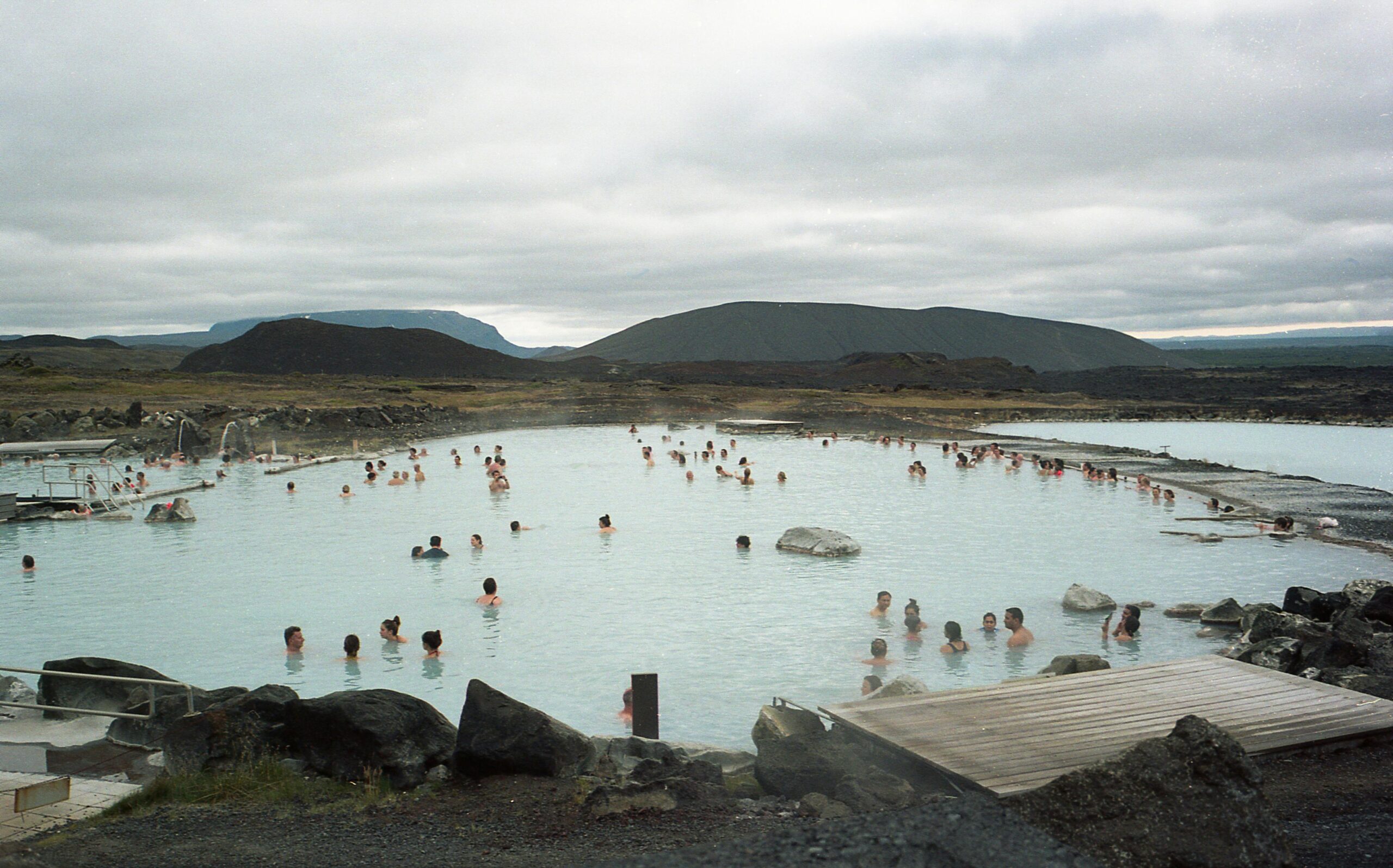
- Mývatn Nature Baths — The northern alternative to the Blue Lagoon: a geothermal bathing lake at Mývatn, with the same milky-blue mineral water but a quarter of the visitors and a dramatic location beside the lake and the Námafjall mountain. The eggy sulphur smell is stronger than the Blue Lagoon; the experience is more authentic.
- Hverir (Námaskarð) Geothermal Field — The most alien landscape in Iceland: the orange and yellow sulphur field at Námaskarð, with boiling mud pools, steam vents, and fumaroles scattered across a hillside that looks like nothing on earth. Free to visit; the smell — strong hydrogen sulphide — announces it from two kilometres away.
- Dettifoss Waterfall — Europe’s most powerful waterfall: the Jökulsá á Fjöllum river drops 44 metres across a 100-metre width, generating a roar and a spray cloud visible for kilometres. Best approached from the east bank road (Route 864) for the closest and most overwhelming viewpoint. The canyon below — Jökulsárgljúfur — is the largest canyon in Iceland.
- Ásbyrgi Canyon — A horseshoe-shaped canyon in the Vatnajökull National Park, 3.5 kilometres long and up to 100 metres deep, created by a catastrophic glacial flood. The mythology says it was formed by the hoof of Óðinn’s eight-legged horse Sleipnir; the geology tells a story barely less extraordinary. The birch forest at the canyon floor is among the densest in Iceland.
- Whale Watching in Húsavík — The whale-watching capital of Europe, on the northeast coast: a 97–99% success rate for encounters with humpback whales, minkes, and occasionally blue whales and sperm whales, with the traditional wooden schooners of the North Sailing company providing the most authentic whale-watching experience in Iceland. The Húsavík Whale Museum is the finest in the country.
- Krafla Volcanic System — The volcanic system north of Mývatn, with the Víti crater (a turquoise lake in a geothermal explosion crater, its name meaning Hell), the Leirhnjúkur lava field still warm underfoot from the eruptions of the 1970s and 1980s, and the Krafla power station harnessing the geothermal energy for the national grid. The walk across the still-steaming Leirhnjúkur lava is one of Iceland’s most disquieting geological experiences.
- Siglufjörður & the Herring Era Museum — The most beautiful town in North Iceland: a former herring fishing boomtown wedged between dramatic fjord mountains on the Tröllaskagi peninsula, with the three-building Herring Era Museum (the finest folk museum in Iceland, winner of the European Museum of the Year Award) telling the story of the industry that made Iceland rich between 1900 and 1960. The drive over the Hestskarð pass to reach it is one of the finest in the north.
The Westfjords: Iceland’s Wild Northwest
- Dynjandi Waterfall (The Jewel of the Westfjords) — A tiered waterfall of extraordinary grace, spreading from 30 metres wide at the top to 60 metres at the base in a series of seven cascades, named Dynjandi (“The Thunderous”). Accessed by a 1-kilometre walk from the road. The finest waterfall in the Westfjords and one of the most beautiful in Iceland, in a landscape of fjord mountains and open sea that gives it an isolation no south coast waterfall possesses.
- Látrabjarg Bird Cliffs — The westernmost point of Europe: a cliff face 14 kilometres long and 440 metres high, the largest seabird colony in the North Atlantic, with millions of razorbills, guillemots, northern gannets, and — most memorably — Atlantic puffins nesting at eye level along the grass-covered cliff edge, seemingly indifferent to human presence. Come in June or July; the puffin encounter here is the finest in Europe.
- Rauðasandur Red Sand Beach — A 10-kilometre beach of extraordinary colour — red, orange, and gold from the shell fragments in the sand — in the remote Westfjords, accessible by a gravel mountain road that is as dramatic as the beach itself. One of Iceland’s most surreal natural landscapes and one of the least visited.
- Ísafjörður & the Westfjords Capital — The most isolated city in Iceland, 500 kilometres from Reykjavík, surrounded by fjords on four sides in a landscape of extraordinary severity. The wooden buildings of the old town (Neðstakaupstaður), the local music festival (LungA, held each summer), and the silence of the surrounding mountains make it the finest small town in Iceland for those who make the journey.
- Hornstrandir Nature Reserve — Iceland’s most remote protected wilderness: the uninhabited peninsula at the far northwest of the Westfjords, accessible only by boat from Ísafjörður, with 100-metre sea cliffs, Arctic fox colonies (the densest in Iceland, entirely unafraid of humans), and hiking trails through a landscape that has been entirely car-free since the last farms were abandoned in the 1950s.
- Þingeyrar Medieval Church & the Laxá Valley — The oldest stone church in Iceland, built in 1877 on the site of the country’s most important medieval monastery, in the Húnaflói region of the northwest. The surrounding Laxá river valley produces some of the finest fly fishing in Iceland for Atlantic salmon.
The Highland Interior: Iceland’s Last Wilderness
- Landmannalaugar: Rainbow Mountains & Hot Springs — The most colourful landscape in Iceland: the rhyolite mountains of the central highlands, in shades of pink, purple, green, yellow, and rust, with a natural hot spring where the geothermal stream meets the cold river — the most accessible and the most extraordinary highland bathing experience in the country. Landmannalaugar is the northern trailhead for the Laugavegur Trail — named by National Geographic as one of the world’s Top 20 Dream Trails.
- Laugavegur Trail (4-Day Highland Trek) — The finest multi-day hiking trail in Iceland: 55 kilometres from Landmannalaugar through the central highlands to Þórsmörk, crossing rhyolite mountains, glacial rivers, obsidian lava fields, and the hot spring valley of Hrafntinnusker. Huts along the route sleep 50–70 people; book months in advance. The trail is typically completed in 3–4 days.
- Kerlingarfjöll Highland Resort — The accessible highland destination: a mountain resort in the central highlands, reached by an F-road from the Ring Road, with dramatic rhyolite peaks, a geothermal valley of steaming vents and hot pools, and the finest highland hiking outside the Laugavegur trail system — notably less crowded than Landmannalaugar.
- Askja Caldera & the Viti Crater — A vast volcanic caldera in the central highlands, accessible only by super jeep or guided tour via the F88 mountain road in summer, containing the turquoise Öskjuvatn crater lake and the explosion crater of Viti (filled with warm geothermal water, swimmable in summer). The surrounding lava desert — where NASA trained the Apollo 11 astronauts — is the most lunar landscape on earth.
- Sprengisandur: The Desert Crossing — The F26 highland road across the central desert — the longest uninhabited stretch in Europe — from the south coast to the north, across a 200-kilometre plateau of volcanic gravel, glacial rivers, and absolute silence. No fuel, no services, no phone signal. The most extreme and the most exhilarating interior drive in Iceland.
- Þórsmörk Valley in the Interior — The valley between three glaciers, reached by super jeep or a river crossing in a 4WD, with the Stakkholtsgjá canyon (a narrow slot gorge of basalt and fern), the Krossá river delta, and the highland birch woodland that is among the most protected wild landscapes in south Iceland.
Volcanoes, Geysers & Geological Wonders
- Reykjanes Peninsula Volcanic Eruptions — The Reykjanes Peninsula southwest of Reykjavík has been in a period of intense volcanic activity since 2021, with eruptions near Grindavík producing lava flows accessible (safely, from a distance) as an entirely new natural spectacle. Check the current status before visiting: the eruptions are intermittent, the landscape is changing, and the experience of standing beside active lava — even from a safe viewing area — is transformative.
- Surtsey Island (UNESCO) — The volcanic island that emerged from the sea in 1963 and has been a closed scientific reserve ever since, accessible only to researchers. The island is visible from the Vestmannaeyjar (Westman Islands) ferry; its story — a new island still being colonised by life — is told in the Vestmannaeyjar Natural History Museum.
- Vestmannaeyjar (Westman Islands) — The archipelago of volcanic islands off the south coast, where the 1973 eruption of Eldfell buried a third of the town of Heimaey under lava and ash in a single night. The community dug out its houses, excavated its street plan, and rebuilt — and Heimaey is now the most extraordinary inhabited volcanic landscape in the world. The Eldheimar museum, built around a house still buried in lava, is the finest volcanic history museum in Iceland.
- Eldfell & Helgafell Volcano Hike, Heimaey — The climb to the summit of Eldfell — the volcano that erupted in 1973 — takes 30 minutes and gives the finest view of Vestmannaeyjar: the volcanic harbour, the lava fields that extended the island, the puffin colonies on the sea cliffs, and the Atlantic stretching to the horizon.
- Hekla Volcano — Iceland’s most active and most feared volcano — known in the Middle Ages as the Gateway to Hell — rises to 1,491 metres in the south Iceland highlands. It erupts every 10 years on average (last major eruption 2000); geologists consider it overdue. Guided hikes to the summit are available in the intervals between eruptions; the approach through the lava fields of previous eruptions is a sobering geological education.
Wildlife, Nature & the Arctic Sky
- Northern Lights (Aurora Borealis) — September to March — The aurora borealis is visible from Iceland from September to March on dark, clear nights with sufficient solar activity. The country’s low light pollution makes it one of the finest aurora destinations in the world. Drive 20 minutes from Reykjavík in any direction, park at a dark viewpoint, and wait. The auroras here range from a faint green shimmer to curtains of green, purple, and white that fill the entire sky. No experience in Iceland exceeds it.
- Total Solar Eclipse, Western Iceland (12 August 2026) — On 12 August 2026, a total solar eclipse will be visible across the western part of Iceland, with the Westfjords, Snæfellsnes Peninsula, and Reykjavík experiencing totality — the longest duration in Europe. A once-in-a-lifetime reason to visit Iceland in 2026 specifically.
- Midnight Sun — June & July — Between mid-May and late July, Iceland experiences 24 hours of daylight, with the sun dipping towards the horizon around midnight without setting. The midnight sun light — low, golden, casting long shadows across glaciers and lava fields — is the finest natural light in Iceland and produces a disorientation of time that reshapes the entire experience of the country.
- Puffin Watching at Látrabjarg, Ingólfshöfði or Westman Islands — Atlantic puffins are Iceland’s most beloved resident: over 60% of the world’s population breeds on its coasts. Látrabjarg in the Westfjords, Ingólfshöfði headland on the south coast (accessed by tractor-drawn hay cart), and the Westman Islands are the finest viewing sites. They are present from May to August.
- Arctic Fox Watching, Westfjords — Iceland’s only native land mammal, the Arctic fox changes from brown to white in winter and inhabits the remotest parts of the country. The Arctic Fox Centre in Súðavík, Westfjords, operates a research programme with habituated foxes that allow close approach — the most accessible wild Arctic fox encounter in Europe.
- Whale Watching from Húsavík — Blue Whale Season (June) — The largest animal ever to have lived on earth — the blue whale — is occasionally encountered in the waters off North Iceland in June, when they move inshore to feed on krill. Húsavík’s whale-watching operations report 97–99% sighting rates for humpback and minke whales year-round.
- Reindeer in the East Fjords — Wild reindeer roam the Eastern Highlands of Iceland, descendants of animals brought from Norway in the 18th century. The valleys above Egilsstaðir and Seyðisfjörður are the most reliable areas for sightings, particularly in winter when the herds descend to lower elevations.
- Péturssey & Stórurð (The Giants’ Boulders), East Iceland — The boulder field of Stórurð in the East Iceland highlands: enormous boulders deposited by an ancient rockfall above a glacial valley, with a turquoise lake among the boulders and an 8-kilometre hiking trail from the valley that is among the finest in East Iceland.
Adventure & Extreme Iceland
- Blue Lagoon — The most visited attraction in Iceland: the milky-blue geothermal bathing lagoon near the Reykjanes Peninsula, fed by the waste water of the Svartsengi geothermal power plant, rich in silica and sulphur, at a constant 37–39°C. Adjacent to Keflavík airport and the perfect arrival or departure experience. Volcanic eruptions near Grindavík have caused temporary closures since 2023 — check status before booking.
- Ice Climbing at Sólheimajökull or Skaftafell — Guided ice climbing on the Sólheimajökull glacier outlet, with crampons, ice axes, and a guide — a two-hour technical experience that covers the basics of ice climbing on a living glacier that is retreating visibly year on year.
- Super Jeep Highland Tour — The most comprehensive way to access the interior: the massive modified 4WD vehicles with tyre pressures reduced for river crossings can reach Landmannalaugar, Askja, and the Sprengisandur desert from either coast in a single day. The river crossings alone justify the experience.
- Snowmobiling on Langjökull Glacier — Langjökull — the second-largest glacier in Iceland — is accessible from Reykjavík in under two hours, and the snowmobile tours across its surface give the experience of the high ice at speed, with the south coast visible behind and the highlands ahead.
- Into the Glacier — Tunnel Through Langjökull — A man-made tunnel system bored 500 metres into the ice of Langjökull, with chambers and corridors showing the full stratigraphy of the glacier — annual layers of ice going back centuries. The most intimate and most accessible encounter with Icelandic glacier ice available.
- Skydiving over the Reykjanes Peninsula — Tandem skydive from 4,000 metres over the volcanic peninsula south of Reykjavík, with the Blue Lagoon, the lava fields, and the Atlantic coastline visible below in a landscape that looks, from above, like a planet-formation diagram.
- Sea Kayaking in the Westfjords or East Fjords — The fjord systems of the Westfjords and East Iceland are among the finest sea kayaking waters in Europe: protected, cold, and spectacular, with sea cliffs, bird colonies, and the possibility of encountering seals and dolphins in the water. Guided tours operate from Ísafjörður and Seyðisfjörður.
- Paragliding above Vík — Tandem paragliding launches from the cliffs above Vík on the south coast, with the black sand beach, the Reynisdrangar sea stacks, and the Eyjafjallajökull glacier spread below — one of the finest aerial views in Iceland in perfect conditions.
East Iceland & The Ring Road
- East Fjords: Seyðisfjörður — The most beautiful town in East Iceland: a wooden, colourful village at the end of a long fjord, accessible by the most dramatic mountain pass on the Ring Road, with a strong arts community, the Skaftfell Centre for Visual Art, the rainbow road leading to the church, and the weekly ferry arrival from mainland Europe (Smyril Line). The most European-feeling small town in Iceland.
- Hengifoss & Litlanesfoss, East Iceland — Iceland’s third-tallest waterfall (128 metres), with striking red clay and black basalt horizontal stripes in the cliff face behind it. The 2.5-kilometre walk passes Litlanesfoss — a smaller waterfall framed by a perfect colonnade of hexagonal basalt columns — before reaching the main fall.
- Snæfellsnes East & the East Fjords Drive — The Ring Road through the East Fjords — winding in and out of a series of long, narrow fjords, past fishing villages and mountain passes — is the most scenic section of the Ring Road and the one most likely to be driven without stopping. Allow three days, not one.
- Jökulsárlón at Dawn — The glacier lagoon before any tour boats arrive and before the summer crowds, in the blue light of the early morning, with the icebergs drifting in absolute silence and a seal occasionally surfacing between them. Set the alarm for 4am in summer; the lagoon at dawn belongs entirely to itself.
Food, Culture & Icelandic Life
- Icelandic Lamb Soup (Kjötsúpa) — The national comfort food: slow-cooked Icelandic lamb with root vegetables, turnip, and barley, in a broth of extraordinary depth. Found at every traditional restaurant in the country; the lamb is reared outdoors on the highland grass and has a flavour entirely its own. Order it at Café Loki opposite Hallgrímskirkja.
- Skyr & the Icelandic Dairy Tradition — Skyr — the thick, protein-rich dairy product that is technically a soft cheese but behaves like yoghurt — has been made in Iceland since the 9th century. The fresh skyr with bilberry jam, available in every café and supermarket, is the finest quick breakfast in the country and the best thing to eat after a morning of hiking.
- Icelandic Hot Dog at Bæjarins Beztu, Reykjavík — The most famous hot dog stand in the world, in continuous operation on the Reykjavík harbour since 1937: a lamb-and-pork sausage in a steamed bun with ketchup, mustard, remoulade, raw onion, and crispy fried onion. Bill Clinton ate here in 2004; the stand has not changed since. Order “eina með öllu” (one with everything).
- Plokkfiskur (Icelandic Fish Stew) — The traditional Icelandic fish dish: flaked white fish (cod or haddock) mashed with potato, onion, béchamel, and butter into a dense, warming stew, served with rye bread and butter. The finest version in Reykjavík is at Matur og Drykkur in the old harbour, which uses the original 1930s recipe.
- Víking Beer at a Reykjavík Craft Bar — The Icelandic craft beer scene has grown rapidly, with Ölvisholt, Kaldi (Brugghús Steðja), and Reykjavík Brewing Company among the finest producers. Kaldi Bar on Laugavegur and Skúli Craft Bar near the harbour are the best addresses for a tutored experience of Icelandic brewing.
- Attending a Hákarl Tasting — The fermented Greenlandic shark, cured for four to six months and hung to dry for several more, is the most extreme traditional food in Iceland: ammonia-intense, rubbery, and served in small cubes with a shot of Brennivín (the Icelandic schnapps known as Black Death). The Bjarnarhöfn Shark Museum on the Snæfellsnes Peninsula is the finest place to taste and understand it.
- The Reykjavík Grapevine & Iceland’s Music Scene — Iceland produces more musicians per capita than any other country in the world. The Reykjavík Grapevine — the city’s English-language culture paper — is the finest guide to the live music scene: venues like Gaukurinn, Kex Hostel’s stage, and the Harpa programme consistently produce some of the most interesting music in northern Europe. Sigur Rós, Björk, Of Monsters and Men, and Ásgeir all started here.
Hidden Gems & Unexpected Iceland
- Flatey Island, Breiðafjörður — A tiny island in Breiðafjörður Bay, reachable by summer ferry, with a handful of painted wooden houses, a tiny church, Arctic tern colonies, eider ducks, and almost no permanent population in winter. The island’s remoteness, the quality of its silence, and the extraordinary birdlife make it the finest undiscovered small destination in Iceland.
- Glymur Waterfall — Iceland’s second-tallest waterfall (198 metres), in a gorge accessible by a hiking trail that crosses the gorge river on a stepping-stone log before climbing the canyon wall. The cave behind the falls, the height of the drop, and the near-absence of visitors make it one of the finest hiking experiences within reach of Reykjavík — 40 kilometres away.
- Víðgelmir Lava Tube, Borgarfjörður — The largest known lava tube in Iceland: a 1,585-metre tunnel formed when the outer surface of a lava flow hardened while the molten interior continued to drain, leaving a cave of extraordinary size and geological detail. Guided tours with lanterns include the stalactites, lava falls, and the thousand-year-old lava formation known as the Queen’s Throne.
- Kerlingarfjöll at Midnight Sun — The highland rhyolite mountains of Kerlingarfjöll, with their geothermal valleys and turquoise hot pools, are extraordinary at any hour — but hiking the Snækollur trail at 11pm in late June, with the midnight sun lighting the coloured mountains from below the horizon, produces a quality of light found nowhere else on earth.
- Grundarfjörður Village in Winter — The small fishing town below Kirkjufell mountain, in the heart of the Snæfellsnes Peninsula, is the finest base in Iceland for northern lights photography: the mountain and the waterfall in the foreground, the aurora above, and the empty harbour road ensuring no light pollution. The local guesthouse owners know every dark viewpoint on the peninsula.
- Hafragilsfoss Canyon, East of Dettifoss — The less-visited waterfall downstream from Dettifoss, best seen from the east bank road that continues south from the Dettifoss viewing area. The view of Hafragilsfoss from the rim of the Jökulsárgljúfur canyon — with the full length of the gorge visible — is one of the finest landscape views in Iceland, and almost no one takes the ten extra minutes to see it.
- Stand on a Glacier at Midnight Under the Midnight Sun — On a long June evening, take the last glacier walk of the day with your guide on Sólheimajökull or Svínafellsjökull. The other groups have gone back to the car park. The light is gold and horizontal. The ice is blue beneath your feet. The crevasses are a deeper blue still. The glacier groans once — the sound of a continent of compressed water settling — and you understand, standing on ten thousand years of ice as the sun refuses to set, that Iceland is not like anywhere else. It is a country still being made, still erupting, still arriving. And you are standing on it at midnight in full daylight, on ice that will be gone within your lifetime, and the world is entirely extraordinary and you knew it all along and somehow forgot until now.
Quick Facts for Visitors
| Best time to visit | June–August (midnight sun, all roads open, wildflowers) |
| Northern Lights | September–March; September and March for long nights + good weather |
| Glacier caves | November–March only |
| Highland F-roads | Open July–September only; 4WD required |
| Currency | Icelandic Króna (ISK) |
| Language | Icelandic (English universally spoken) |
| Getting around | Rental car (essential); campervan for Ring Road; domestic flights for Westfjords |
| Capital | Reykjavík |
| Ring Road (Route 1) | 1,332 km; allow 7–10 days minimum |
| Ideal trip length | 7 days for Ring Road + Golden Circle · 10–14 days to include Westfjords and Highlands |
| 2026 special event | Total solar eclipse, 12 August — visible in totality over Reykjavík and Westfjords |
Iceland does not require good weather to be magnificent. The mist on the glacier, the rain on the black sand, the sky turning green above the lava field — the country is most itself in conditions that make visitors reach for their hoods and keep walking. The aurora appears only in darkness. The ice caves exist only in winter. The midnight sun makes no sense until you have stood in it. Iceland rewards the visitor who comes prepared for everything and insists on nothing.