Bangalore contains multitudes. It is simultaneously India’s most forward-looking city and one of its most historically layered — a place where a 9th-century Kannada temple stands a kilometre from a glass-walled tech campus, where the world’s most complex craft beer scene fills streets that still have century-old coffee houses, and where the evening air in Cubbon Park smells of rain on warm stone in a way that has nothing to do with innovation and everything to do with geography. Sitting at 920 metres on the Deccan Plateau, Bangalore has the finest year-round climate of any major Indian city and the temperament to match: cosmopolitan, intellectually alive, and unusually, genuinely welcoming.
Namma Bengaluru — Our Bengaluru, as the Kannada-speaking city calls itself — is the India that the world’s technology industry built its future on, and the India that was here long before any of that began. This guide covers both.
Heritage & Historic Bangalore
Palaces, Forts & Colonial Landmarks
- Bangalore Palace — A Tudor-Gothic palace built in 1887 by the Wadiyar maharajas of Mysore, modelled on Windsor Castle, with battlements, towers, Flemish-style turrets, and 45,000 square metres of interior rooms lined with paintings, photographs, and the personal collection of the royal family. The grounds host major concerts; the interior — armour, antique furniture, Belgian chandeliers — is the finest royal residence open to visitors in Karnataka.
- Tipu Sultan’s Summer Palace — A two-storey teak and sandalwood palace in the Pete district of Old Bangalore, built by the Tiger of Mysore in 1791 as his seasonal residence. The carved wooden pillars, the painted murals of his battles against the British, and the cool, shadowed interior produce one of the most atmospheric historical encounters in the city.
- Bangalore Fort (Kempegowda’s Fort) — The original mud fort built by Kempegowda I in 1537 — the founder of the city — later rebuilt in stone by Hyder Ali. Only the Delhi and Mysore gates survive intact, in the heart of the bustling Krishnarajendra Market. The gates are the oldest standing structures in Bangalore.
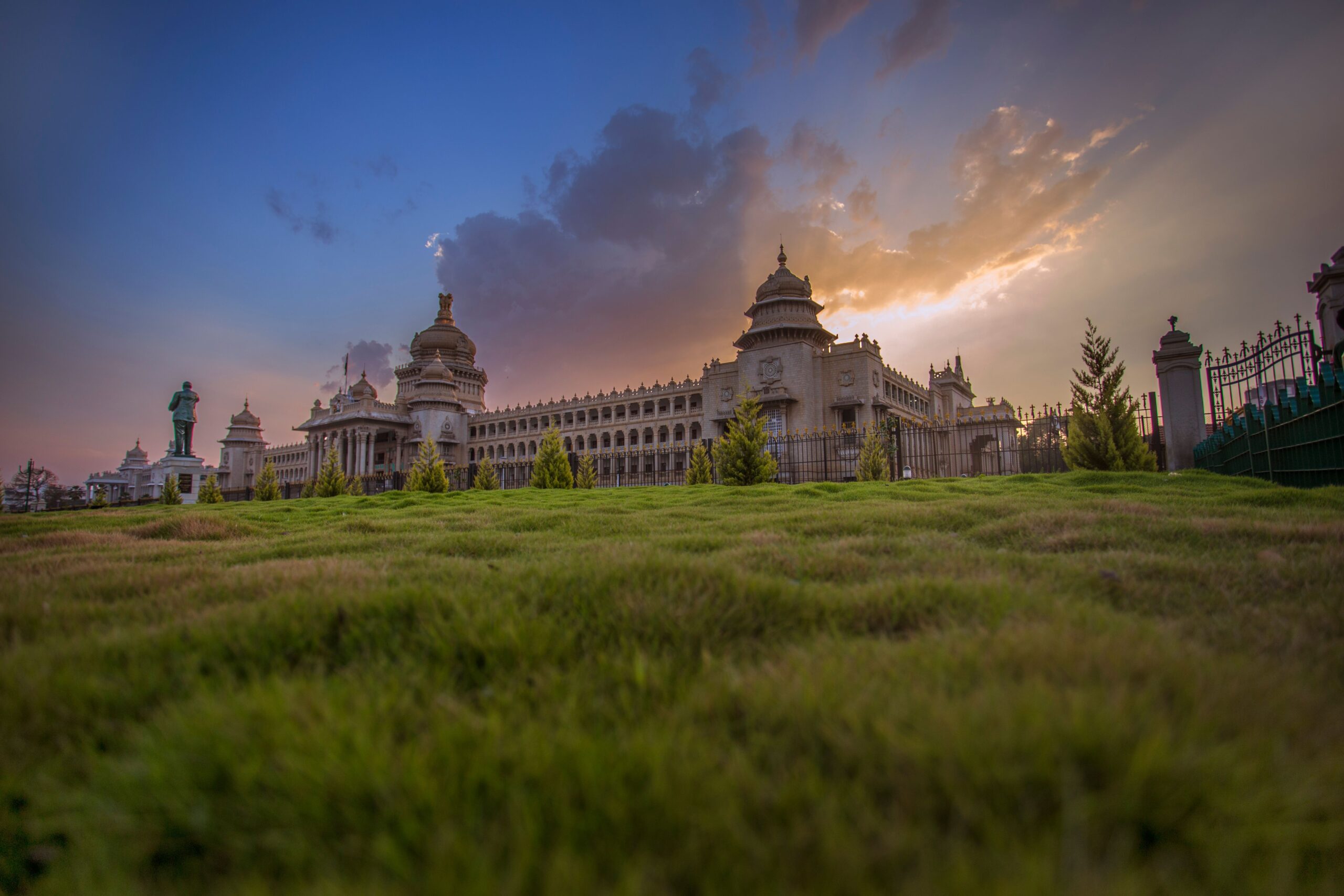
- Vidhana Soudha — The seat of the Karnataka state legislature: a massive neo-Dravidian building completed in 1956, inspired by the temples of Belur and Halebidu, with a granite facade, 60-metre dome, and the inscription “Government Work is God’s Work” above the main entrance. Floodlit on Sunday evenings and national holidays, when the spectacle is best seen from Ambedkar Veedhi.
- Attara Kacheri (High Court of Karnataka) — The elegant red neo-Classical building opposite Vidhana Soudha, built in 1864 in the Indo-Gothic style, with 18 Corinthian columns and an interior of considerable grandeur. One of the finest British-era public buildings in south India.
- St Mark’s Cathedral, MG Road — Bangalore’s oldest Anglican church, consecrated in 1816, with a circular nave, Ionic columns, and memorial tablets to the officers of the East India Company who built the cantonment. The most complete colonial ecclesiastical building in the city and a surprising pocket of silence in the heart of modern MG Road.
- The Cantonment Walking Tour — The British cantonment laid out in the 1800s northeast of the old city has the finest concentration of colonial-era bungalows, tree-lined avenues, and churches in Bangalore: St Andrew’s Kirk, the Methodist Church, the original Parade Ground (now Mahatma Gandhi Road), and the Ulsoor Lake bungalows. Walk it in the early morning when the jacaranda is in bloom.
- Kempegowda Tower, Lalbagh — The 16th-century watchtower built by Kempegowda I on the rock outcrop in Lalbagh Botanical Garden — one of four he erected to mark the limits of the city he founded. The climb to the base of the tower and the view of the garden below provides the most direct connection to the city’s founding story.
Temples & Religious Heritage
- ISKCON Temple, Rajajinagar — One of the largest Krishna temples in the world: a complex of shrines, exhibition halls, and gardens on a Rajajinagar hilltop, with three main temples in dravidian and rajasthani style, extraordinary craftsmanship throughout, and the finest prasadam restaurant in the city. The evening aarti is attended by thousands.
- Dodda Ganesha Temple (Shree Dodda Ganapathi), Basavanagudi — The most beloved temple in old Bangalore: a 16th-century Ganesha shrine in the heart of Basavanagudi, with a monolithic 18-foot Ganesha carved from a single rock, surrounded by a tree-shaded courtyard in a neighbourhood that has changed least of any in the city. Visit on a Tuesday or Vinayaka Chaturthi for the most intense experience.
- Bull Temple (Nandi Temple), Basavanagudi — A 16th-century Dravidian temple housing one of the largest monolithic Nandi (Shiva’s bull) in India: a five-metre granite figure carved in 1537 and still visited daily by hundreds of devotees. The Kadalekai Parishe (Groundnut Fair) held in November beside the temple is the most atmospheric annual market in old Bangalore.
- Begur Nageshwara Temple — A 9th-century Shiva temple in the southern outskirts, with the finest example of Ganga period stone carving in the Bangalore district — inscriptions, pillars, and a main sanctuary of considerable antiquity. One of the oldest structures in greater Bangalore and almost entirely overlooked by visitors.
- Gavi Gangadhareshwara Cave Temple — A unique cave temple in Gavipuram, where twice a year (Makara Sankranti and the winter solstice) the rays of the setting sun pass precisely between the horns of a large stone trident in the courtyard and illuminate the Shivalinga in the inner sanctum. The natural rock-cut interior, with Kempegowda’s inscriptions, is remarkable year-round.
- Ulsoor Lake Shiva Temple & Morning Walk — The 12th-century Someshwara temple on the banks of Ulsoor Lake, one of the oldest temples in Bangalore, with a beautiful tank, a tree-shaded approach, and the morning light on the water making it one of the finest quiet experiences in east Bangalore.
Parks, Gardens & Green Bangalore
- Lalbagh Botanical Garden — The finest botanical garden in peninsular India: 240 acres of tropical and subtropical plants, a glasshouse modelled on London’s Crystal Palace, a 3,000-million-year-old granite rock at its centre, and trees that were planted by Hyder Ali in the 18th century. The dawn walk — when the roses are wet and the birds are in full voice — is one of the great free pleasures of Bangalore. The Republic Day and Independence Day Flower Shows here have been held since 1912.
- Cubbon Park — The 300-acre central park, established by the British in 1870, still contains the finest collection of mature trees in the city: rosewood, teak, silver oak, and sandalwood in an urban forest that feels genuinely wild in its interior reaches. The High Court, Attara Kacheri, and the Cubbon Park Museum are at its edges; the pathways belong to the city’s walkers, cyclists, and students every morning.
- Bannerghatta Biological Park — A 100-square-kilometre wildlife reserve 22 kilometres south of the city, with a safari through zones containing tigers, lions, bears, and elephants in their natural habitat — the only zoo-cum-national park in India. The butterfly enclosure is the finest in the country.
- Turahalli Forest — The only genuinely wild forest within the Bangalore city limits: 574 acres of dry deciduous forest in Kanakapura Road, with hiking trails, rock formations, and birdsong at a density that makes it hard to believe a city of 13 million surrounds it. Best visited at dawn on weekdays.
- Sankey Tank & Malleshwaram — The 19th-century reservoir in Sadashivanagar, with a 2-kilometre lakeside walking track, egrets and kingfishers in the reeds, and the Malleshwaram neighbourhood’s morning culture — filter coffee stalls, flower vendors, and the Saturday morning market on Margosa Road — making it the finest early-morning neighbourhood experience in northwest Bangalore.
- Ulsoor Lake, Morning Rowing — A large tank in the heart of Bangalore’s eastern residential area, with rowing boats, a children’s park, and the backdrop of the old cantonment bungalows. The Bangalore Rowing Club, established in 1892, is the oldest sporting club in Karnataka and operates from the lake’s eastern shore.
Neighbourhoods: Bangalore’s Many Worlds
- Indiranagar: The Craft Beer Mile — The stretch of 100 Feet Road in Indiranagar is India’s craft beer capital: Toit (the brewery that started the revolution), Arbor Brewing Company, Windmills Craftworks, Big Pitcher, and over a dozen more packed into a walkable corridor. The microbrewery scene here — with experimental styles using kokum, coffee, mango, and Indian spices — is more creative than anything in Delhi or Mumbai. An evening pub walk through Indiranagar is the most distinctly Bangalore experience available.
- Koramangala: Startup Culture & Food — The neighbourhood where India’s tech startup culture is most densely concentrated, with the offices of Flipkart, Swiggy, Ola, and dozens of unicorns within a kilometre of each other, and a food scene — 5th and 6th Blocks particularly — that runs from South Indian tiffin joints to Japanese ramen bars. Koramangala Social is the definitive co-working-bar hybrid that the city invented.
- Malleswaram: Old Bangalore — The neighbourhood that most accurately preserves pre-tech Bangalore: the 18-temple street (Sampige Road), the century-old Malleswaram market, the Wednesday flower market, morning idli stalls that have operated for 50 years, and the residential lanes of old Brahmin families with jasmine on the gates. The contrast with Indiranagar is everything.
- Basavanagudi: The Original City — South Bangalore’s oldest neighbourhood, with the Bull Temple, the National College grounds, Gandhi Bazaar’s vegetable market, and the Vidyarthi Bhavan — the most celebrated dosa restaurant in India, in continuous operation since 1943. Walking from the Dodda Ganesha temple through Gandhi Bazaar to the Bull Temple is the best heritage walk in the city.
- Jayanagar: Books, Food & Culture — One of Asia’s largest planned residential layouts, now the most liveable neighbourhood in south Bangalore: the 4th Block shopping area, the Jayanagar Park, the Udupi and Darshini restaurants that line every street, and the Kannada literary culture that makes it feel more deeply local than any part of north or east Bangalore.
- Church Street & MG Road — The colonial heart of commercial Bangalore: Church Street with its Blossom Book House (the finest second-hand bookshop in the city), independent cafés, restaurants, and the Church Street Social. MG Road with its metro station, Garuda Mall, and the residual memories of the avenue that was once Bangalore’s great boulevard.
- Frazer Town & Richards Town — The Muslim and Anglo-Indian neighbourhoods north of the cantonment, with the Friday market on Johnson Market Road, the Jama Masjid, the excellent Karnataka Muslim cuisine (biryani, haleem, Iftaar stalls during Ramadan), and the Anglo-Indian bakers who still produce rum cake, vinegar cake, and sorpotel in front rooms that have been bakeries for three generations.
- Sarjapur Road & Bellandur: New Bangalore — The outer ring road corridor that contains the offices of Amazon, Microsoft, Goldman Sachs, and SAP alongside some of the finest craft beer venues, breakfast spots, and weekend brunch culture in east Bangalore. Less charming than Indiranagar; more immediately representative of where the city’s future is headed.
Museums, Art & Culture
- Visvesvaraya Industrial and Technological Museum — Named after the visionary engineer-statesman Sir M. Visvesvaraya, this museum on Kasturba Road is the finest science and technology museum in south India, with interactive exhibits on electricity, engines, space, and the history of Indian industrialisation. The original steam engine on the ground floor is one of the finest museum objects in Bangalore.
- Karnataka Chitrakala Parishath — The state academy of fine arts on Kumara Krupa Road, with permanent galleries of contemporary Kannada painting, tribal art, Mysore traditional painting, and rotating exhibitions that make it the most important visual arts institution in Karnataka. The Navarang Gallery for modern Indian art is consistently excellent.
- HAL Heritage Centre & Aerospace Museum — The museum at the Hindustan Aeronautics Limited complex in Marathahalli traces India’s aerospace story from the HT-2 trainer (1951) to the Tejas fighter jet. The aircraft displays — over 25 aircraft in a hangar and outdoor park — are the finest in south India and extraordinary for aviation enthusiasts.
- Jawaharlal Nehru Planetarium — One of India’s finest planetariums, in Cubbon Park, with daily sky shows, a solar observatory open on weekday mornings, and an astronomy exhibition. The digital projector system installed in 2019 produces India’s most immersive dome experience.
- Rangoli Metro Art Centre — The public art gallery beneath the MG Road metro station, managed by Karnataka Chitrakala Parishath, with free rotating exhibitions of contemporary Indian art in the commuter underpass. The most accessible and the most democratically placed gallery in Bangalore.
- Government Museum, Kasturba Road — Karnataka’s oldest museum (1865), with collections of Hoysala sculpture, South Indian bronzes, Vijayanagara coins, Neolithic artefacts, and natural history specimens. Less visited than the Visvesvaraya Museum and considerably more historically significant.
- Ranga Shankara Theatre, JP Nagar — The finest theatre in Bangalore: a 320-seat venue with a year-round programme of Kannada, English, and Hindi theatre, producing work that makes it the most serious dramatic arts institution in the city. The café and the reading room are part of the culture.
- Alliance Française & Goethe-Institut — The French cultural centre on Millers Road and the German Goethe-Institut on Lavelle Road run the finest international cultural programmes in Bangalore: film screenings, language courses, music performances, and art exhibitions that bring European cultural life to the city at its most accessible.
Food: Bangalore’s Great Obsession
- Masala Dosa at Vidyarthi Bhavan, Basavanagudi — The most celebrated restaurant in Bangalore: a Brahmin hotel in continuous operation since 1943, serving the finest masala dosa in India — a thin, lacquer-crisp fermented rice crepe with a precisely spiced potato filling — at marble-topped tables, to a queue that forms before the doors open at 6:30am. The sambar and coconut chutney are part of the experience.
- Filter Coffee at Indian Coffee House, MG Road — The Workers’ Coffee House, in a circular Corbusier-influenced building on MG Road, serves strong South Indian filter coffee in the stainless steel tumbler-and-dabara set to a clientele that has included journalists, politicians, and students since 1957. The most honest café in Bangalore.
- Idli & Vada at Brahmin’s Coffee Bar, Basavanagudi — A tiny, legendary tiffin stall in the Shankarapuram lane of Basavanagudi, with a menu of three items: idli, vada, and khara bath. The idlis are the finest in the city; the queue extends down the lane by 7am. Open mornings only; closes when the food runs out.
- Thatte Idli at CTR, Malleswaram — Central Tiffin Room in Malleswaram serves the thatte idli — a large, flat, plate-sized idli with the consistency of a cloud — that has its origins in the Shivamogga district. CTR’s version is the benchmark, served with coconut chutney and sambar. Saturday morning queues are a Malleswaram institution.
- Ragi Mudde & Mutton Saaru at a Local Darshini — The traditional Karnataka meal: ragi mudde (a dense ball of finger millet, rolled by hand, protein-rich and deeply local) eaten with mutton saaru (a fiery, tamarind-spiked thin mutton curry) or soppu saaru (spinach gravy). Found at working-class Karnataka restaurants in Jayanagar, Kanakapura Road, and Shivajinagar. The most Kannadiga food experience in the city.
- Biryani at Meghana Foods, Koramangala — The most beloved biryani restaurant in Bangalore: the Andhra-style dum biryani, with tender meat and the correct ratio of spice and aroma, in a modest setting in Koramangala that draws queues every evening. The bone-in chicken biryani with mirchi salan is the standard order.
- Coastal Karnataka Seafood at Karavalli, Gateway Hotel — The finest restaurant in Bangalore for the coastal cuisines of Karnataka and Kerala: Mangalorean fish curry with neer dosa, Coorgi pandi curry (black pork with Coorgi spices), Malabar prawn moilee, and appam — served in a garden restaurant of real elegance. The food is as good as anything you will eat on the coast itself.
- South Indian Meals at Mavalli Tiffin Room (MTR) — The Lalbagh branch of the legendary MTR (Mavalli Tiffin Room, founded 1924) serves the full traditional Karnataka vegetarian meals service on banana leaf: six vegetables, rasam, sambhar, payasam, papad, and rice, in a ritual sequence that the waiters perform with practised authority.
- Street Food Walk: VV Puram Food Street — Bangalore’s famous street food lane near Lalbagh, operational every evening from 6pm: churmuri (puffed rice with vegetables and chutneys), set dosa, Mangalore buns (banana-sweetened poori), gobi manchurian, corn chaat, and the extraordinary combination of goli bajje and coconut chutney. The finest outdoor food experience in the city.
- Craft Beer at Toit Brewpub, Indiranagar — The brewery that defined Bangalore’s craft beer identity: Toit’s Weiss (a Bavarian-style hefeweizen with local character), its seasonal releases, and the rooftop terrace on a Bangalore evening make it the benchmark against which every other brewery in the city is measured. The food — wood-fired pizza, chilli cheese toast — is the best in the microbrewery circuit.
- Mangalorean Lunch at Giri Manja’s or Madurai Veedu — The Bunt community’s cuisine — Mangalorean chicken sukka, kori rotti (chicken curry with crisp rice wafers), bangda fry (mackerel in a spiced coconut masala) — is the finest regional food culture in Bangalore outside the dominant South Indian vegetarian tradition. The restaurants of Frazer Town and Shivajinagar serve it with minimum ceremony and maximum flavour.
- Sunday Brunch at a Koramangala Café — The Sunday brunch culture of Koramangala and Indiranagar — avocado toast and shakshuka alongside filter coffee and masala omelettes, at places like The Hole in the Wall Café, Matteo, and The Permit Room — represents Bangalore’s hybrid urban personality more accurately than any heritage site.
Craft Beer, Wine & Nightlife
- Microbrewery Crawl: Indiranagar to Koramangala — The India-defining evening: starting at Toit on Indiranagar 100 Feet Road, moving to Arbor Brewing Company, then Big Pitcher, then crossing to Windmills Craftworks in Whitefield (for jazz and Belgian witbier), then ending at Byg Brewski in Hennur for the outdoor garden and the sheer scale of the operation. Bangalore’s microbrewery scene has over 70 venues; no other Indian city has more than a dozen.
- Windmills Craftworks, Whitefield — The most sophisticated brewpub in Bangalore: a jazz and blues live music venue alongside an exceptional microbrewery, with the Belgian Witbier and the seasonal barrel-aged ales as the standout expressions. The Sunday jazz sessions with a long lunch are the finest weekend afternoon in east Bangalore.
- Byg Brewski Brewing Company, Hennur — The largest microbrewery in Asia (at capacity), spread across a forested hillside in north Bangalore with multiple restaurant concepts, a trampoline park, live music stages, and the city’s most ambitious hop garden. Best visited at opening on weekday evenings to avoid the weekend crowds.
- Arbor Brewing Company, Indiranagar — Bangalore’s American-style craft beer bar, with the finest IPAs in the city and a menu that takes its food as seriously as its beer. The Bombay IPA — brewed with Indian spices — is the signature expression.
- The Humming Tree, Indiranagar — Bangalore’s finest live music venue: a mid-sized club that programmes the best Indian independent music, jazz, and international touring acts in the city, with a sound system and an intimacy of scale that makes it the most musically credible venue in south India.
- Hard Rock Café, MG Road — The Bangalore outpost of the international chain is more musically serious than its reputation suggests: the live music nights, the memorabilia collection, and the consistent programme of cover bands and original artists make it the most reliable mid-scale live music experience in the city.
Art, Tech & the New Bangalore
- Nrityagram Dance Village, Hesaraghatta — Thirty kilometres from the city on the Hesaraghatta road: the residential dance village founded by Protima Gauri in 1990, where students live and train full-time in Odissi and other Indian classical dance forms. The Sunday morning open performances — held in the outdoor amphitheatre — are the most concentrated classical performing arts experience available near Bangalore.
- Art of Living International Centre, Kanakpura Road — The global headquarters of Sri Sri Ravi Shankar’s Art of Living Foundation, 21 kilometres south of the city: a vast ashram campus with the Sri Sri Vishalakshi Mantap (one of the largest meditation halls in the world), organic farms, and programmes open to visitors. The morning meditation and the Vedic fire ceremony are the most accessible programmes.
- Jaaga — Bengaluru’s Creative Hub — The coworking and arts space in Trinity Circle, one of the original maker spaces in India, with a programme of talks, performances, and exhibitions that has helped define Bangalore’s creative-tech culture. The events programme — open to all — is the finest free cultural calendar in the city.
- 1 Shanthiroad Studio/Gallery — The most internationally significant contemporary art gallery in Bangalore: a residency and exhibition space in Shanthiroad that has shown artists ranging from Sudarshan Shetty to Sheela Gowda and operates at the level of Mumbai’s best institutions. Free to visit by appointment.
- UB City: Luxury, Architecture & the Kingfisher Story — The luxury mixed-use development on Vittal Mallya Road, built on the site of United Breweries — Vijay Mallya’s original empire — with the finest luxury retail, restaurants, and the sculpture garden at its base. The building’s backstory — the rise and fall of India’s most flamboyant industrialist — makes every visit to its glass atrium historically loaded.
- NIMHANS Convention Centre Events — The National Institute of Mental Health and Neuro Sciences campus in Hosur Road hosts the largest technology and cultural conventions in south India, including the Bangalore Literature Festival (November) — the finest literary event in south India — and the Bengaluru Tech Summit.
Day Trips from Bangalore
- Mysuru (Mysore) — Palace City — The most complete royal city in south India: the Amba Vilas (Mysore) Palace — the most visited monument in India after the Taj Mahal — illuminated by 97,000 lightbulbs on Sunday evenings and during Dussehra, the Devaraja Market’s flowers and spices, the Mysore Pak sweet, and the Chamundi Hills temple above the city. Three hours from Bangalore; a full, properly Kannada day.
- Coorg (Kodagu): Coffee, Mist & Rivers — The hill district of Kodagu, five hours southwest of Bangalore, with coffee plantations threading through the Western Ghats, the Kaveri river’s headwaters at Talacauvery, the Abbey Falls, Raja’s Seat at sunset in Madikeri, and the Kodava cuisine — pandi curry, kadambuttu, and fish pulimunchi — that is unlike any food in Karnataka.
- Nandi Hills Sunrise Trek — The most popular day trip from Bangalore: a 60-kilometre drive north to the 1,478-metre hilltop fortress, followed by a sunrise of extraordinary clarity when the valley fog lies thick below and the light comes over the Eastern Ghats. Arrive by 5:30am; the queues at the gate begin at 4am in season.
- Chikkamagaluru: Coffee Country — The birthplace of Indian coffee cultivation, in the forested hills of the Western Ghats three hours west of Bangalore: estate homestays, the Mullayanagiri peak (2,695 metres, the highest in Karnataka), the Bhadra Wildlife Sanctuary, and coffee-tasting at the estates that produce the finest arabica in India.
- Hampi — Empire of Ruins — Five hours north of Bangalore: the UNESCO-listed ruins of Vijayanagara, capital of the greatest South Indian empire (14th–16th century), spread across 25 kilometres of granite boulders and rice fields in the Tungabhadra valley. The Virupaksha Temple (still active after 700 years), the Vittala Temple’s musical pillars, the Queen’s Bath, and the Elephant Stables are the finest medieval ruins in south India.
- Belur & Halebidu: The Hoysala Temples — Three hours from Bangalore: the twin Hoysala temple complexes of the 12th century, with the finest stone carving in India — walls covered in a continuous frieze of deities, animals, dancers, and scrollwork at a density and precision that took three generations of craftsmen to produce. The Chennakeshava temple at Belur is inscribed with over 40,000 figures; the Hoysaleshwara at Halebidu has never been finished.
- Shravanabelagola: The Monolithic Jain Statue — Three hours northwest: the 18-metre monolithic statue of the Jain saint Gomateshwara (Bahubali), carved in 983 AD from a single granite rock on a hilltop and one of the largest monolithic sculptures in the world. The Mahamastakabhisheka, held every 12 years (next in 2030), draws millions. The climb of 618 steps on bare feet and the view from the summit are extraordinary.
- Skandagiri (Kalavara Durga) Night Trek — A night trek that has become a Bangalore institution: leaving the city at midnight, reaching the base of the 1,450-metre Skandagiri hill by 2am, trekking three hours to the summit through forest, and watching the sunrise above a sea of cloud with the ruined fort visible in the first light. The most atmospheric trekking experience within reach of the city.
- Sakleshpur: Malnad Coffee Trails — The Malnad region of Hassan district, four hours from Bangalore, with coffee and spice plantations on steep Western Ghats hillsides, the scenic Sakleshpur–Subramanya railway (one of the finest scenic train routes in south India), the Manjarabad Fort above the valley, and the finest birdwatching in the region.
- Talakadu: Sand Temples & the Kaveri — An extraordinary pilgrimage site on the Kaveri river bank, where five 10th-century Shiva temples are being slowly consumed by the encroaching sand dunes — a phenomenon unique in Karnataka. The partially buried Vaidyeshwara temple and the Kaveri river meeting point make it one of the most unusual archaeological landscapes in south India.
Wellness, Yoga & Spiritual Bangalore
- Isha Yoga Centre, Electronic City — The Bangalore centre of Sadhguru’s Isha Foundation, with daily yoga and meditation programmes open to the public, the Adiyogi statue (112 feet, the world’s largest bust), and a programme of introductory yoga sessions that are among the most practically oriented spiritual experiences available near the city.
- Yoga at Mysore-Style Shala, Jayanagar or Gokulam — The Ashtanga yoga tradition — practised in the Mysore self-practice style, where the teacher adjusts individual students in a silent room — has its roots in Mysore (three hours from Bangalore) and is practised in several dedicated shalas in Jayanagar and the outer suburbs. A week of morning Mysore-style practice is the most transformative wellness experience available near the city.
- Ayurvedic Treatment at a Keraleeyam or Prakruthi Spa — Bangalore has the finest Ayurvedic treatment centres in Karnataka, with practitioners trained in Kerala’s classical tradition. A Shirodhara (continuous oil pouring on the forehead), Abhyanga (full-body massage with warm medicated oils), or Panchakarma programme at a serious Ayurvedic centre is the most therapeutic and most distinctly South Indian wellness experience in the city.
- Meditation at the Global Vipassana Centre, Dhamma Paphulla — The Bangalore Vipassana centre on the outskirts, offering 10-day residential courses in Vipassana meditation in the tradition of S.N. Goenka. Free of charge (donation-based); requires pre-registration months in advance. The most life-changing experience available near Bangalore.
- Art of Living Happiness Programme, Kangeri Ashram — A three-day weekend programme introducing Sudarshan Kriya — a specific breathing technique — at the Art of Living ashram on Kanakapura Road. Open to all; the combination of pranayama, meditation, and community produces a genuinely restorative experience.
Shopping: Bangalore’s Markets & Boutiques
- KR Market (Krishnarajendra City Market) — Bangalore’s largest and oldest market, established in 1928, in the heart of the old city: a vast covered building of wholesale flowers (the finest flower market in south India, best before 6am), vegetables, fruit, and spice on a scale that makes it one of the most intense market experiences in India.
- Commercial Street — The historic shopping street east of MG Road, with a density of textile shops, jewellers, footwear stores, and electronics vendors that has made it the most reliable mid-range shopping destination in Bangalore for 70 years. The lanes behind Commercial Street have smaller and often superior fabric and saree merchants.
- Brigade Road & Church Street — The two lanes parallel to MG Road, with the best concentration of independent clothing boutiques, bookshops, and restaurants in central Bangalore. Blossom Book House — eight floors of second-hand books — is the finest used bookshop in south India and the cultural heart of this stretch.
- Fab India, Forest Essentials & Indian Design Shopping — Bangalore has the finest concentration of quality Indian design retail in the south: Fab India (handwoven cotton, block-print textiles, organic food), Forest Essentials (Ayurvedic luxury), Good Earth (Indian craft and luxury homeware), and the Sunday Soul Sante flea market in Koramangala for independent designers and artisan producers.
- Cauvery Handicrafts Emporium, MG Road — The Karnataka government’s official handicrafts showroom on MG Road, with fixed prices and the most comprehensive collection of Karnataka crafts: Channapatna lacquerware, Bidriware (silver-on-metal inlay from Bidar), rosewood carvings, silk sarees, and Karnataka bronzes. The finest one-stop shopping for authentic Karnataka crafts.
- Shivajinagar Wholesale Market — The wholesale market district around Shivajinagar bus station, where the city’s restaurants, caterers, and households source their ingredients: spice merchants with sacks of pepper, cardamom, and dried chilli; flower wholesalers; fabric merchants; and the extraordinary Johnson Market fish and meat section. The most intensely commercial neighbourhood in Bangalore.
Adventure & Outdoor Bangalore
- Cycling in Cubbon Park — Sunday mornings from 6am to 9am, Cubbon Park’s internal roads are closed to motor traffic. Hire a bicycle from the gate and ride through the park’s avenues of rosewood and teak — the only time in the week when Bangalore moves at an entirely human pace.
- Rock Climbing at Ramnagaram — The rocky outcrop of Ramnagaram, 50 kilometres southwest of Bangalore, has the finest sport climbing in the region: basalt columns and crack climbs in a setting made famous as the location of the 1975 Hindi film Sholay. Multiple operators run beginners’ courses and advanced single-pitch routes on weekends.
- Trekking at Anthargange — Cave Trek — A short trek from Kolar district (70 kilometres east of Bangalore) through a volcanic boulder landscape with natural caves — some requiring crawling through narrow passages — to a hilltop with views over the Eastern Ghats. One of the finest half-day adventure treks within reach of the city.
- Bheemeshwari Nature Camp & Fishing — A forest department nature camp on the Cauvery river, 100 kilometres south of Bangalore, with kayaking and fishing for the Mahseer — the golden Mahseer of the Cauvery is one of the finest sporting fish in India, found only in these rivers. The forest setting and the river camp are entirely removed from the city’s pace.
- Paragliding at Kamshet or Nandi Hills — Weekend paragliding courses and tandem flights operate from the Nandi Hills area and from Kamshet (near Pune, a six-hour drive): Bangalore’s proximity to the Western Ghats ridge makes it the nearest major city to some of India’s finest paragliding terrain.
- Wonderla Amusement Park, Mysore Road — The finest amusement park in south India: 60+ rides including the Recoil roller coaster, Wave Pool, and Rain Disco, spread across 81 acres. The finest family and group day out within the city limits.
Festivals & Events
- Bangalore Literature Festival (November) — The finest literary event in south India, held at the NIMHANS convention centre each November: two days of conversations between India’s most significant writers, poets, historians, and public intellectuals, with sessions in Kannada, Hindi, and English. Entirely free to attend; some ticketed sessions for featured speakers.
- Bengaluru Tech Summit (October) — South Asia’s largest technology conference, drawing 20,000+ delegates, global tech leaders, and startup founders to the city for three days of innovation demonstrations, policy discussions, and networking. The largest gathering of the technology industry in India.
- Kadalekai Parishe (Groundnut Fair), Basavanagudi (November) — The annual groundnut fair at the Bull Temple: farmers from across Karnataka bring their first peanut harvest to offer to the Nandi bull, and the surrounding streets are filled with groundnut sellers, traditional food stalls, and the extraordinary atmosphere of an agricultural festival that has been held for centuries in the oldest part of the city.
- Republic Day & Independence Day Flower Shows, Lalbagh — The biannual flower shows in the Lalbagh glasshouse (January 26 and August 15) are the finest horticultural events in south India, with elaborate themed displays of seasonal flowers assembled over weeks by the horticultural department. Queue at opening for the best light and the most manageable crowd.
- Dussehra at Mysore (Day Trip, October) — Though the celebration is in Mysore, Bangalore empties every year for the Mysore Dussehra — a 10-day festival culminating in the Vijayadashami procession of the royal family’s golden howdah elephant through the illuminated streets, watched by a million people. The largest Dussehra celebration in India.
Hidden Gems & Unexpected Bangalore
- Nrityagram at Sunset — The dirt road from Hesaraghatta to the dance village passes through the last remaining stretches of the Bangalore plateau’s original landscape: open rocky ground, thorn scrub, and the extraordinary quality of light that makes the Deccan different from everywhere else in India. Arrive in the late afternoon and walk the perimeter of the village as the sun sets over the tanks.
- HAL Old Airport Road’s Evening Walk — The aviation history belt east of the city: old hangars, the HAL museum, and the residential neighbourhoods of Domlur and Indiranagar that grew from the aviation colony. The evening roadside stalls serving roasted corn and chai between the old bungalows have a quality that newer Bangalore entirely lacks.
- The Bangalore Underground: Pete District Walk — The Old City’s merchant quarter — Chickpet, Balepet, Cottonpet, Akkipet — is a network of wholesale trading streets whose commerce has barely changed since the 18th century: silk merchants, brass dealers, flower wholesalers, cotton traders, and the extraordinary density of the Karnataka Muslim commercial community. Best walked with a knowledgeable guide in the morning.
- Bannerghatta Road’s Ethnic Restaurants — The road south from Jayanagar to the National Park passes through a series of Tamil, Coorgi, Andhra, and Kerala ethnic restaurants that serve the best regional food in Bangalore at prices that make the Koramangala dining scene seem expensive. The Coorgi restaurants near JP Nagar — for pandi curry and kadambuttu — are the finest.
- Film Shooting Locations: Ramoji Film City Day Trip (Hyderabad) or Innovative Film City — Innovative Film City at Bidadi, 40 kilometres on the Mysore road, has the themed sets used in hundreds of Kannada, Tamil, and Telugu film productions: a Western town, a Snow World, a replica of Mysore Palace, and the only indoor rain and thunder effect studio in south India.
- Bangalore Fort’s Hidden Chambers — The surviving gate structures of the original Bangalore Fort, in the KR Market area, contain some of the finest early modern stonework in the city — largely ignored by the market-goers who pass them daily. The Mysore Gate and Delhi Gate are among the few visible physical remains of the pre-British city above ground.
- Sunset from Nandi Hills Fort — Beyond the sunrise experience, Nandi Hills’ fortification — the Tipu Sultan summer fort of Tamarind Tree Hill, with its secret tunnels, Bhoga Nandeeshwara temple below, and the extraordinary 360-degree view of the Karnataka plateau — is best experienced in the late afternoon, when the light on the granite is a different thing entirely from the dawn.
- A Morning at Malleswaram Market — The Wednesday and Saturday flower and vegetable market on Sampige Road in Malleswaram: vendors arranging marigold garlands, jasmine strings, and rose petals for temple worship alongside fresh greens, jackfruit, and the white gourd vegetables unique to Karnataka. The market has been here since the neighbourhood was laid out in 1898. It is unhurried, beautiful, and entirely free.
- Filter Coffee at Dawn, Anywhere in Old Bangalore — On your last morning, walk to any small South Indian café in Basavanagudi, Malleswaram, or Jayanagar before 8am. Order a filter coffee in the steel tumbler-and-dabara set. The waiter will pour it from height to cool it and create the foam. Sit at a marble table under a ceiling fan. The newspaper arrives. Someone behind you orders idli. The day begins. This is Bangalore in its most essential form — not the startup unicorn, not the microbrewery, not the tech campus, but the filter coffee and the morning light and the Deccan plateau doing its quiet, extraordinary thing at 920 metres above the sea.
Quick Facts for Visitors
| Best time to visit | October to February (cool, dry, 15–28°C) |
| Monsoon | June to September — heavy rain; the city turns green; indoor activities |
| Summer | March to May — warm but not extreme (28–35°C); manageable |
| Currency | Indian Rupee (INR) |
| Language | Kannada (official); Hindi and English universally spoken |
| Getting around | Namma Metro (expanding rapidly) · Ola/Uber · Auto-rickshaw (essential for short distances) |
| Official name | Bengaluru (renamed 2006; both names in common use) |
| Elevation | 920 metres — gives the city its year-round pleasant climate |
| Ideal trip length | 3–4 days for the city · 7 days to include day trips to Mysore, Coorg, and Hampi |
Bangalore is a city that reveals itself in layers. The tech campus and the 9th-century temple are not contradictions — they are both true simultaneously, both present, both worth your attention. The best version of Bangalore is the one where you stop rushing between landmarks and simply sit down somewhere — a dosa stall, a park bench, a microbrewery terrace — and let the city happen around you at its own unhurried, confident, permanently 25-degree pace.